

127
5
Cross-link density is the direct measure of the extent of the curing of thermosetting resin. The higher the cross-link density, the
better is the curing. According to the definition, the cross-link
density is the concentration of chemical bonds within a cured
polymer. When polymer chains are linked together by cross-links,
they lose some of their ability to move as individual polymer
chains. High cross-link densities cause polymers to become very
rigid or glassy. It is measured in terms of hardness and the modulus of the cured component. A method to measure the cross-link
density is to place the cured part in a solvent, and the weight of the
part that is not dissolved or swollen in the solvent gives the indirect measure of the cross-link density. With an optimum curing
temperature and curing time, the cross-link density is not only
good, but it also is uniform [15]. The uniformity of the cross-link
density is important for uniform performance of the composite
product.
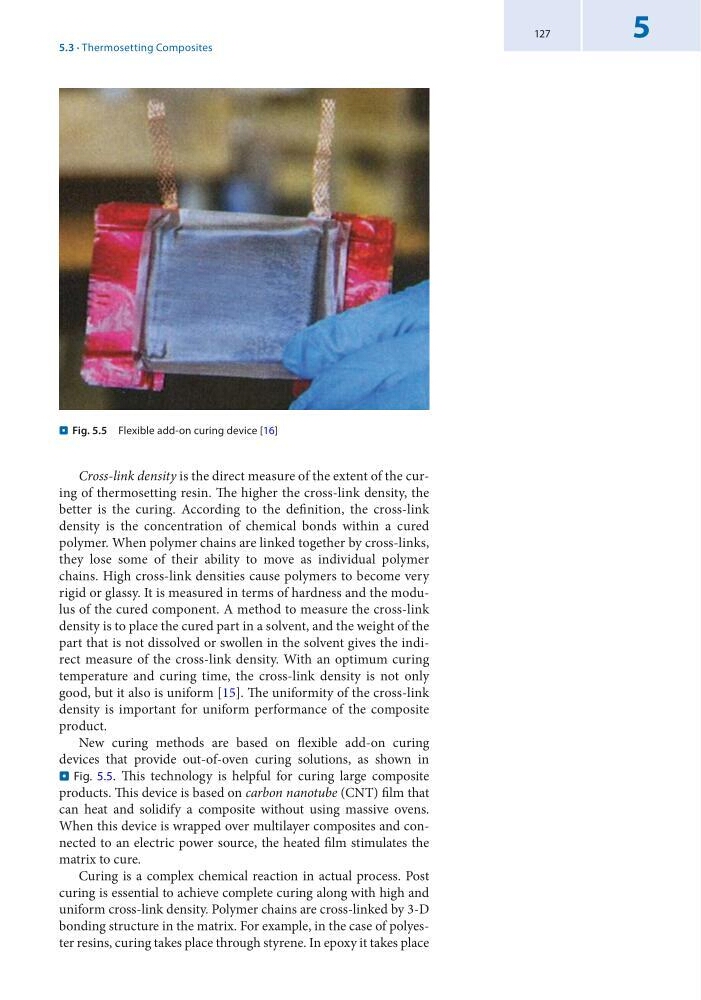
New curing methods are based on flexible add-on curing
devices that provide out-of-oven curing solutions, as shown in
. Fig. 5.5. This technology is helpful for curing large composite
products. This device is based on carbon nanotube (CNT) film that
can heat and solidify a composite without using massive ovens.
When this device is wrapped over multilayer composites and connected to an electric power source, the heated film stimulates the
matrix to cure.
Curing is a complex chemical reaction in actual process. Post
curing is essential to achieve complete curing along with high and
uniform cross-link density. Polymer chains are cross-linked by 3-D
bonding structure in the matrix. For example, in the case of polyester resins, curing takes place through styrene. In epoxy it takes place
. Fig. 5.5 Flexible add-on curing device [16]
5.3 · Thermosetting Composites
5
Cross-link density is the direct measure of the extent of the curing of thermosetting resin. The higher the cross-link density, the
better is the curing. According to the definition, the cross-link
density is the concentration of chemical bonds within a cured
polymer. When polymer chains are linked together by cross-links,
they lose some of their ability to move as individual polymer
chains. High cross-link densities cause polymers to become very
rigid or glassy. It is measured in terms of hardness and the modulus of the cured component. A method to measure the cross-link
density is to place the cured part in a solvent, and the weight of the
part that is not dissolved or swollen in the solvent gives the indirect measure of the cross-link density. With an optimum curing
temperature and curing time, the cross-link density is not only
good, but it also is uniform [15]. The uniformity of the cross-link
density is important for uniform performance of the composite
product.
New curing methods are based on flexible add-on curing
devices that provide out-of-oven curing solutions, as shown in
. Fig. 5.5. This technology is helpful for curing large composite
products. This device is based on carbon nanotube (CNT) film that
can heat and solidify a composite without using massive ovens.
When this device is wrapped over multilayer composites and connected to an electric power source, the heated film stimulates the
matrix to cure.
Curing is a complex chemical reaction in actual process. Post
curing is essential to achieve complete curing along with high and
uniform cross-link density. Polymer chains are cross-linked by 3-D
bonding structure in the matrix. For example, in the case of polyester resins, curing takes place through styrene. In epoxy it takes place
. Fig. 5.5 Flexible add-on curing device [16]
5.3 · Thermosetting Composites