

125
5
5 Tailorable curing time
5 Adaptability to most of the moulding processes
5 Processability through different moulding methods and mould
materials
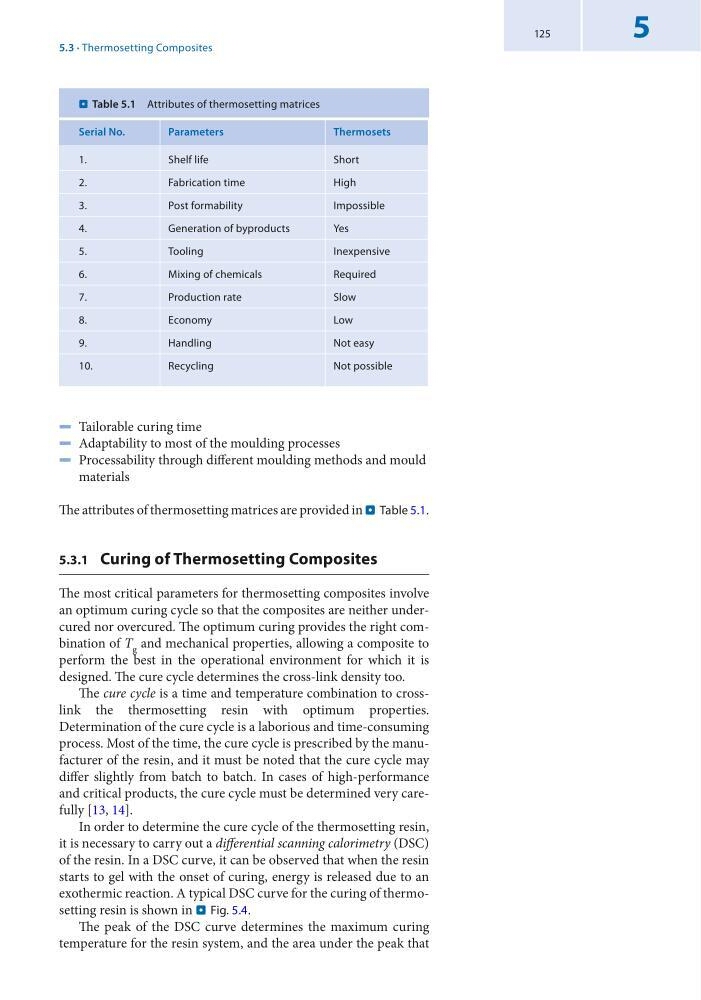
The attributes of thermosetting matrices are provided in . Table 5.1.
5.3.1 Curing of Thermosetting Composites
The most critical parameters for thermosetting composites involve
an optimum curing cycle so that the composites are neither undercured nor overcured. The optimum curing provides the right combination of T g and mechanical properties, allowing a composite to
perform the best in the operational environment for which it is
designed. The cure cycle determines the cross-link density too.
The cure cycle is a time and temperature combination to crosslink the thermosetting resin with optimum properties.
Determination of the cure cycle is a laborious and time-consuming
process. Most of the time, the cure cycle is prescribed by the manufacturer of the resin, and it must be noted that the cure cycle may
differ slightly from batch to batch. In cases of high-performance
and critical products, the cure cycle must be determined very carefully [13, 14].
In order to determine the cure cycle of the thermosetting resin,
it is necessary to carry out a differential scanning calorimetry (DSC)
of the resin. In a DSC curve, it can be observed that when the resin
starts to gel with the onset of curing, energy is released due to an
exothermic reaction. A typical DSC curve for the curing of thermosetting resin is shown in . Fig. 5.4.
The peak of the DSC curve determines the maximum curing
temperature for the resin system, and the area under the peak that
. Table 5.1 Attributes of thermosetting matrices
Serial No.
Parameters
Thermosets
1.
Shelf life
Short
2.
Fabrication time
High
3.
Post formability
Impossible
4.
Generation of byproducts
Yes
5.
Tooling
Inexpensive
6.
Mixing of chemicals
Required
7.
Production rate
Slow
8.
Economy
Low
9.
Handling
Not easy
10.
Recycling
Not possible
5.3 · Thermosetting Composites
5
5 Tailorable curing time
5 Adaptability to most of the moulding processes
5 Processability through different moulding methods and mould
materials
The attributes of thermosetting matrices are provided in . Table 5.1.
5.3.1 Curing of Thermosetting Composites
The most critical parameters for thermosetting composites involve
an optimum curing cycle so that the composites are neither undercured nor overcured. The optimum curing provides the right combination of T g and mechanical properties, allowing a composite to
perform the best in the operational environment for which it is
designed. The cure cycle determines the cross-link density too.
The cure cycle is a time and temperature combination to crosslink the thermosetting resin with optimum properties.
Determination of the cure cycle is a laborious and time-consuming
process. Most of the time, the cure cycle is prescribed by the manufacturer of the resin, and it must be noted that the cure cycle may
differ slightly from batch to batch. In cases of high-performance
and critical products, the cure cycle must be determined very carefully [13, 14].
In order to determine the cure cycle of the thermosetting resin,
it is necessary to carry out a differential scanning calorimetry (DSC)
of the resin. In a DSC curve, it can be observed that when the resin
starts to gel with the onset of curing, energy is released due to an
exothermic reaction. A typical DSC curve for the curing of thermosetting resin is shown in . Fig. 5.4.
The peak of the DSC curve determines the maximum curing
temperature for the resin system, and the area under the peak that
. Table 5.1 Attributes of thermosetting matrices
Serial No.
Parameters
Thermosets
1.
Shelf life
Short
2.
Fabrication time
High
3.
Post formability
Impossible
4.
Generation of byproducts
Yes
5.
Tooling
Inexpensive
6.
Mixing of chemicals
Required
7.
Production rate
Slow
8.
Economy
Low
9.
Handling
Not easy
10.
Recycling
Not possible
5.3 · Thermosetting Composites