

115
4
12. The viscoelastic behaviour of a certain polymer is to be represented by spring and dashpot elements having constants of
2 GN/m 2 and 90 GN/m 2 , respectively. If a stress of 12 MN/m 2 is
applied for 100 sec and then completely removed, compare the
values of strain predicted by Maxwell and Kelvin–Voigt models
after 150 sec.
13. A commercial sample of polyethylene has the following Ellis
model parameters: η 0 = 1.3 × 10 4 N.s/m 2 , τ 1/2 = 7.0 × 10 3 N/m 2 ,
and α = 2.5. Calculate the volume rate of flow in a pipe with an
internal diameter of 3 cm, length of 20 cm, and a pressure drop
of 5.0 × 10 6 N/m 2 .
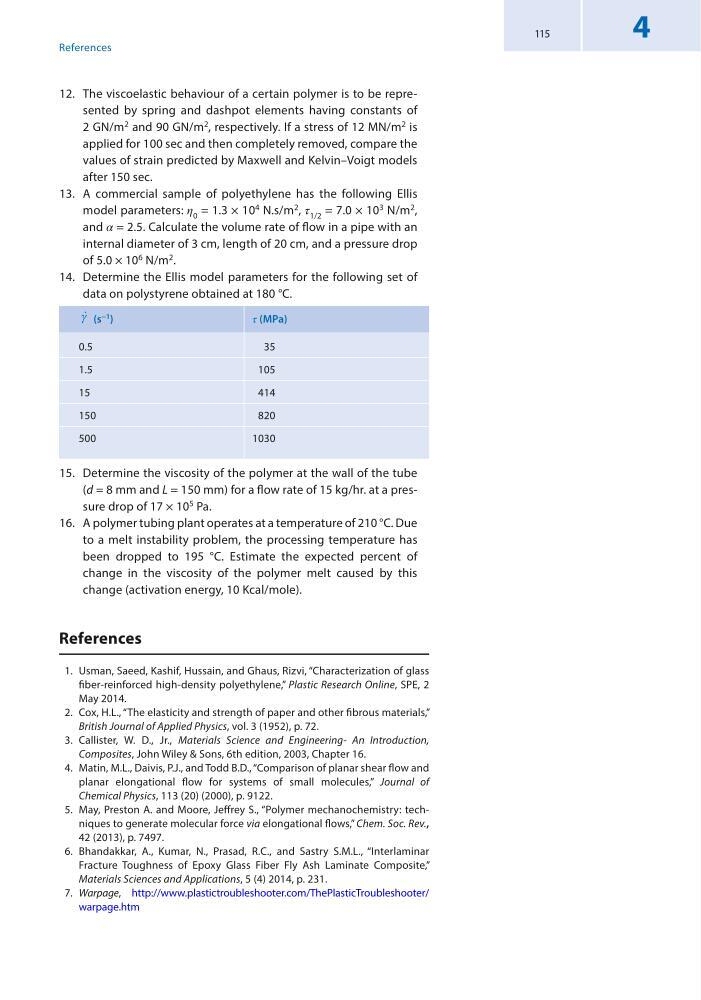
14. Determine the Ellis model parameters for the following set of
data on polystyrene obtained at 180 °C.
γ (s −1 )
τ (MPa)
0.5
35
1.5
105
15
414
150
820
500
1030
15. Determine the viscosity of the polymer at the wall of the tube
(d = 8 mm and L = 150 mm) for a flow rate of 15 kg/hr. at a pressure drop of 17 × 10 5 Pa.
16. A polymer tubing plant operates at a temperature of 210 °C. Due
to a melt instability problem, the processing temperature has
been dropped to 195 °C. Estimate the expected percent of
change in the viscosity of the polymer melt caused by this
change (activation energy, 10 Kcal/mole).
References
1. Usman, Saeed, Kashif, Hussain, and Ghaus, Rizvi, “Characterization of glass
fiber-reinforced high-density polyethylene,” Plastic Research Online, SPE, 2
May 2014.
2. Cox, H.L., “The elasticity and strength of paper and other fibrous materials,”
British Journal of Applied Physics, vol. 3 (1952), p. 72.
3. Callister, W. D., Jr., Materials Science and Engineering- An Introduction,
Composites, John Wiley & Sons, 6th edition, 2003, Chapter 16.
4. Matin, M.L., Daivis, P.J., and Todd B.D., “Comparison of planar shear flow and
planar elongational flow for systems of small molecules,” Journal of
Chemical Physics, 113 (20) (2000), p. 9122.
5. May, Preston A. and Moore, Jeffrey S., “Polymer mechanochemistry: techniques to generate molecular force via elongational flows,” Chem. Soc. Rev.,
42 (2013), p. 7497.
6. Bhandakkar, A., Kumar, N., Prasad, R.C., and Sastry S.M.L., “Interlaminar
Fracture Toughness of Epoxy Glass Fiber Fly Ash Laminate Composite,”
Materials Sciences and Applications, 5 (4) 2014, p. 231.
7. Warpage, http://www. plastictroubleshooter. com/ThePlasticTroubleshooter/
warpage. htm
References
4
12. The viscoelastic behaviour of a certain polymer is to be represented by spring and dashpot elements having constants of
2 GN/m 2 and 90 GN/m 2 , respectively. If a stress of 12 MN/m 2 is
applied for 100 sec and then completely removed, compare the
values of strain predicted by Maxwell and Kelvin–Voigt models
after 150 sec.
13. A commercial sample of polyethylene has the following Ellis
model parameters: η 0 = 1.3 × 10 4 N.s/m 2 , τ 1/2 = 7.0 × 10 3 N/m 2 ,
and α = 2.5. Calculate the volume rate of flow in a pipe with an
internal diameter of 3 cm, length of 20 cm, and a pressure drop
of 5.0 × 10 6 N/m 2 .
14. Determine the Ellis model parameters for the following set of
data on polystyrene obtained at 180 °C.
γ (s −1 )
τ (MPa)
0.5
35
1.5
105
15
414
150
820
500
1030
15. Determine the viscosity of the polymer at the wall of the tube
(d = 8 mm and L = 150 mm) for a flow rate of 15 kg/hr. at a pressure drop of 17 × 10 5 Pa.
16. A polymer tubing plant operates at a temperature of 210 °C. Due
to a melt instability problem, the processing temperature has
been dropped to 195 °C. Estimate the expected percent of
change in the viscosity of the polymer melt caused by this
change (activation energy, 10 Kcal/mole).
References
1. Usman, Saeed, Kashif, Hussain, and Ghaus, Rizvi, “Characterization of glass
fiber-reinforced high-density polyethylene,” Plastic Research Online, SPE, 2
May 2014.
2. Cox, H.L., “The elasticity and strength of paper and other fibrous materials,”
British Journal of Applied Physics, vol. 3 (1952), p. 72.
3. Callister, W. D., Jr., Materials Science and Engineering- An Introduction,
Composites, John Wiley & Sons, 6th edition, 2003, Chapter 16.
4. Matin, M.L., Daivis, P.J., and Todd B.D., “Comparison of planar shear flow and
planar elongational flow for systems of small molecules,” Journal of
Chemical Physics, 113 (20) (2000), p. 9122.
5. May, Preston A. and Moore, Jeffrey S., “Polymer mechanochemistry: techniques to generate molecular force via elongational flows,” Chem. Soc. Rev.,
42 (2013), p. 7497.
6. Bhandakkar, A., Kumar, N., Prasad, R.C., and Sastry S.M.L., “Interlaminar
Fracture Toughness of Epoxy Glass Fiber Fly Ash Laminate Composite,”
Materials Sciences and Applications, 5 (4) 2014, p. 231.
7. Warpage, http://www. plastictroubleshooter. com/ThePlasticTroubleshooter/
warpage. htm
References