

114
4
Exercises
1. Define simple shear flow. Why is it necessary to use simple shear
flow geometry for rheological measurements?
2. Use the power law equation and prove that polymer melts have
shear-thinning behaviour.
3. Find the shear rate components of a flow through a tapered tube
of Ellis model fluid.
4. Draw a τ vs.
γ plot for the following:
(a) A shear-thinning fluid having yield stress
(b) A non-Newtonian fluid exhibiting zero shear viscosity
5. Sketch the velocity profile for the flow of a power law fluid
between two horizontal plates where the upper plate is moving
and the pressure gradient is given as
(a) ∆P > 0
(b) ∆P = 0, and
(c) ∆P < 0
6. Determine the shear rate components in (a) the axial annular
flow with an imposed pressure gradient, (b) radial flow of the
power law fluid between two parallel discs.
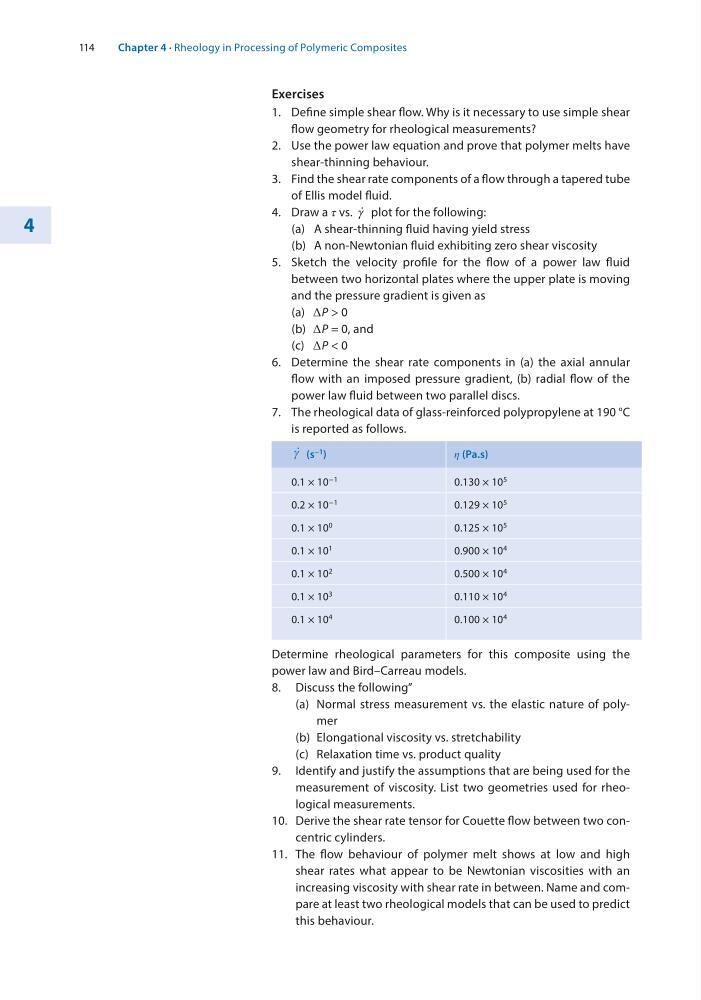
7. The rheological data of glass-reinforced polypropylene at 190 °C
is reported as follows.
γ (s −1 )
η (Pa.s)
0.1 × 10 −1
0.130 × 10 5
0.2 × 10 −1
0.129 × 10 5
0.1 × 10 0
0.125 × 10 5
0.1 × 10 1
0.900 × 10 4
0.1 × 10 2
0.500 × 10 4
0.1 × 10 3
0.110 × 10 4
0.1 × 10 4
0.100 × 10 4
Determine rheological parameters for this composite using the
power law and Bird–Carreau models.
8. Discuss the following”
(a) Normal stress measurement vs. the elastic nature of polymer
(b) Elongational viscosity vs. stretchability
(c) Relaxation time vs. product quality
9. Identify and justify the assumptions that are being used for the
measurement of viscosity. List two geometries used for rheological measurements.
10. Derive the shear rate tensor for Couette flow between two concentric cylinders.
11. The flow behaviour of polymer melt shows at low and high
shear rates what appear to be Newtonian viscosities with an
increasing viscosity with shear rate in between. Name and compare at least two rheological models that can be used to predict
this behaviour.
Chapter 4 · Rheology in Processing of Polymeric Composites
4
Exercises
1. Define simple shear flow. Why is it necessary to use simple shear
flow geometry for rheological measurements?
2. Use the power law equation and prove that polymer melts have
shear-thinning behaviour.
3. Find the shear rate components of a flow through a tapered tube
of Ellis model fluid.
4. Draw a τ vs.
γ plot for the following:
(a) A shear-thinning fluid having yield stress
(b) A non-Newtonian fluid exhibiting zero shear viscosity
5. Sketch the velocity profile for the flow of a power law fluid
between two horizontal plates where the upper plate is moving
and the pressure gradient is given as
(a) ∆P > 0
(b) ∆P = 0, and
(c) ∆P < 0
6. Determine the shear rate components in (a) the axial annular
flow with an imposed pressure gradient, (b) radial flow of the
power law fluid between two parallel discs.
7. The rheological data of glass-reinforced polypropylene at 190 °C
is reported as follows.
γ (s −1 )
η (Pa.s)
0.1 × 10 −1
0.130 × 10 5
0.2 × 10 −1
0.129 × 10 5
0.1 × 10 0
0.125 × 10 5
0.1 × 10 1
0.900 × 10 4
0.1 × 10 2
0.500 × 10 4
0.1 × 10 3
0.110 × 10 4
0.1 × 10 4
0.100 × 10 4
Determine rheological parameters for this composite using the
power law and Bird–Carreau models.
8. Discuss the following”
(a) Normal stress measurement vs. the elastic nature of polymer
(b) Elongational viscosity vs. stretchability
(c) Relaxation time vs. product quality
9. Identify and justify the assumptions that are being used for the
measurement of viscosity. List two geometries used for rheological measurements.
10. Derive the shear rate tensor for Couette flow between two concentric cylinders.
11. The flow behaviour of polymer melt shows at low and high
shear rates what appear to be Newtonian viscosities with an
increasing viscosity with shear rate in between. Name and compare at least two rheological models that can be used to predict
this behaviour.
Chapter 4 · Rheology in Processing of Polymeric Composites