

112
4
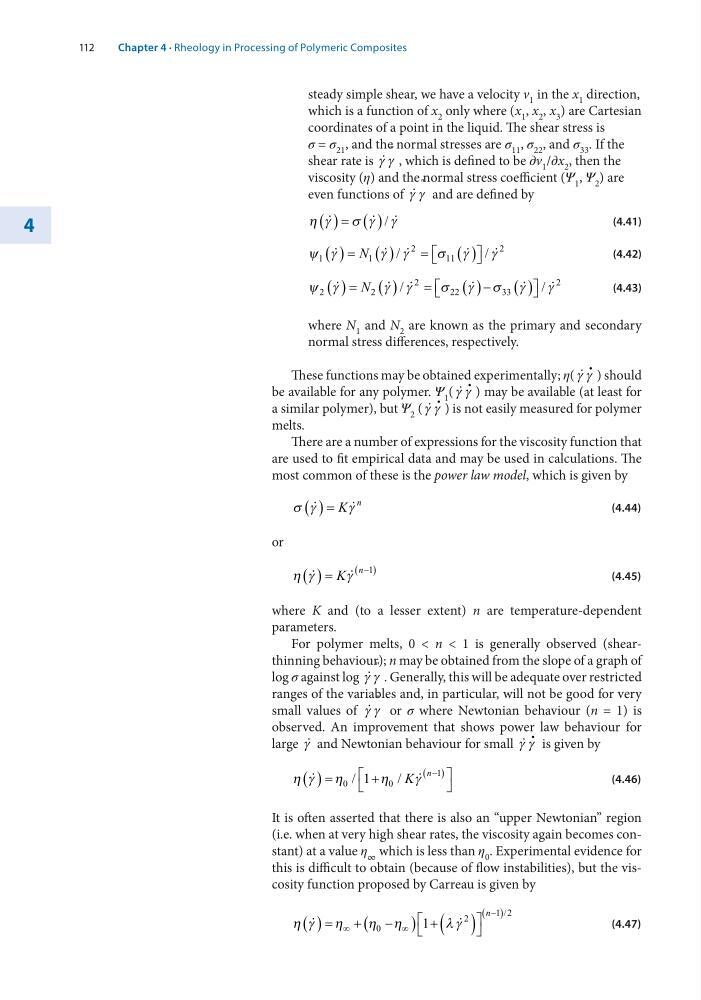
steady simple shear, we have a velocity v 1 in the x 1 direction,
which is a function of x 2 only where (x 1 , x 2 , x 3 ) are Cartesian
coordinates of a point in the liquid. The shear stress is
σ = σ 21 , and the normal stresses are σ 11 , σ 22 , and σ 33 . If the
shear rate is
γ γ
" , which is defined to be ∂v 1 /∂x 2 , then the
viscosity (η) and the normal stress coefficient (Ψ 1 , Ψ 2 ) are
even functions of
γ γ
" and are defined by
η γ σ γ γ
( ) = ( )/
(4.41)
ψ γ
γ γ
σ γ
γ
1
1
2
11
2
( ) = ( ) =
( )
N
/
/
(4.42)
ψ γ
γ γ
σ γ σ γ
γ
2
2
2
22
33
2
( ) = ( ) =
( )− ( )
N
/
/
(4.43)
where N 1 and N 2 are known as the primary and secondary
normal stress differences, respectively.
These functions may be obtained experimentally; η(
i
γ γ ) should
be available for any polymer. Ψ 1 (
i
γ γ ) may be available (at least for
a similar polymer), but Ψ 2 (
i
γ γ ) is not easily measured for polymer
melts.
There are a number of expressions for the viscosity function that
are used to fit empirical data and may be used in calculations. The
most common of these is the power law model, which is given by
σ γ
γ
( ) = K
n
(4.44)
or
η γ
γ
( ) =
−
( )
K
n 1
(4.45)
where K and (to a lesser extent) n are temperature-dependent
parameters.
For polymer melts, 0 < n < 1 is generally observed (shearthinning behaviour); n may be obtained from the slope of a graph of
log σ against log
γ γ
" . Generally, this will be adequate over restricted
ranges of the variables and, in particular, will not be good for very
small values of
γ γ
" or σ where Newtonian behaviour (n = 1) is
observed. An improvement that shows power law behaviour for
large
γ and Newtonian behaviour for small
i
γ γ is given by
η γ η
η
γ
( ) =
+
−
( )
0
0
1
1
/
/K
n
(4.46)
It is often asserted that there is also an “upper Newtonian” region
(i.e. when at very high shear rates, the viscosity again becomes constant) at a value η ∞ which is less than η 0 . Experimental evidence for
this is difficult to obtain (because of flow instabilities), but the viscosity function proposed by Carreau is given by
η γ η
η η
λγ
( ) = + −
(
) + ( )
∞
∞
−
( )
0
2
1 2
1
n /
(4.47)
Chapter 4 · Rheology in Processing of Polymeric Composites
4
steady simple shear, we have a velocity v 1 in the x 1 direction,
which is a function of x 2 only where (x 1 , x 2 , x 3 ) are Cartesian
coordinates of a point in the liquid. The shear stress is
σ = σ 21 , and the normal stresses are σ 11 , σ 22 , and σ 33 . If the
shear rate is
γ γ
" , which is defined to be ∂v 1 /∂x 2 , then the
viscosity (η) and the normal stress coefficient (Ψ 1 , Ψ 2 ) are
even functions of
γ γ
" and are defined by
η γ σ γ γ
( ) = ( )/
(4.41)
ψ γ
γ γ
σ γ
γ
1
1
2
11
2
( ) = ( ) =
( )
N
/
/
(4.42)
ψ γ
γ γ
σ γ σ γ
γ
2
2
2
22
33
2
( ) = ( ) =
( )− ( )
N
/
/
(4.43)
where N 1 and N 2 are known as the primary and secondary
normal stress differences, respectively.
These functions may be obtained experimentally; η(
i
γ γ ) should
be available for any polymer. Ψ 1 (
i
γ γ ) may be available (at least for
a similar polymer), but Ψ 2 (
i
γ γ ) is not easily measured for polymer
melts.
There are a number of expressions for the viscosity function that
are used to fit empirical data and may be used in calculations. The
most common of these is the power law model, which is given by
σ γ
γ
( ) = K
n
(4.44)
or
η γ
γ
( ) =
−
( )
K
n 1
(4.45)
where K and (to a lesser extent) n are temperature-dependent
parameters.
For polymer melts, 0 < n < 1 is generally observed (shearthinning behaviour); n may be obtained from the slope of a graph of
log σ against log
γ γ
" . Generally, this will be adequate over restricted
ranges of the variables and, in particular, will not be good for very
small values of
γ γ
" or σ where Newtonian behaviour (n = 1) is
observed. An improvement that shows power law behaviour for
large
γ and Newtonian behaviour for small
i
γ γ is given by
η γ η
η
γ
( ) =
+
−
( )
0
0
1
1
/
/K
n
(4.46)
It is often asserted that there is also an “upper Newtonian” region
(i.e. when at very high shear rates, the viscosity again becomes constant) at a value η ∞ which is less than η 0 . Experimental evidence for
this is difficult to obtain (because of flow instabilities), but the viscosity function proposed by Carreau is given by
η γ η
η η
λγ
( ) = + −
(
) + ( )
∞
∞
−
( )
0
2
1 2
1
n /
(4.47)
Chapter 4 · Rheology in Processing of Polymeric Composites