

111
4
γ
γ
t
w t
( ) =
( )
0 sin
(4.36)
and measuring the resultant sinusoidal equation as
τ
τ
δ
t
w t
( ) =
+
(
)
0 sin
(4.37)
where
γ(t) = Sinusoidal strain
γ 0 = Strain-amplitude
wω = Frequency of oscillation
τ(t) = Sinusoidally varying stress
τ 0 = Stress amplitude
δ = Phase angle
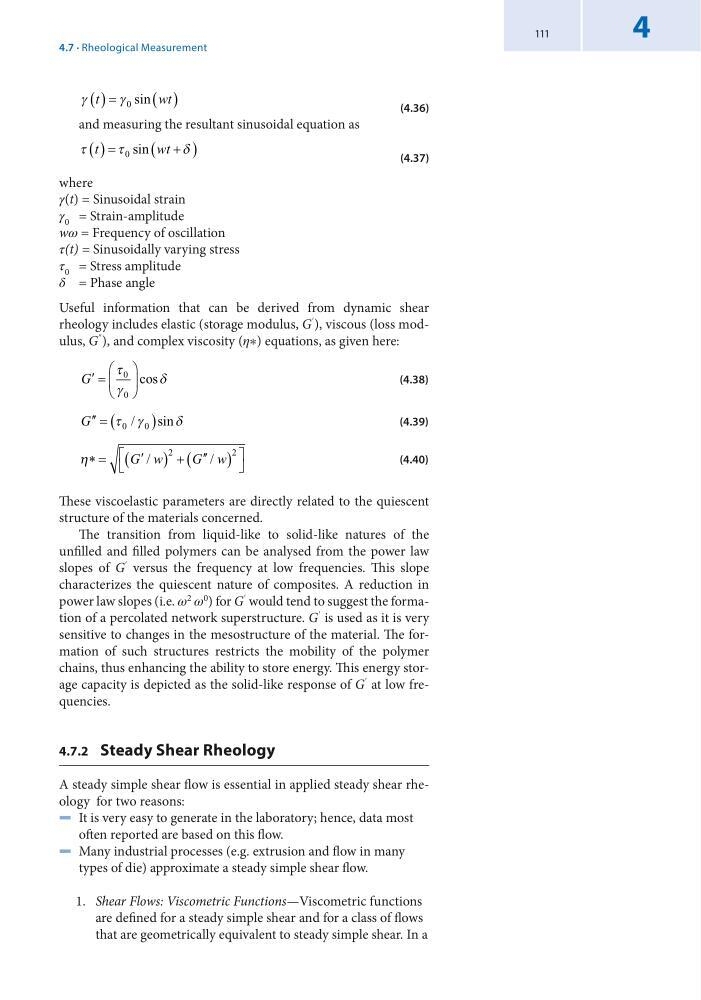
Useful information that can be derived from dynamic shear
rheology includes elastic (storage modulus, G ′ ), viscous (loss modulus, G ″ ), and complex viscosity (η∗) equations, as given here:
′ =
G
τ
γ
δ
0
0
cos
(4.38)
′′ = (
)
G
τ γ
δ
0
0
/
sin
(4.39)
η∗ = (
) + (
)
′
′ ′
G w
G w
/
/
2
2
(4.40)
These viscoelastic parameters are directly related to the quiescent
structure of the materials concerned.
The transition from liquid-like to solid-like natures of the
unfilled and filled polymers can be analysed from the power law
slopes of G ′ versus the frequency at low frequencies. This slope
characterizes the quiescent nature of composites. A reduction in
power law slopes (i.e. ω 2 ω 0 ) for G ′ would tend to suggest the formation of a percolated network superstructure. G ′ is used as it is very
sensitive to changes in the mesostructure of the material. The formation of such structures restricts the mobility of the polymer
chains, thus enhancing the ability to store energy. This energy storage capacity is depicted as the solid-like response of G ′ at low frequencies.
4.7.2 Steady Shear Rheology
A steady simple shear flow is essential in applied steady shear rheology for two reasons:
5 It is very easy to generate in the laboratory; hence, data most
often reported are based on this flow.
5 Many industrial processes (e.g. extrusion and flow in many
types of die) approximate a steady simple shear flow.
1. Shear Flows: Viscometric Functions—Viscometric functions
are defined for a steady simple shear and for a class of flows
that are geometrically equivalent to steady simple shear. In a
4.7 · Rheological Measurement
4
γ
γ
t
w t
( ) =
( )
0 sin
(4.36)
and measuring the resultant sinusoidal equation as
τ
τ
δ
t
w t
( ) =
+
(
)
0 sin
(4.37)
where
γ(t) = Sinusoidal strain
γ 0 = Strain-amplitude
wω = Frequency of oscillation
τ(t) = Sinusoidally varying stress
τ 0 = Stress amplitude
δ = Phase angle
Useful information that can be derived from dynamic shear
rheology includes elastic (storage modulus, G ′ ), viscous (loss modulus, G ″ ), and complex viscosity (η∗) equations, as given here:
′ =
G
τ
γ
δ
0
0
cos
(4.38)
′′ = (
)
G
τ γ
δ
0
0
/
sin
(4.39)
η∗ = (
) + (
)
′
′ ′
G w
G w
/
/
2
2
(4.40)
These viscoelastic parameters are directly related to the quiescent
structure of the materials concerned.
The transition from liquid-like to solid-like natures of the
unfilled and filled polymers can be analysed from the power law
slopes of G ′ versus the frequency at low frequencies. This slope
characterizes the quiescent nature of composites. A reduction in
power law slopes (i.e. ω 2 ω 0 ) for G ′ would tend to suggest the formation of a percolated network superstructure. G ′ is used as it is very
sensitive to changes in the mesostructure of the material. The formation of such structures restricts the mobility of the polymer
chains, thus enhancing the ability to store energy. This energy storage capacity is depicted as the solid-like response of G ′ at low frequencies.
4.7.2 Steady Shear Rheology
A steady simple shear flow is essential in applied steady shear rheology for two reasons:
5 It is very easy to generate in the laboratory; hence, data most
often reported are based on this flow.
5 Many industrial processes (e.g. extrusion and flow in many
types of die) approximate a steady simple shear flow.
1. Shear Flows: Viscometric Functions—Viscometric functions
are defined for a steady simple shear and for a class of flows
that are geometrically equivalent to steady simple shear. In a
4.7 · Rheological Measurement