

1 3
Topics in Current Chemistry (2020) 378:29
along with ultrasonic irradiation proved effective in controlling the size of TiO 2 nanoparticles, leading to more effective degradation in the subsequent application [39].
ZnO-based photocatalysts, in addition to TiO 2 photocatalysts, have also received
considerable attention for their use in the degradation of organic pollutants. Here
I discuss the various reports on ZnO photocatalyst synthesis using ultrasonication.
Both undoped and Dy-doped ZnO synthesized by sonication were found to yield
good photodegradation results due to the uniformity of the synthesized nanorodstructure morphologies [40]. In that study, an ultrasonic bath operating at 35 kHz
was used as the source of ultrasound during the synthesis of the catalyst. In another
study, silica coated ZnO was synthesized using ZnO, tetraethoxysilane (TEOS),
and ammonia mixed in an ethanol–water medium [41]. The authors of that study
reported that the use of sonication could reduce the time of synthesis to 2 h. Similarly, in another study, the application of sonication successfully produced larger
lattice volumes in Mg-doped ZnO photocatalyst [42]. In that work, ultrasound was
applied using an ultrasonic processor operating at a power intensity of 800 W/cm
2
and a frequency of 25 kHz. The authors reported that the obtained nanoparticles
of ZnO doped with Mg(II) had a spherical shape and that all particles were almost
similar in size [42].
Other than TiO 2 - and ZnO-based photocatalysts, various other semiconductor
nanomaterials have also been effectively synthesized using sonication. For example,
the Bi 2 O 3 photocatalyst was effectively synthesized using a simple sonochemical
method in which polyvinylpyrrolidone (PVP) surfactant was used to control grain
sizes and morphologies [43]. Bi 2 O 3 could be synthesized within 75 min and showed
86% photodegradation of methyl orange in the actual photocatalytic oxidation application. In another study, Ag/AgCl nanocubes using a PVP precursor were rapidly
synthesized ultrasonically within 35 min [44]. The ultrasonically synthesized Ag
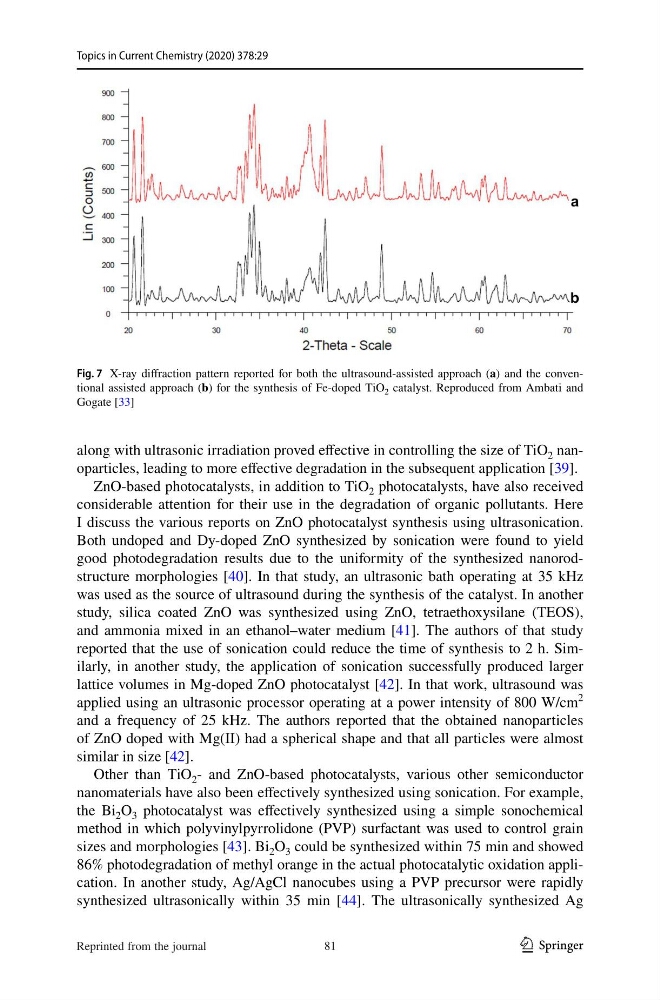
Fig. 7 X-ray diffraction pattern reported for both the ultrasound-assisted approach (a) and the conventional assisted approach (b) for the synthesis of Fe-doped TiO 2 catalyst. Reproduced from Ambati and
Gogate [33]
81
Reprinted from the journal
Topics in Current Chemistry (2020) 378:29
along with ultrasonic irradiation proved effective in controlling the size of TiO 2 nanoparticles, leading to more effective degradation in the subsequent application [39].
ZnO-based photocatalysts, in addition to TiO 2 photocatalysts, have also received
considerable attention for their use in the degradation of organic pollutants. Here
I discuss the various reports on ZnO photocatalyst synthesis using ultrasonication.
Both undoped and Dy-doped ZnO synthesized by sonication were found to yield
good photodegradation results due to the uniformity of the synthesized nanorodstructure morphologies [40]. In that study, an ultrasonic bath operating at 35 kHz
was used as the source of ultrasound during the synthesis of the catalyst. In another
study, silica coated ZnO was synthesized using ZnO, tetraethoxysilane (TEOS),
and ammonia mixed in an ethanol–water medium [41]. The authors of that study
reported that the use of sonication could reduce the time of synthesis to 2 h. Similarly, in another study, the application of sonication successfully produced larger
lattice volumes in Mg-doped ZnO photocatalyst [42]. In that work, ultrasound was
applied using an ultrasonic processor operating at a power intensity of 800 W/cm
2
and a frequency of 25 kHz. The authors reported that the obtained nanoparticles
of ZnO doped with Mg(II) had a spherical shape and that all particles were almost
similar in size [42].
Other than TiO 2 - and ZnO-based photocatalysts, various other semiconductor
nanomaterials have also been effectively synthesized using sonication. For example,
the Bi 2 O 3 photocatalyst was effectively synthesized using a simple sonochemical
method in which polyvinylpyrrolidone (PVP) surfactant was used to control grain
sizes and morphologies [43]. Bi 2 O 3 could be synthesized within 75 min and showed
86% photodegradation of methyl orange in the actual photocatalytic oxidation application. In another study, Ag/AgCl nanocubes using a PVP precursor were rapidly
synthesized ultrasonically within 35 min [44]. The ultrasonically synthesized Ag
Fig. 7 X-ray diffraction pattern reported for both the ultrasound-assisted approach (a) and the conventional assisted approach (b) for the synthesis of Fe-doped TiO 2 catalyst. Reproduced from Ambati and
Gogate [33]
81
Reprinted from the journal