

1 3
Topics in Current Chemistry (2020) 378:2
NTBs 179 m
2
/g. The US wave exposure at the pretreatment stage led to S BET of 258
and 245 m
2
/g, for US power of 7.6 and 38.1 W, respectively. The positive effect of
ultrasonication is via the enhancement of the de-aggregation of the particles, resulting in the peeling thorough swelling of large nanosheets that role to NTBs [118].
Without US waves, the size of the peeled nanosheets and, as a result, the size of the
formed NTBs is smaller.
The same research team studied (in 2009) the effect of different preparation
variables and combinations like particles size of the raw TiO 2 (400 nm and 1 μm),
temperature during the synthesis (90–180 °C), and sonication power, with valuable
conclusions on how these variables can adjust the morphological and structural features [117]. The hydrothermal treatment at 150 °C without sonication of the commercial TiO 2 particles of size ~ 400 nm led to NTBs of an average length of 79 nm
and a specific surface of 179 m
2
/g. The respective values were 143 nm and 118 m
2
/g
when the largest (1 μm) raw particles were used. This was linked to the formation
of bigger but less in number intermediate sheets during the peeling. By studying the
effect of different temperatures (90, 120, 150, and 180 °C), it was concluded that the
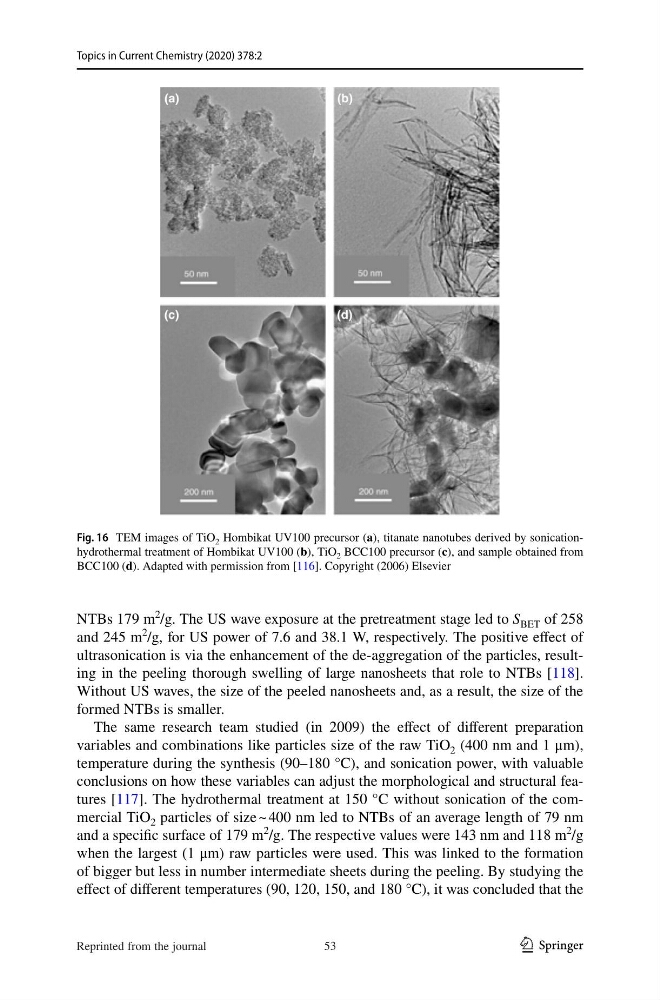
Fig. 16 TEM images of TiO 2 Hombikat UV100 precursor (a), titanate nanotubes derived by sonicationhydrothermal treatment of Hombikat UV100 (b), TiO 2 BCC100 precursor (c), and sample obtained from
BCC100 (d). Adapted with permission from [116]. Copyright (2006) Elsevier
53
Reprinted from the journal
Topics in Current Chemistry (2020) 378:2
NTBs 179 m
2
/g. The US wave exposure at the pretreatment stage led to S BET of 258
and 245 m
2
/g, for US power of 7.6 and 38.1 W, respectively. The positive effect of
ultrasonication is via the enhancement of the de-aggregation of the particles, resulting in the peeling thorough swelling of large nanosheets that role to NTBs [118].
Without US waves, the size of the peeled nanosheets and, as a result, the size of the
formed NTBs is smaller.
The same research team studied (in 2009) the effect of different preparation
variables and combinations like particles size of the raw TiO 2 (400 nm and 1 μm),
temperature during the synthesis (90–180 °C), and sonication power, with valuable
conclusions on how these variables can adjust the morphological and structural features [117]. The hydrothermal treatment at 150 °C without sonication of the commercial TiO 2 particles of size ~ 400 nm led to NTBs of an average length of 79 nm
and a specific surface of 179 m
2
/g. The respective values were 143 nm and 118 m
2
/g
when the largest (1 μm) raw particles were used. This was linked to the formation
of bigger but less in number intermediate sheets during the peeling. By studying the
effect of different temperatures (90, 120, 150, and 180 °C), it was concluded that the
Fig. 16 TEM images of TiO 2 Hombikat UV100 precursor (a), titanate nanotubes derived by sonicationhydrothermal treatment of Hombikat UV100 (b), TiO 2 BCC100 precursor (c), and sample obtained from
BCC100 (d). Adapted with permission from [116]. Copyright (2006) Elsevier
53
Reprinted from the journal