

Topics in Current Chemistry (2020) 378:2
1 3
and ~ 0.8-nm interlayer spacing), diameters from 4–6 nm, and lengths between 30
and 200 nm. Sonication by two different powers, of 7.6 and 38.1 W, led to increase
of the TiNTBs’ diameter. The majority of the NTBs had a length above 300 nm,
while the diameter was in the same range with that of the short ones. Based on the
previous analysis by XRD of the d-spacing between the adjacent layers of the tube
walls by Suzuki and Yoshikawa, the authors concluded that the US irradiation and
the resulted increase of the length was not accompanied with an interlayer spacing
change. Additionally, the strong intensity diffractions of the initial TiO 2 (anatase
phase) were totally diminish in all synthesized TiNTBs.
The dynamic light scattering (DLS) results showed average sizes of 53, 490, and
1760 nm for the samples prepared under 0, 7.6, and 38.1 W, respectively. Additionally, the size distribution was very narrow in the case without US irradiation, and the
distribution was dramatically increased by increment of the applied US power. The
formation of NTBs in size many folds higher the pristine particles can be linked to
bigger peeled nanosheets prior the rolling, and/or to the connection of the formed
tubes. An increasing trend was found between the specific surface area (S BET ) and
the power of US irradiation. The raw powder had an S BET of 8 m
2
/g, and the short
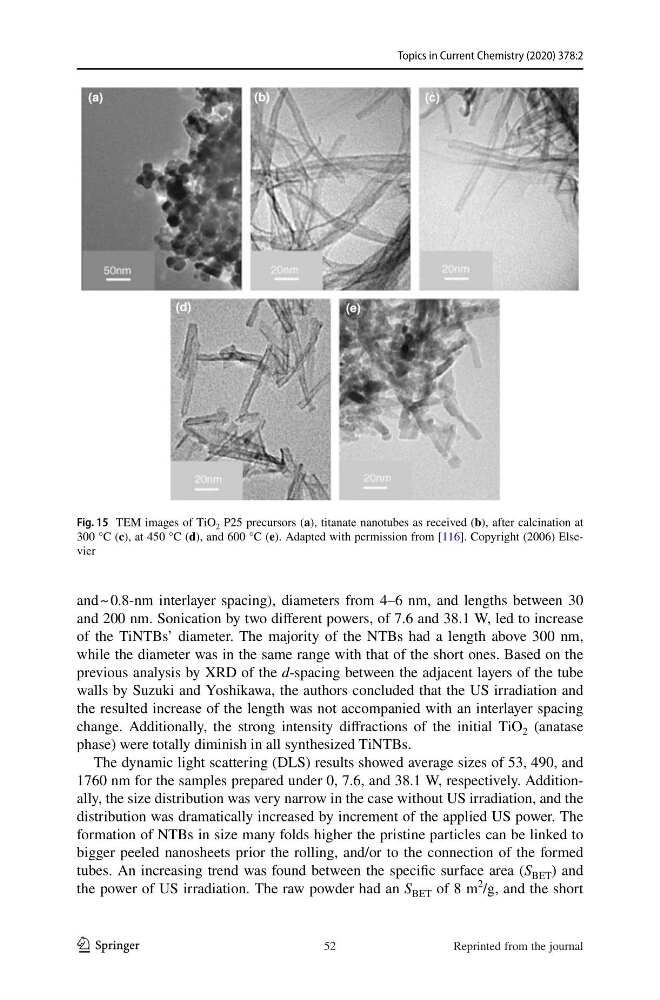
Fig. 15 TEM images of TiO 2 P25 precursors (a), titanate nanotubes as received (b), after calcination at
300 °C (c), at 450 °C (d), and 600 °C (e). Adapted with permission from [116]. Copyright (2006) Elsevier
52
Reprinted from the journal
1 3
and ~ 0.8-nm interlayer spacing), diameters from 4–6 nm, and lengths between 30
and 200 nm. Sonication by two different powers, of 7.6 and 38.1 W, led to increase
of the TiNTBs’ diameter. The majority of the NTBs had a length above 300 nm,
while the diameter was in the same range with that of the short ones. Based on the
previous analysis by XRD of the d-spacing between the adjacent layers of the tube
walls by Suzuki and Yoshikawa, the authors concluded that the US irradiation and
the resulted increase of the length was not accompanied with an interlayer spacing
change. Additionally, the strong intensity diffractions of the initial TiO 2 (anatase
phase) were totally diminish in all synthesized TiNTBs.
The dynamic light scattering (DLS) results showed average sizes of 53, 490, and
1760 nm for the samples prepared under 0, 7.6, and 38.1 W, respectively. Additionally, the size distribution was very narrow in the case without US irradiation, and the
distribution was dramatically increased by increment of the applied US power. The
formation of NTBs in size many folds higher the pristine particles can be linked to
bigger peeled nanosheets prior the rolling, and/or to the connection of the formed
tubes. An increasing trend was found between the specific surface area (S BET ) and
the power of US irradiation. The raw powder had an S BET of 8 m
2
/g, and the short
Fig. 15 TEM images of TiO 2 P25 precursors (a), titanate nanotubes as received (b), after calcination at
300 °C (c), at 450 °C (d), and 600 °C (e). Adapted with permission from [116]. Copyright (2006) Elsevier
52
Reprinted from the journal