

1 3
Topics in Current Chemistry (2020) 378:2
Ti–OH/Ti–O ratio of 0.73, while for the black sample, the ratio was more than
double (1.60). The authors determined the hydroxylation degree and assumed
a molecular formula of TiO 2-x (OH) 2x , where “x” represents the hydroxylation
extension. The reported molecular formulas were TiO 1.156 (OH) 0.844 for the white
powder and TiO 0.768 (OH) 1.232 for the black sample. Calcination of all colored
samples at 800 °C until a constant weight led to white powders, as a result of the
transformation of Ti–OH to Ti–O. Based on all the above-mentioned results, it
was concluded that the high-power US irradiation duration had a direct correlation to the hydroxylation and amorphism.
The increase of the hydroxylation and amorphism as a result of longer ultrasonic
irradiation had additional positive impact on the desired, and ultimately key, features
in catalysis due to improvement of light harvesting; the structural and optical features. The absorbance intensity through the whole visible and near-infrared regions
was improved by the increase of the ultrasonication duration, while the bandgap was
decreasing. The white and the black samples had a bandgap of 3.37 and 3.11 eV,
respectively. The density of states (DOS) constructed by the optical absorbance and
valance band XPS spectra (Fig. 8) showed that the narrowing of the bandgap was
assigned to electronic structure alterations due to orbital overlapping, and the blueshift of the valence band maximum towards the Fermi energy.
The increased porosity is also an important factor for photocatalytic application,
since it enhances the reaction rates as a result of improved diffusion of the reactants
and the availability of the active sites. For all studied samples, the obtained type IV
nitrogen sorption isotherms with type H2 hysteresis loops revealed the existence of
meso-pores/voids [91], resulted from the interstitial spaces between the nanoparticles, as was reported in various cases [80]. The lowest porosity values were found
for the non-US-treated white powder; a surface area of 166.43 m
2
/g and total pore
volume of 0.109 cm
3
/g. The US irradiation gave rise to the microporosity due to
the hydroxylation of TiO 2 , as it was reported in other cases [92]. The black sample
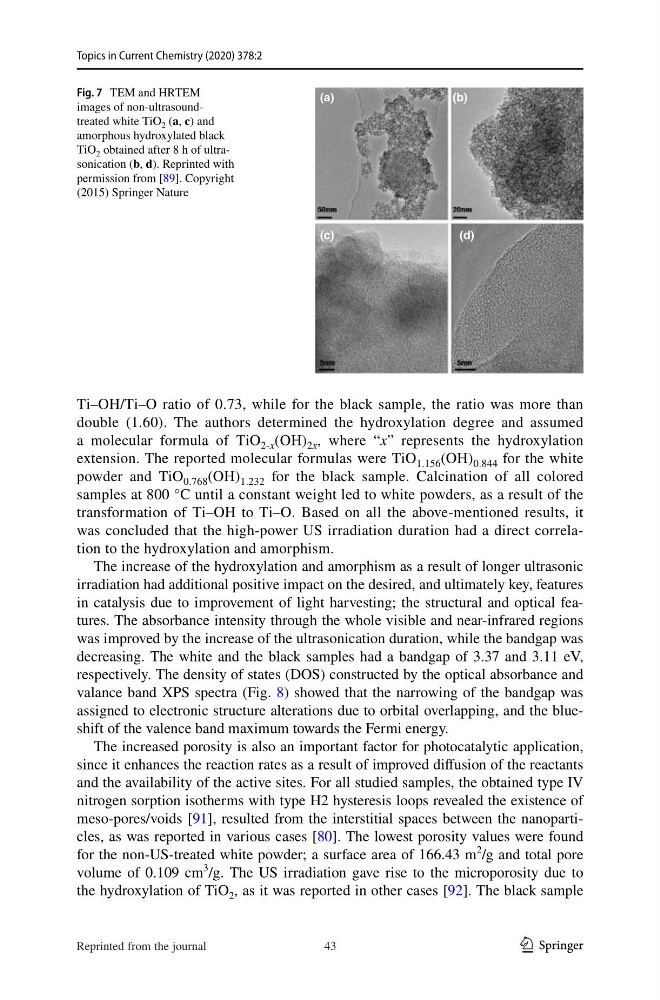
Fig. 7 TEM and HRTEM
images of non-ultrasoundtreated white TiO 2 (a, c) and
amorphous hydroxylated black
TiO 2 obtained after 8 h of ultrasonication (b, d). Reprinted with
permission from [89]. Copyright
(2015) Springer Nature
43
Reprinted from the journal
Topics in Current Chemistry (2020) 378:2
Ti–OH/Ti–O ratio of 0.73, while for the black sample, the ratio was more than
double (1.60). The authors determined the hydroxylation degree and assumed
a molecular formula of TiO 2-x (OH) 2x , where “x” represents the hydroxylation
extension. The reported molecular formulas were TiO 1.156 (OH) 0.844 for the white
powder and TiO 0.768 (OH) 1.232 for the black sample. Calcination of all colored
samples at 800 °C until a constant weight led to white powders, as a result of the
transformation of Ti–OH to Ti–O. Based on all the above-mentioned results, it
was concluded that the high-power US irradiation duration had a direct correlation to the hydroxylation and amorphism.
The increase of the hydroxylation and amorphism as a result of longer ultrasonic
irradiation had additional positive impact on the desired, and ultimately key, features
in catalysis due to improvement of light harvesting; the structural and optical features. The absorbance intensity through the whole visible and near-infrared regions
was improved by the increase of the ultrasonication duration, while the bandgap was
decreasing. The white and the black samples had a bandgap of 3.37 and 3.11 eV,
respectively. The density of states (DOS) constructed by the optical absorbance and
valance band XPS spectra (Fig. 8) showed that the narrowing of the bandgap was
assigned to electronic structure alterations due to orbital overlapping, and the blueshift of the valence band maximum towards the Fermi energy.
The increased porosity is also an important factor for photocatalytic application,
since it enhances the reaction rates as a result of improved diffusion of the reactants
and the availability of the active sites. For all studied samples, the obtained type IV
nitrogen sorption isotherms with type H2 hysteresis loops revealed the existence of
meso-pores/voids [91], resulted from the interstitial spaces between the nanoparticles, as was reported in various cases [80]. The lowest porosity values were found
for the non-US-treated white powder; a surface area of 166.43 m
2
/g and total pore
volume of 0.109 cm
3
/g. The US irradiation gave rise to the microporosity due to
the hydroxylation of TiO 2 , as it was reported in other cases [92]. The black sample
Fig. 7 TEM and HRTEM
images of non-ultrasoundtreated white TiO 2 (a, c) and
amorphous hydroxylated black
TiO 2 obtained after 8 h of ultrasonication (b, d). Reprinted with
permission from [89]. Copyright
(2015) Springer Nature
43
Reprinted from the journal