

1 3
Topics in Current Chemistry (2020) 378:2
black sample revealed a broadening of the six typical Raman-active modes which
were appeared in the white powder, and some additional new bands not linked to
any of the three classic polymorphs of TiO 2 . The X-ray photoelectron spectroscopy (XPS) analysis revealed an almost identical and impurity-free bonding environment for Ti. On the contrary, the hydrogenation also resulted in a new O 1s
peak (at 530.9 eV) which was attributed by the authors to the formation of Ti–OH
moieties. Since the dangling bonds tends to attract hydrogen, the authors expected
that the H doping occurred predominately in the outer disordered layer where
more dangling bonds exist compared to the inner crystalline core. The bandgap of
the non-hydrogenated materials was determined by diffuse reflectance as 3.3 eV
(slightly higher than bulk anatase). The black TiO 2 showed a dramatically narrower bandgap , while the onset of the optical absorption started from ~ 1200 nm
(1.0 eV). The authors linked this to the “band tail states” phenomena, where the
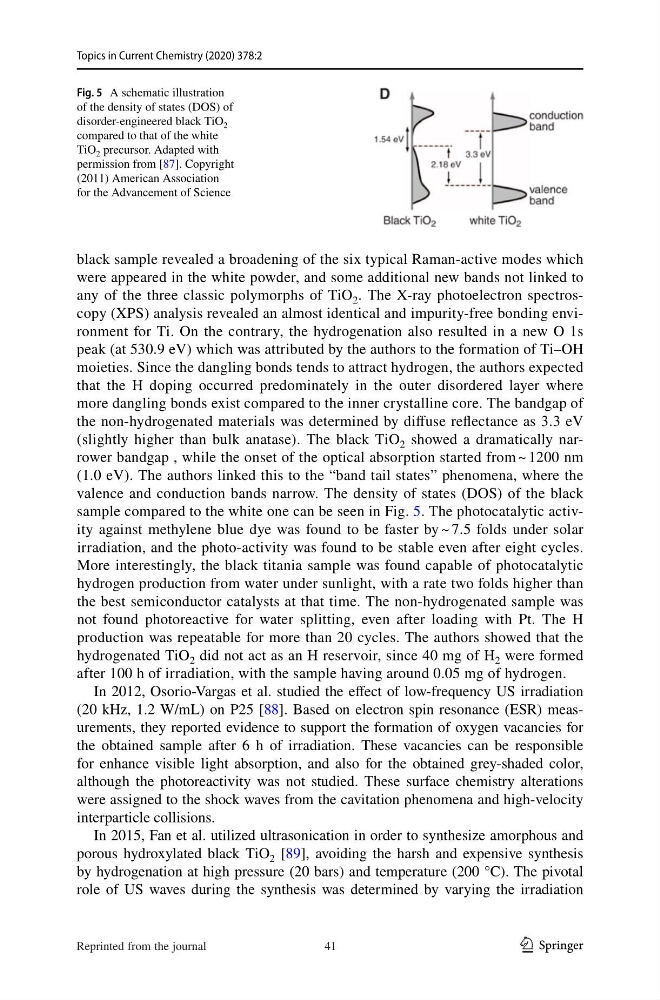
valence and conduction bands narrow. The density of states (DOS) of the black
sample compared to the white one can be seen in Fig. 5. The photocatalytic activity against methylene blue dye was found to be faster by ~ 7.5 folds under solar
irradiation, and the photo-activity was found to be stable even after eight cycles.
More interestingly, the black titania sample was found capable of photocatalytic
hydrogen production from water under sunlight, with a rate two folds higher than
the best semiconductor catalysts at that time. The non-hydrogenated sample was
not found photoreactive for water splitting, even after loading with Pt. The H
production was repeatable for more than 20 cycles. The authors showed that the
hydrogenated TiO 2 did not act as an H reservoir, since 40 mg of H 2 were formed
after 100 h of irradiation, with the sample having around 0.05 mg of hydrogen.
In 2012, Osorio-Vargas et al. studied the effect of low-frequency US irradiation
(20 kHz, 1.2 W/mL) on P25 [88]. Based on electron spin resonance (ESR) measurements, they reported evidence to support the formation of oxygen vacancies for
the obtained sample after 6 h of irradiation. These vacancies can be responsible
for enhance visible light absorption, and also for the obtained grey-shaded color,
although the photoreactivity was not studied. These surface chemistry alterations
were assigned to the shock waves from the cavitation phenomena and high-velocity
interparticle collisions.
In 2015, Fan et al. utilized ultrasonication in order to synthesize amorphous and
porous hydroxylated black TiO 2 [89], avoiding the harsh and expensive synthesis
by hydrogenation at high pressure (20 bars) and temperature (200 °C). The pivotal
role of US waves during the synthesis was determined by varying the irradiation
Fig. 5 A schematic illustration
of the density of states (DOS) of
disorder-engineered black TiO 2
compared to that of the white
TiO 2 precursor. Adapted with
permission from [87]. Copyright
(2011) American Association
for the Advancement of Science
41
Reprinted from the journal
Topics in Current Chemistry (2020) 378:2
black sample revealed a broadening of the six typical Raman-active modes which
were appeared in the white powder, and some additional new bands not linked to
any of the three classic polymorphs of TiO 2 . The X-ray photoelectron spectroscopy (XPS) analysis revealed an almost identical and impurity-free bonding environment for Ti. On the contrary, the hydrogenation also resulted in a new O 1s
peak (at 530.9 eV) which was attributed by the authors to the formation of Ti–OH
moieties. Since the dangling bonds tends to attract hydrogen, the authors expected
that the H doping occurred predominately in the outer disordered layer where
more dangling bonds exist compared to the inner crystalline core. The bandgap of
the non-hydrogenated materials was determined by diffuse reflectance as 3.3 eV
(slightly higher than bulk anatase). The black TiO 2 showed a dramatically narrower bandgap , while the onset of the optical absorption started from ~ 1200 nm
(1.0 eV). The authors linked this to the “band tail states” phenomena, where the
valence and conduction bands narrow. The density of states (DOS) of the black
sample compared to the white one can be seen in Fig. 5. The photocatalytic activity against methylene blue dye was found to be faster by ~ 7.5 folds under solar
irradiation, and the photo-activity was found to be stable even after eight cycles.
More interestingly, the black titania sample was found capable of photocatalytic
hydrogen production from water under sunlight, with a rate two folds higher than
the best semiconductor catalysts at that time. The non-hydrogenated sample was
not found photoreactive for water splitting, even after loading with Pt. The H
production was repeatable for more than 20 cycles. The authors showed that the
hydrogenated TiO 2 did not act as an H reservoir, since 40 mg of H 2 were formed
after 100 h of irradiation, with the sample having around 0.05 mg of hydrogen.
In 2012, Osorio-Vargas et al. studied the effect of low-frequency US irradiation
(20 kHz, 1.2 W/mL) on P25 [88]. Based on electron spin resonance (ESR) measurements, they reported evidence to support the formation of oxygen vacancies for
the obtained sample after 6 h of irradiation. These vacancies can be responsible
for enhance visible light absorption, and also for the obtained grey-shaded color,
although the photoreactivity was not studied. These surface chemistry alterations
were assigned to the shock waves from the cavitation phenomena and high-velocity
interparticle collisions.
In 2015, Fan et al. utilized ultrasonication in order to synthesize amorphous and
porous hydroxylated black TiO 2 [89], avoiding the harsh and expensive synthesis
by hydrogenation at high pressure (20 bars) and temperature (200 °C). The pivotal
role of US waves during the synthesis was determined by varying the irradiation
Fig. 5 A schematic illustration
of the density of states (DOS) of
disorder-engineered black TiO 2
compared to that of the white
TiO 2 precursor. Adapted with
permission from [87]. Copyright
(2011) American Association
for the Advancement of Science
41
Reprinted from the journal