

1 3
Topics in Current Chemistry (2019) 377:22
In reactors with the catalyst immobilized over a surface, rxn takes the following
form:
In this case,
⟨
e
a,s
x
⟩
Acat
represents the LSRPA averaged over A cat .
In photocatalytic studies, the photonic efficiency is more frequently reported
than the reaction efficiency, probably because it is much simpler to calculate, but
its usefulness is under discussion [109]. The incident radiation flux can be evaluated straightforwardly. On the contrary, calculation of the fraction of energy effectively absorbed by the catalyst involves the measurement of the optical properties of
the absorbing material and the resolution of radiation models, taking into account
the phenomena of absorption, reflection, and scattering of radiation by the catalyst.
Considering that only the absorbed photons are employed in photocatalytic reactions, the reaction efficiency is more appropriate for evaluating the performance of
photocatalytic systems. Therefore, ph can only be considered as the lower limit of
rxn [115].
Efficiency parameters that consider the fraction of absorbed energy ( abs and rxn )
are particularly important for comparing catalytic materials with different absorption properties, as in the case of visible light active catalysts. To illustrate this
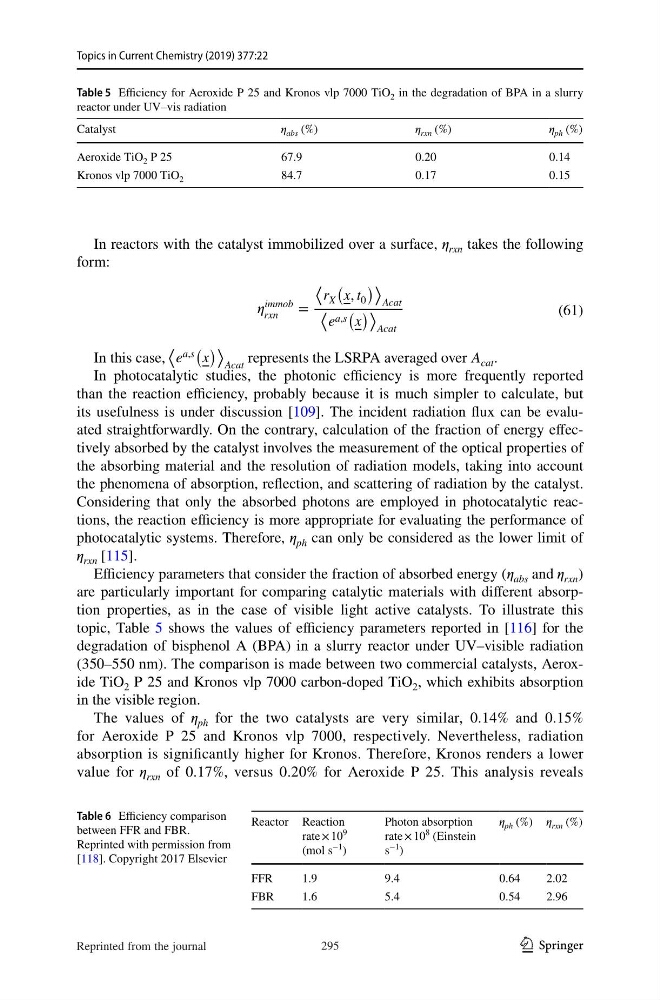
topic, Table 5 shows the values of efficiency parameters reported in [116] for the
degradation of bisphenol A (BPA) in a slurry reactor under UV–visible radiation
(350–550 nm). The comparison is made between two commercial catalysts, Aeroxide TiO 2 P 25 and Kronos vlp 7000 carbon-doped TiO 2 , which exhibits absorption
in the visible region.
The values of ph for the two catalysts are very similar, 0.14% and 0.15%
for Aeroxide P 25 and Kronos vlp 7000, respectively. Nevertheless, radiation
absorption is significantly higher for Kronos. Therefore, Kronos renders a lower
value for rxn of 0.17%, versus 0.20% for Aeroxide P 25. This analysis reveals
(61)
immob
rxn
=
⟨
r X
x, t 0
⟩
Acat
⟨
e a,s
x
⟩
Acat
Table 5 Efficiency for Aeroxide P 25 and Kronos vlp 7000 TiO 2 in the degradation of BPA in a slurry
reactor under UV–vis radiation
Catalyst
abs (%)
rxn (%)
ph (%)
Aeroxide TiO 2 P 25
67.9
0.20
0.14
Kronos vlp 7000 TiO 2
84.7
0.17
0.15
Table 6 Efficiency comparison
between FFR and FBR.
Reprinted with permission from
[118]. Copyright 2017 Elsevier
Reactor Reaction
rate × 10
9
(mol s
−1
)
Photon absorption
rate × 10
8 (Einstein
s
−1 )
ph (%) rxn (%)
FFR
1.9
9.4
0.64
2.02
FBR
1.6
5.4
0.54
2.96
295
Reprinted from the journal
Topics in Current Chemistry (2019) 377:22
In reactors with the catalyst immobilized over a surface, rxn takes the following
form:
In this case,
⟨
e
a,s
x
⟩
Acat
represents the LSRPA averaged over A cat .
In photocatalytic studies, the photonic efficiency is more frequently reported
than the reaction efficiency, probably because it is much simpler to calculate, but
its usefulness is under discussion [109]. The incident radiation flux can be evaluated straightforwardly. On the contrary, calculation of the fraction of energy effectively absorbed by the catalyst involves the measurement of the optical properties of
the absorbing material and the resolution of radiation models, taking into account
the phenomena of absorption, reflection, and scattering of radiation by the catalyst.
Considering that only the absorbed photons are employed in photocatalytic reactions, the reaction efficiency is more appropriate for evaluating the performance of
photocatalytic systems. Therefore, ph can only be considered as the lower limit of
rxn [115].
Efficiency parameters that consider the fraction of absorbed energy ( abs and rxn )
are particularly important for comparing catalytic materials with different absorption properties, as in the case of visible light active catalysts. To illustrate this
topic, Table 5 shows the values of efficiency parameters reported in [116] for the
degradation of bisphenol A (BPA) in a slurry reactor under UV–visible radiation
(350–550 nm). The comparison is made between two commercial catalysts, Aeroxide TiO 2 P 25 and Kronos vlp 7000 carbon-doped TiO 2 , which exhibits absorption
in the visible region.
The values of ph for the two catalysts are very similar, 0.14% and 0.15%
for Aeroxide P 25 and Kronos vlp 7000, respectively. Nevertheless, radiation
absorption is significantly higher for Kronos. Therefore, Kronos renders a lower
value for rxn of 0.17%, versus 0.20% for Aeroxide P 25. This analysis reveals
(61)
immob
rxn
=
⟨
r X
x, t 0
⟩
Acat
⟨
e a,s
x
⟩
Acat
Table 5 Efficiency for Aeroxide P 25 and Kronos vlp 7000 TiO 2 in the degradation of BPA in a slurry
reactor under UV–vis radiation
Catalyst
abs (%)
rxn (%)
ph (%)
Aeroxide TiO 2 P 25
67.9
0.20
0.14
Kronos vlp 7000 TiO 2
84.7
0.17
0.15
Table 6 Efficiency comparison
between FFR and FBR.
Reprinted with permission from
[118]. Copyright 2017 Elsevier
Reactor Reaction
rate × 10
9
(mol s
−1
)
Photon absorption
rate × 10
8 (Einstein
s
−1 )
ph (%) rxn (%)
FFR
1.9
9.4
0.64
2.02
FBR
1.6
5.4
0.54
2.96
295
Reprinted from the journal