

Topics in Current Chemistry (2019) 377:22
1 3
Self-defined photoreactor performance parameters have also been reported
in the scientific literature. Serrano and de Lasa [111] proposed the photocatalytic
thermodynamic efficiency factor (PTFE) based on thermodynamic considerations.
The PTFE is the ratio of the energy used for the formation of hydroxyl radicals to
the energy absorbed by the catalyst [62, 112]. Li et al. [113] compared the performance of suspended and immobilized systems based on a ratio between initial reaction rates. More recently, Leblebici et al. [114] compared 12 photocatalytic reactor
designs with a new benchmark measure, the photocatalytic space–time yield.
6.2 Photonic and Quantum Efficiency for Comparison Purposes
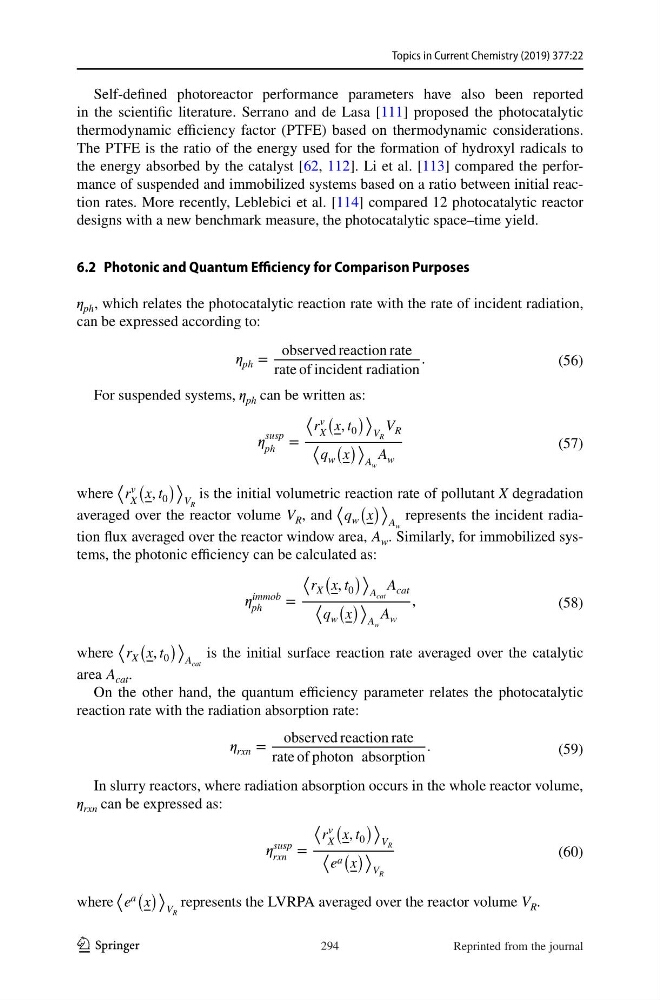
ph , which relates the photocatalytic reaction rate with the rate of incident radiation,
can be expressed according to:
For suspended systems, ph can be written as:
where
⟨
r
v
X
x, t 0
⟩
V R
is the initial volumetric reaction rate of pollutant X degradation
averaged over the reactor volume V R , and
⟨
q w
x
⟩
A w
represents the incident radiation flux averaged over the reactor window area, A w . Similarly, for immobilized systems, the photonic efficiency can be calculated as:
where
⟨
r X
x, t 0
⟩
A cat
is the initial surface reaction rate averaged over the catalytic
area A cat .
On the other hand, the quantum efficiency parameter relates the photocatalytic
reaction rate with the radiation absorption rate:
In slurry reactors, where radiation absorption occurs in the whole reactor volume,
rxn can be expressed as:
where
⟨
e
a
x
⟩
V R
represents the LVRPA averaged over the reactor volume V R .
(56)
ph =
observed reaction rate
rate of incident radiation
.
(57)
susp
ph
=
⟨
r
v
X
x, t 0
⟩
V R
V R
⟨
q w
x
⟩
A w
A w
(58)
immob
ph
=
⟨
r X
x, t 0
⟩
A cat
A cat
⟨
q w
x
⟩
A w
A w
,
(59)
rxn =
observed reaction rate
rate of photon absorption
.
(60)
susp
rxn
=
⟨
r
v
X
x, t 0
⟩
V R
⟨
e a
x
⟩
V R
294
Reprinted from the journal
1 3
Self-defined photoreactor performance parameters have also been reported
in the scientific literature. Serrano and de Lasa [111] proposed the photocatalytic
thermodynamic efficiency factor (PTFE) based on thermodynamic considerations.
The PTFE is the ratio of the energy used for the formation of hydroxyl radicals to
the energy absorbed by the catalyst [62, 112]. Li et al. [113] compared the performance of suspended and immobilized systems based on a ratio between initial reaction rates. More recently, Leblebici et al. [114] compared 12 photocatalytic reactor
designs with a new benchmark measure, the photocatalytic space–time yield.
6.2 Photonic and Quantum Efficiency for Comparison Purposes
ph , which relates the photocatalytic reaction rate with the rate of incident radiation,
can be expressed according to:
For suspended systems, ph can be written as:
where
⟨
r
v
X
x, t 0
⟩
V R
is the initial volumetric reaction rate of pollutant X degradation
averaged over the reactor volume V R , and
⟨
q w
x
⟩
A w
represents the incident radiation flux averaged over the reactor window area, A w . Similarly, for immobilized systems, the photonic efficiency can be calculated as:
where
⟨
r X
x, t 0
⟩
A cat
is the initial surface reaction rate averaged over the catalytic
area A cat .
On the other hand, the quantum efficiency parameter relates the photocatalytic
reaction rate with the radiation absorption rate:
In slurry reactors, where radiation absorption occurs in the whole reactor volume,
rxn can be expressed as:
where
⟨
e
a
x
⟩
V R
represents the LVRPA averaged over the reactor volume V R .
(56)
ph =
observed reaction rate
rate of incident radiation
.
(57)
susp
ph
=
⟨
r
v
X
x, t 0
⟩
V R
V R
⟨
q w
x
⟩
A w
A w
(58)
immob
ph
=
⟨
r X
x, t 0
⟩
A cat
A cat
⟨
q w
x
⟩
A w
A w
,
(59)
rxn =
observed reaction rate
rate of photon absorption
.
(60)
susp
rxn
=
⟨
r
v
X
x, t 0
⟩
V R
⟨
e a
x
⟩
V R
294
Reprinted from the journal