

Topics in Current Chemistry (2019) 377:22
1 3
coupled through the reaction rate expression that appeared in the boundary condition at the fluid–solid interface. The heterogeneous reaction rate was modeled using
semiempirical Langmuir–Hinshelwood–Hougen–Watson (LHHW) kinetics. Alexiadis et al. [102] modeled an annular fixed-bed reactor with an axial cylindrical UV
lamp. The photocatalyst (TiO 2 ) was supported on quartz rings. The hydrodynamic
model assumes convection in the axial direction with radial dispersion. The reaction
is considered to take place only on the external surface of the catalyst, and external mass transfer limitations are taken into account. A complex kinetic expression
based on a detailed reaction mechanism was employed. Vella et al. [98] assumed a
differential reactor operation and kinetic control regime to simulate the degradation
of formic acid in a TiO 2 -quartz wool-packed bed reactor with recycle. The reaction
rate equation was derived from a plausible mechanistic scheme, arriving at a kinetic
expression with the form of Eq. (4) in Table 1, in which hydroxyl radical attack was
considered to be the main degradation route. Cloteaux et al. [104] employed a plug
flow model with axial dispersion, a Langmuir–Hinshelwood kinetic expression, and
an external mass transfer coefficient to model the degradation of formaldehyde in
a fixed-bed reactor with TiO 2 -coated Raschig rings. Vaiano et al. [94] modeled a
flat-plate continuous reactor with N-doped TiO 2 immobilized on glass spheres. They
developed a reactor model considering plug flow behavior inside the packed bed,
without considering external mass transfer phenomena. A Langmuir–Hinshelwood
type of kinetic equation was used to model the degradation of methylene blue. Claes
et al. [96] assumed apparent first-order kinetics and ideal plug flow reactor model to
estimate the kinetic constant for the degradation of methylene blue in a rectangular
reactor filled with TiO 2 -coated glass beads.
Manassero et al. [105] simulated the degradation of the water pollutant clofibric
acid (CA) in a packed-bed batch reactor with recycle. The reactor was filled with
TiO 2 -coated rings. Reaction rate expressions representing the degradation of CA and
the main reaction intermediates were mechanistically derived, and took the form of
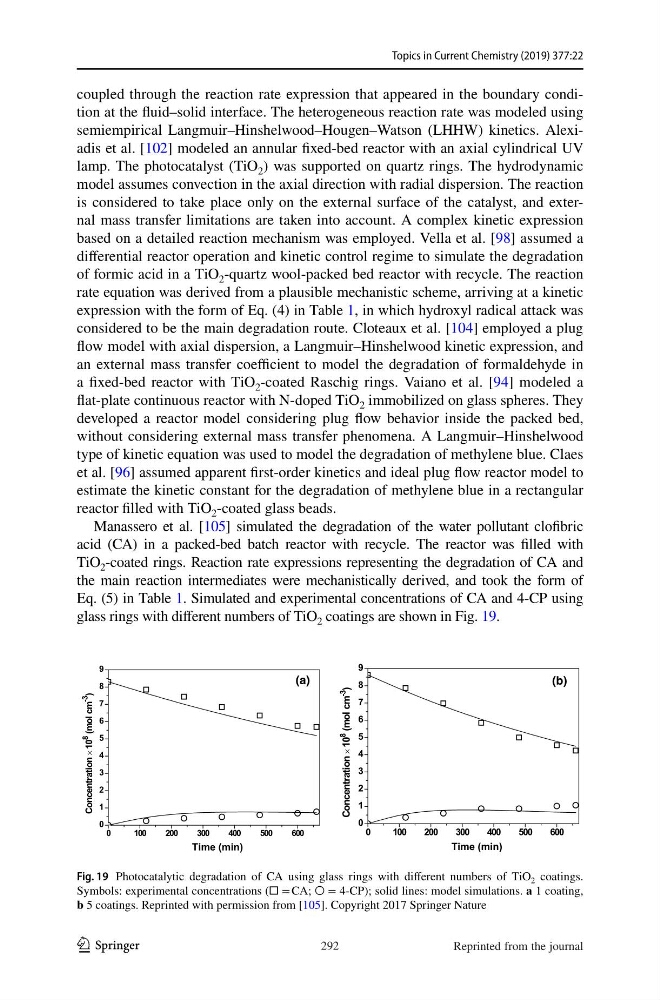
Eq. (5) in Table 1. Simulated and experimental concentrations of CA and 4-CP using
glass rings with different numbers of TiO 2 coatings are shown in Fig. 19.
0
1 00
200
300
400
5 00
600
0
1
2
3
4
5
6
7
8
9
Concentration ×
10
8
(mol cm
-3
)
Time (min)
0
100
200
300
400
500
600
0
1
2
3
4
5
6
7
8
9
Concentration ×
10
8
(mol cm
-3
)
Time (min)
(a)
(b)
Fig. 19 Photocatalytic degradation of CA using glass rings with different numbers of TiO 2 coatings.
Symbols: experimental concentrations (□ = CA; ○ = 4-CP); solid lines: model simulations. a 1 coating,
b 5 coatings. Reprinted with permission from [105]. Copyright 2017 Springer Nature
292
Reprinted from the journal
1 3
coupled through the reaction rate expression that appeared in the boundary condition at the fluid–solid interface. The heterogeneous reaction rate was modeled using
semiempirical Langmuir–Hinshelwood–Hougen–Watson (LHHW) kinetics. Alexiadis et al. [102] modeled an annular fixed-bed reactor with an axial cylindrical UV
lamp. The photocatalyst (TiO 2 ) was supported on quartz rings. The hydrodynamic
model assumes convection in the axial direction with radial dispersion. The reaction
is considered to take place only on the external surface of the catalyst, and external mass transfer limitations are taken into account. A complex kinetic expression
based on a detailed reaction mechanism was employed. Vella et al. [98] assumed a
differential reactor operation and kinetic control regime to simulate the degradation
of formic acid in a TiO 2 -quartz wool-packed bed reactor with recycle. The reaction
rate equation was derived from a plausible mechanistic scheme, arriving at a kinetic
expression with the form of Eq. (4) in Table 1, in which hydroxyl radical attack was
considered to be the main degradation route. Cloteaux et al. [104] employed a plug
flow model with axial dispersion, a Langmuir–Hinshelwood kinetic expression, and
an external mass transfer coefficient to model the degradation of formaldehyde in
a fixed-bed reactor with TiO 2 -coated Raschig rings. Vaiano et al. [94] modeled a
flat-plate continuous reactor with N-doped TiO 2 immobilized on glass spheres. They
developed a reactor model considering plug flow behavior inside the packed bed,
without considering external mass transfer phenomena. A Langmuir–Hinshelwood
type of kinetic equation was used to model the degradation of methylene blue. Claes
et al. [96] assumed apparent first-order kinetics and ideal plug flow reactor model to
estimate the kinetic constant for the degradation of methylene blue in a rectangular
reactor filled with TiO 2 -coated glass beads.
Manassero et al. [105] simulated the degradation of the water pollutant clofibric
acid (CA) in a packed-bed batch reactor with recycle. The reactor was filled with
TiO 2 -coated rings. Reaction rate expressions representing the degradation of CA and
the main reaction intermediates were mechanistically derived, and took the form of
Eq. (5) in Table 1. Simulated and experimental concentrations of CA and 4-CP using
glass rings with different numbers of TiO 2 coatings are shown in Fig. 19.
0
1 00
200
300
400
5 00
600
0
1
2
3
4
5
6
7
8
9
Concentration ×
10
8
(mol cm
-3
)
Time (min)
0
100
200
300
400
500
600
0
1
2
3
4
5
6
7
8
9
Concentration ×
10
8
(mol cm
-3
)
Time (min)
(a)
(b)
Fig. 19 Photocatalytic degradation of CA using glass rings with different numbers of TiO 2 coatings.
Symbols: experimental concentrations (□ = CA; ○ = 4-CP); solid lines: model simulations. a 1 coating,
b 5 coatings. Reprinted with permission from [105]. Copyright 2017 Springer Nature
292
Reprinted from the journal