

Topics in Current Chemistry (2020) 378:3
1 3
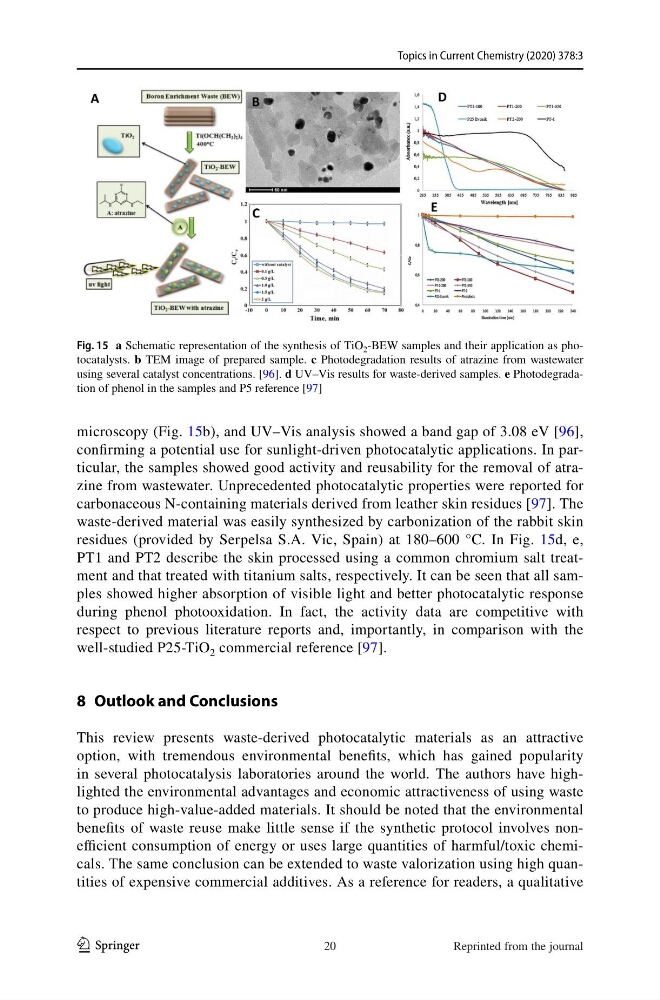
microscopy (Fig. 15b), and UV–Vis analysis showed a band gap of 3.08 eV [96],
confirming a potential use for sunlight-driven photocatalytic applications. In particular, the samples showed good activity and reusability for the removal of atrazine from wastewater. Unprecedented photocatalytic properties were reported for
carbonaceous N-containing materials derived from leather skin residues [97]. The
waste-derived material was easily synthesized by carbonization of the rabbit skin
residues (provided by Serpelsa S.A. Vic, Spain) at 180–600 °C. In Fig. 15d, e,
PT1 and PT2 describe the skin processed using a common chromium salt treatment and that treated with titanium salts, respectively. It can be seen that all samples showed higher absorption of visible light and better photocatalytic response
during phenol photooxidation. In fact, the activity data are competitive with
respect to previous literature reports and, importantly, in comparison with the
well-studied P25-TiO 2 commercial reference [97].
8 Outlook and Conclusions
This review presents waste-derived photocatalytic materials as an attractive
option, with tremendous environmental benefits, which has gained popularity
in several photocatalysis laboratories around the world. The authors have highlighted the environmental advantages and economic attractiveness of using waste
to produce high-value-added materials. It should be noted that the environmental
benefits of waste reuse make little sense if the synthetic protocol involves nonefficient consumption of energy or uses large quantities of harmful/toxic chemicals. The same conclusion can be extended to waste valorization using high quantities of expensive commercial additives. As a reference for readers, a qualitative
Fig. 15 a Schematic representation of the synthesis of TiO 2 -BEW samples and their application as photocatalysts. b TEM image of prepared sample. c Photodegradation results of atrazine from wastewater
using several catalyst concentrations. [96]. d UV–Vis results for waste-derived samples. e Photodegradation of phenol in the samples and P5 reference [97]
20
Reprinted from the journal
1 3
microscopy (Fig. 15b), and UV–Vis analysis showed a band gap of 3.08 eV [96],
confirming a potential use for sunlight-driven photocatalytic applications. In particular, the samples showed good activity and reusability for the removal of atrazine from wastewater. Unprecedented photocatalytic properties were reported for
carbonaceous N-containing materials derived from leather skin residues [97]. The
waste-derived material was easily synthesized by carbonization of the rabbit skin
residues (provided by Serpelsa S.A. Vic, Spain) at 180–600 °C. In Fig. 15d, e,
PT1 and PT2 describe the skin processed using a common chromium salt treatment and that treated with titanium salts, respectively. It can be seen that all samples showed higher absorption of visible light and better photocatalytic response
during phenol photooxidation. In fact, the activity data are competitive with
respect to previous literature reports and, importantly, in comparison with the
well-studied P25-TiO 2 commercial reference [97].
8 Outlook and Conclusions
This review presents waste-derived photocatalytic materials as an attractive
option, with tremendous environmental benefits, which has gained popularity
in several photocatalysis laboratories around the world. The authors have highlighted the environmental advantages and economic attractiveness of using waste
to produce high-value-added materials. It should be noted that the environmental
benefits of waste reuse make little sense if the synthetic protocol involves nonefficient consumption of energy or uses large quantities of harmful/toxic chemicals. The same conclusion can be extended to waste valorization using high quantities of expensive commercial additives. As a reference for readers, a qualitative
Fig. 15 a Schematic representation of the synthesis of TiO 2 -BEW samples and their application as photocatalysts. b TEM image of prepared sample. c Photodegradation results of atrazine from wastewater
using several catalyst concentrations. [96]. d UV–Vis results for waste-derived samples. e Photodegradation of phenol in the samples and P5 reference [97]
20
Reprinted from the journal