

1 3
Topics in Current Chemistry (2020) 378:3
g-C 3 N 4 –Fe 2 O 3 sample showed very good recyclability and sufficient magnetism
to allow efficient recovery under an external magnetic field.
Boron-containing materials have recently gained attention in the field of photocatalysis due to their excellent optical properties. In fact, the strong absorption of this material in the UV–Vis/IR range has yielded remarkable local photothermal effects and outstanding results in CO 2 reduction reactions. As in other
industrial extraction-purification processes, boron generates a large amount of
boron-containing waste. In one study, boron-enriched waste (BEW) was used to
produce a photocatalytic material tested during atrazine degradation reaction. The
TiO 2 -BEW material was obtained using a simple impregnation method followed
by calcination at 400 °C, as schematically illustrated in Fig. 15a. Titanium(IV)
isopropoxide was used as the Ti source, and the final materials, according to
the elemental analysis, presented ca. 13.7 wt% of TiO 2 . Characterization of the
waste-derived samples was performed using a multi-technique approach. Pseudospherical TiO 2 nanoparticles uniformly scattered on BEW were measured by
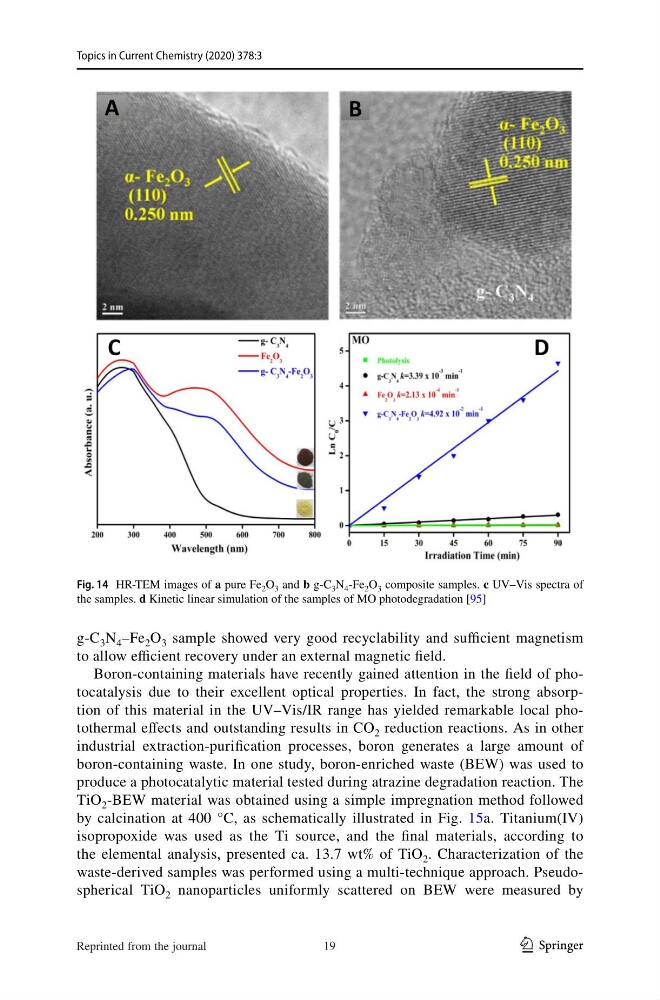
Fig. 14 HR-TEM images of a pure Fe 2 O 3 and b g-C 3 N 4 -Fe 2 O 3 composite samples. c UV–Vis spectra of
the samples. d Kinetic linear simulation of the samples of MO photodegradation [95]
19
Reprinted from the journal
Topics in Current Chemistry (2020) 378:3
g-C 3 N 4 –Fe 2 O 3 sample showed very good recyclability and sufficient magnetism
to allow efficient recovery under an external magnetic field.
Boron-containing materials have recently gained attention in the field of photocatalysis due to their excellent optical properties. In fact, the strong absorption of this material in the UV–Vis/IR range has yielded remarkable local photothermal effects and outstanding results in CO 2 reduction reactions. As in other
industrial extraction-purification processes, boron generates a large amount of
boron-containing waste. In one study, boron-enriched waste (BEW) was used to
produce a photocatalytic material tested during atrazine degradation reaction. The
TiO 2 -BEW material was obtained using a simple impregnation method followed
by calcination at 400 °C, as schematically illustrated in Fig. 15a. Titanium(IV)
isopropoxide was used as the Ti source, and the final materials, according to
the elemental analysis, presented ca. 13.7 wt% of TiO 2 . Characterization of the
waste-derived samples was performed using a multi-technique approach. Pseudospherical TiO 2 nanoparticles uniformly scattered on BEW were measured by
Fig. 14 HR-TEM images of a pure Fe 2 O 3 and b g-C 3 N 4 -Fe 2 O 3 composite samples. c UV–Vis spectra of
the samples. d Kinetic linear simulation of the samples of MO photodegradation [95]
19
Reprinted from the journal