

1 3
Topics in Current Chemistry (2019) 377:22
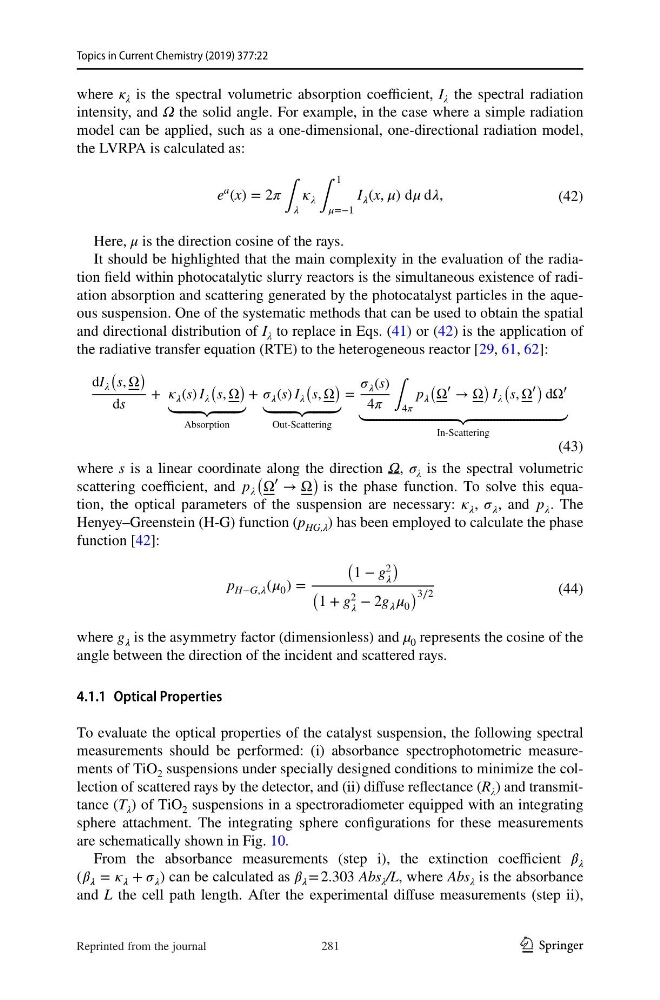
where κ λ is the spectral volumetric absorption coefficient, I λ the spectral radiation
intensity, and Ω the solid angle. For example, in the case where a simple radiation
model can be applied, such as a one-dimensional, one-directional radiation model,
the LVRPA is calculated as:
Here, μ is the direction cosine of the rays.
It should be highlighted that the main complexity in the evaluation of the radiation field within photocatalytic slurry reactors is the simultaneous existence of radiation absorption and scattering generated by the photocatalyst particles in the aqueous suspension. One of the systematic methods that can be used to obtain the spatial
and directional distribution of I λ to replace in Eqs. (41) or (42) is the application of
the radiative transfer equation (RTE) to the heterogeneous reactor [29, 61, 62]:
where s is a linear coordinate along the direction Ω, σ λ is the spectral volumetric
scattering coefficient, and p
Ω
� → Ω
is the phase function. To solve this equation, the optical parameters of the suspension are necessary: , , and p . The
Henyey–Greenstein (H-G) function (p HG,λ ) has been employed to calculate the phase
function [42]:
where g is the asymmetry factor (dimensionless) and µ 0 represents the cosine of the
angle between the direction of the incident and scattered rays.
4.1.1 Optical Properties
To evaluate the optical properties of the catalyst suspension, the following spectral
measurements should be performed: (i) absorbance spectrophotometric measurements of TiO 2 suspensions under specially designed conditions to minimize the collection of scattered rays by the detector, and (ii) diffuse reflectance (R λ ) and transmittance (T λ ) of TiO 2 suspensions in a spectroradiometer equipped with an integrating
sphere attachment. The integrating sphere configurations for these measurements
are schematically shown in Fig. 10.
From the absorbance measurements (step i), the extinction coefficient
( = + ) can be calculated as = 2.303 Abs λ /L, where Abs λ is the absorbance
and L the cell path length. After the experimental diffuse measurements (step ii),
(42)
e
a (x) = 2 ∫
∫
1
=−1
I (x, ) d d,
(43)
dI
s, Ω
ds
+ (s) I
s, Ω
⏟⏞⏞⏞⏞⏞⏟⏞⏞⏞⏞⏞⏟
Absorption
+ (s) I
s, Ω
⏟⏞⏞⏞⏞⏞⏟⏞⏞⏞⏞⏞⏟
Out-Scattering
=
(s)
4 ∫ 4
p
Ω
� → Ω
I
s, Ω
�
dΩ
�
⏟⏞⏞⏞⏞⏞⏞⏞⏞⏞⏞⏞⏞⏞⏞⏞⏞⏞⏞⏞⏞⏞⏞⏞⏞⏞⏟⏞⏞⏞⏞⏞⏞⏞⏞⏞⏞⏞⏞⏞⏞⏞⏞⏞⏞⏞⏞⏞⏞⏞⏞⏞⏟
In-Scattering
(44)
p H−G, ( 0 ) =
1 − g
2
1 + g
2
− 2g 0
3∕2
281
Reprinted from the journal
Topics in Current Chemistry (2019) 377:22
where κ λ is the spectral volumetric absorption coefficient, I λ the spectral radiation
intensity, and Ω the solid angle. For example, in the case where a simple radiation
model can be applied, such as a one-dimensional, one-directional radiation model,
the LVRPA is calculated as:
Here, μ is the direction cosine of the rays.
It should be highlighted that the main complexity in the evaluation of the radiation field within photocatalytic slurry reactors is the simultaneous existence of radiation absorption and scattering generated by the photocatalyst particles in the aqueous suspension. One of the systematic methods that can be used to obtain the spatial
and directional distribution of I λ to replace in Eqs. (41) or (42) is the application of
the radiative transfer equation (RTE) to the heterogeneous reactor [29, 61, 62]:
where s is a linear coordinate along the direction Ω, σ λ is the spectral volumetric
scattering coefficient, and p
Ω
� → Ω
is the phase function. To solve this equation, the optical parameters of the suspension are necessary: , , and p . The
Henyey–Greenstein (H-G) function (p HG,λ ) has been employed to calculate the phase
function [42]:
where g is the asymmetry factor (dimensionless) and µ 0 represents the cosine of the
angle between the direction of the incident and scattered rays.
4.1.1 Optical Properties
To evaluate the optical properties of the catalyst suspension, the following spectral
measurements should be performed: (i) absorbance spectrophotometric measurements of TiO 2 suspensions under specially designed conditions to minimize the collection of scattered rays by the detector, and (ii) diffuse reflectance (R λ ) and transmittance (T λ ) of TiO 2 suspensions in a spectroradiometer equipped with an integrating
sphere attachment. The integrating sphere configurations for these measurements
are schematically shown in Fig. 10.
From the absorbance measurements (step i), the extinction coefficient
( = + ) can be calculated as = 2.303 Abs λ /L, where Abs λ is the absorbance
and L the cell path length. After the experimental diffuse measurements (step ii),
(42)
e
a (x) = 2 ∫
∫
1
=−1
I (x, ) d d,
(43)
dI
s, Ω
ds
+ (s) I
s, Ω
⏟⏞⏞⏞⏞⏞⏟⏞⏞⏞⏞⏞⏟
Absorption
+ (s) I
s, Ω
⏟⏞⏞⏞⏞⏞⏟⏞⏞⏞⏞⏞⏟
Out-Scattering
=
(s)
4 ∫ 4
p
Ω
� → Ω
I
s, Ω
�
dΩ
�
⏟⏞⏞⏞⏞⏞⏞⏞⏞⏞⏞⏞⏞⏞⏞⏞⏞⏞⏞⏞⏞⏞⏞⏞⏞⏞⏟⏞⏞⏞⏞⏞⏞⏞⏞⏞⏞⏞⏞⏞⏞⏞⏞⏞⏞⏞⏞⏞⏞⏞⏞⏞⏟
In-Scattering
(44)
p H−G, ( 0 ) =
1 − g
2
1 + g
2
− 2g 0
3∕2
281
Reprinted from the journal