

Topics in Current Chemistry (2019) 377:22
1 3
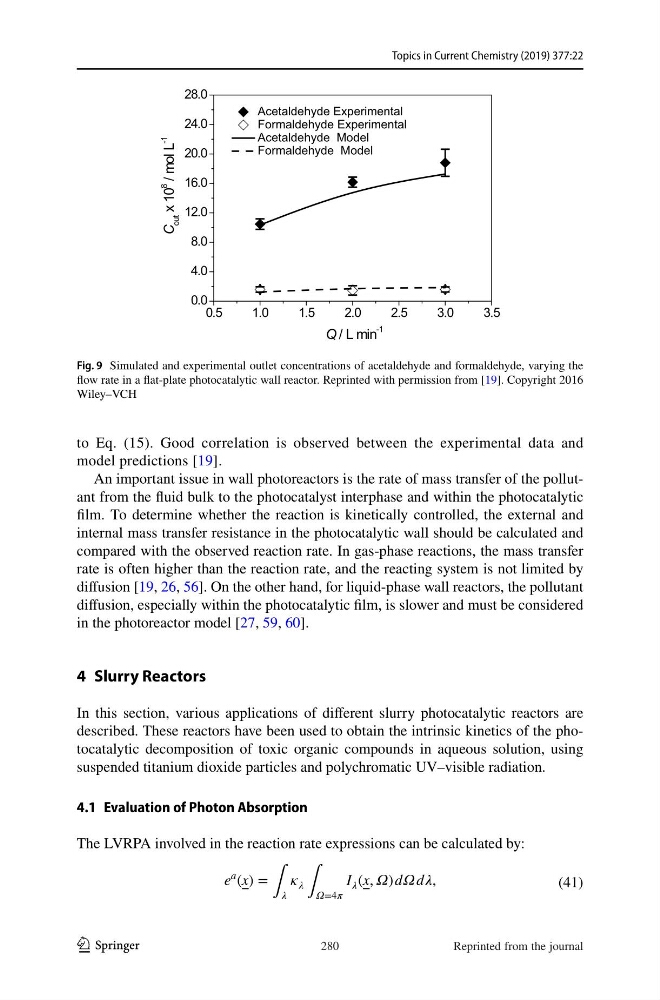
to Eq. (15). Good correlation is observed between the experimental data and
model predictions [19].
An important issue in wall photoreactors is the rate of mass transfer of the pollutant from the fluid bulk to the photocatalyst interphase and within the photocatalytic
film. To determine whether the reaction is kinetically controlled, the external and
internal mass transfer resistance in the photocatalytic wall should be calculated and
compared with the observed reaction rate. In gas-phase reactions, the mass transfer
rate is often higher than the reaction rate, and the reacting system is not limited by
diffusion [19, 26, 56]. On the other hand, for liquid-phase wall reactors, the pollutant
diffusion, especially within the photocatalytic film, is slower and must be considered
in the photoreactor model [27, 59, 60].
4 Slurry Reactors
In this section, various applications of different slurry photocatalytic reactors are
described. These reactors have been used to obtain the intrinsic kinetics of the photocatalytic decomposition of toxic organic compounds in aqueous solution, using
suspended titanium dioxide particles and polychromatic UV–visible radiation.
4.1 Evaluation of Photon Absorption
The LVRPA involved in the reaction rate expressions can be calculated by:
(41)
e
a (x) = ∫
∫ =4
I (x, ) d d,
0.5
1 .0
1.5
2 .0
2.5
3 .0
3.5
0.0
4.0
8.0
12.0
16.0
20.0
24.0
28.0
Acetaldehyde Experimental
Formaldehyde Experimental
Acetaldehyde Model
Formaldehyde Model
C
out
x 10
8
/ mol L
-1
Q / L min
-1
Fig. 9 Simulated and experimental outlet concentrations of acetaldehyde and formaldehyde, varying the
flow rate in a flat-plate photocatalytic wall reactor. Reprinted with permission from [19]. Copyright 2016
Wiley–VCH
280
Reprinted from the journal
1 3
to Eq. (15). Good correlation is observed between the experimental data and
model predictions [19].
An important issue in wall photoreactors is the rate of mass transfer of the pollutant from the fluid bulk to the photocatalyst interphase and within the photocatalytic
film. To determine whether the reaction is kinetically controlled, the external and
internal mass transfer resistance in the photocatalytic wall should be calculated and
compared with the observed reaction rate. In gas-phase reactions, the mass transfer
rate is often higher than the reaction rate, and the reacting system is not limited by
diffusion [19, 26, 56]. On the other hand, for liquid-phase wall reactors, the pollutant
diffusion, especially within the photocatalytic film, is slower and must be considered
in the photoreactor model [27, 59, 60].
4 Slurry Reactors
In this section, various applications of different slurry photocatalytic reactors are
described. These reactors have been used to obtain the intrinsic kinetics of the photocatalytic decomposition of toxic organic compounds in aqueous solution, using
suspended titanium dioxide particles and polychromatic UV–visible radiation.
4.1 Evaluation of Photon Absorption
The LVRPA involved in the reaction rate expressions can be calculated by:
(41)
e
a (x) = ∫
∫ =4
I (x, ) d d,
0.5
1 .0
1.5
2 .0
2.5
3 .0
3.5
0.0
4.0
8.0
12.0
16.0
20.0
24.0
28.0
Acetaldehyde Experimental
Formaldehyde Experimental
Acetaldehyde Model
Formaldehyde Model
C
out
x 10
8
/ mol L
-1
Q / L min
-1
Fig. 9 Simulated and experimental outlet concentrations of acetaldehyde and formaldehyde, varying the
flow rate in a flat-plate photocatalytic wall reactor. Reprinted with permission from [19]. Copyright 2016
Wiley–VCH
280
Reprinted from the journal