

Topics in Current Chemistry (2019) 377:22
1 3
In cases of simpler geometries such as continuous annular [46, 51–56] or flat-plate
[2, 19, 21, 26, 32, 57] wall reactors, Eqs. (32)–(34) can be simplified and solved analytically or with numerical methods other than CFD. Imoberdorf et al. [51–53] modeled
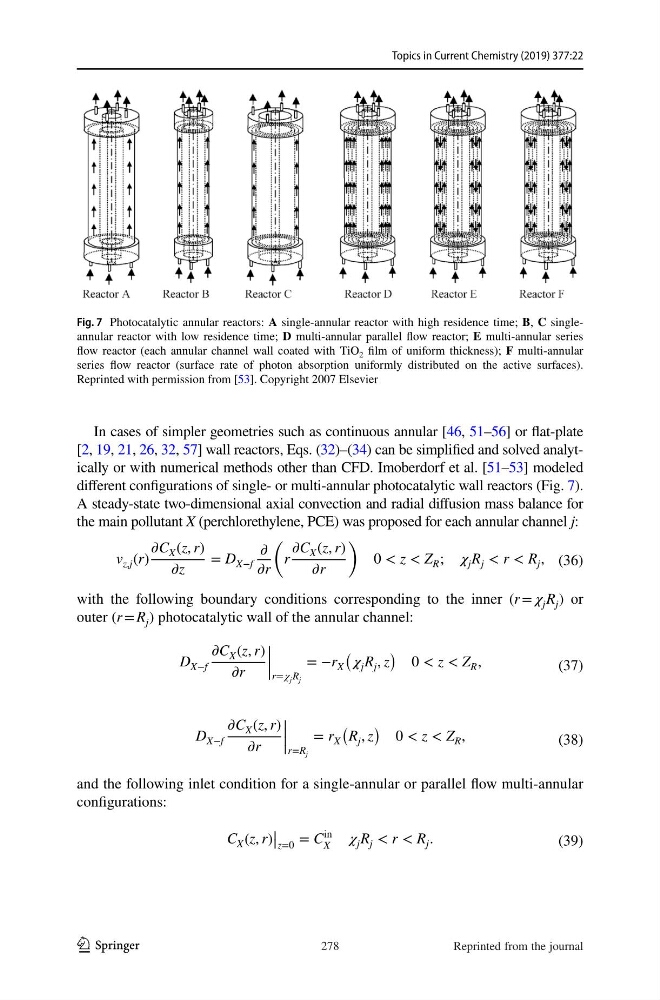
different configurations of single- or multi-annular photocatalytic wall reactors (Fig. 7).
A steady-state two-dimensional axial convection and radial diffusion mass balance for
the main pollutant X (perchlorethylene, PCE) was proposed for each annular channel j:
with the following boundary conditions corresponding to the inner (r = j R j ) or
outer (r = R j ) photocatalytic wall of the annular channel:
and the following inlet condition for a single-annular or parallel flow multi-annular
configurations:
(36)
v z,j (r)
í µí¼C X (z, r)
í µí¼z
= D X−f
í µí¼
í µí¼r
r
í µí¼C X (z, r)
í µí¼r
0 < z < Z R ; í µí¼ j R j < r < R j ,
(37)
D X−f
í µí¼C X (z, r)
í µí¼r
|
|
|
|r=í µí¼ j R j
= −r X
í µí¼ j R j , z
0 < z < Z R ,
(38)
D X−f
í µí¼C X (z, r)
í µí¼r
|
|
|
|r=R j
= r X
R j , z
0 < z < Z R ,
(39)
C X (z, r) |
|z=0 = C
in
X
í µí¼ j R j < r < R j .
Fig. 7 Photocatalytic annular reactors: A single-annular reactor with high residence time; B, C singleannular reactor with low residence time; D multi-annular parallel flow reactor; E multi-annular series
flow reactor (each annular channel wall coated with TiO 2 film of uniform thickness); F multi-annular
series flow reactor (surface rate of photon absorption uniformly distributed on the active surfaces).
Reprinted with permission from [53]. Copyright 2007 Elsevier
278
Reprinted from the journal
1 3
In cases of simpler geometries such as continuous annular [46, 51–56] or flat-plate
[2, 19, 21, 26, 32, 57] wall reactors, Eqs. (32)–(34) can be simplified and solved analytically or with numerical methods other than CFD. Imoberdorf et al. [51–53] modeled
different configurations of single- or multi-annular photocatalytic wall reactors (Fig. 7).
A steady-state two-dimensional axial convection and radial diffusion mass balance for
the main pollutant X (perchlorethylene, PCE) was proposed for each annular channel j:
with the following boundary conditions corresponding to the inner (r = j R j ) or
outer (r = R j ) photocatalytic wall of the annular channel:
and the following inlet condition for a single-annular or parallel flow multi-annular
configurations:
(36)
v z,j (r)
í µí¼C X (z, r)
í µí¼z
= D X−f
í µí¼
í µí¼r
r
í µí¼C X (z, r)
í µí¼r
0 < z < Z R ; í µí¼ j R j < r < R j ,
(37)
D X−f
í µí¼C X (z, r)
í µí¼r
|
|
|
|r=í µí¼ j R j
= −r X
í µí¼ j R j , z
0 < z < Z R ,
(38)
D X−f
í µí¼C X (z, r)
í µí¼r
|
|
|
|r=R j
= r X
R j , z
0 < z < Z R ,
(39)
C X (z, r) |
|z=0 = C
in
X
í µí¼ j R j < r < R j .
Fig. 7 Photocatalytic annular reactors: A single-annular reactor with high residence time; B, C singleannular reactor with low residence time; D multi-annular parallel flow reactor; E multi-annular series
flow reactor (each annular channel wall coated with TiO 2 film of uniform thickness); F multi-annular
series flow reactor (surface rate of photon absorption uniformly distributed on the active surfaces).
Reprinted with permission from [53]. Copyright 2007 Elsevier
278
Reprinted from the journal