

1 3
Topics in Current Chemistry (2019) 377:22
for the active sites during the adsorption process, but holes are trapped by hydroxyl
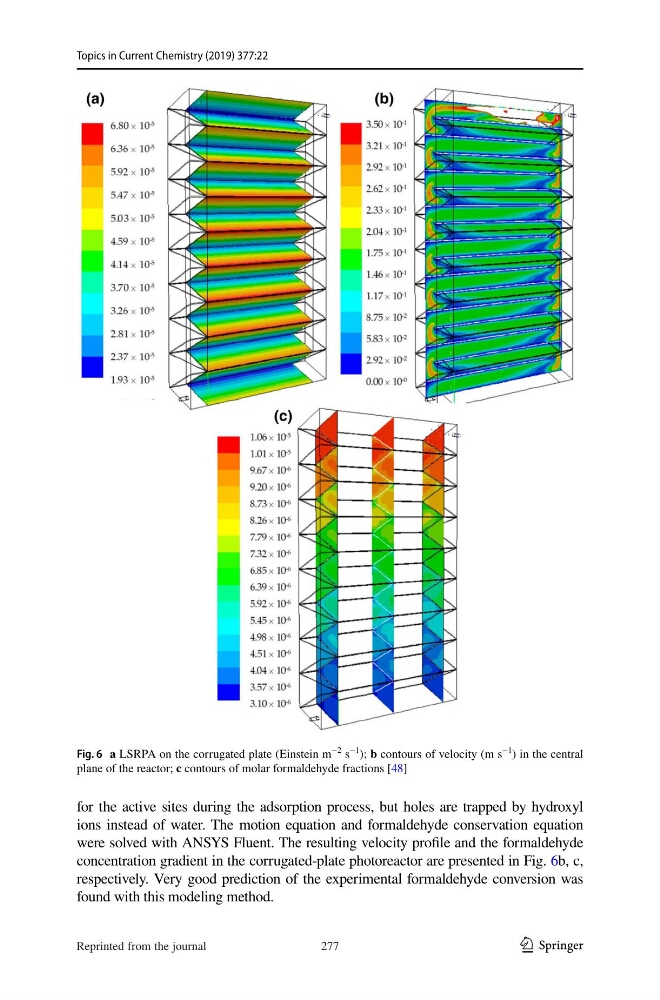
ions instead of water. The motion equation and formaldehyde conservation equation
were solved with ANSYS Fluent. The resulting velocity profile and the formaldehyde
concentration gradient in the corrugated-plate photoreactor are presented in Fig. 6b, c,
respectively. Very good prediction of the experimental formaldehyde conversion was
found with this modeling method.
Fig. 6 a LSRPA on the corrugated plate (Einstein m
−2 s
−1 ); b contours of velocity (m s
−1
) in the central
plane of the reactor; c contours of molar formaldehyde fractions [48]
277
Reprinted from the journal
Topics in Current Chemistry (2019) 377:22
for the active sites during the adsorption process, but holes are trapped by hydroxyl
ions instead of water. The motion equation and formaldehyde conservation equation
were solved with ANSYS Fluent. The resulting velocity profile and the formaldehyde
concentration gradient in the corrugated-plate photoreactor are presented in Fig. 6b, c,
respectively. Very good prediction of the experimental formaldehyde conversion was
found with this modeling method.
Fig. 6 a LSRPA on the corrugated plate (Einstein m
−2 s
−1 ); b contours of velocity (m s
−1
) in the central
plane of the reactor; c contours of molar formaldehyde fractions [48]
277
Reprinted from the journal