

1 3
Topics in Current Chemistry (2019) 377:22
2.1 Photocatalytic Kinetics in Liquid Phase
In liquid-phase reactions, pollutant oxidation can occur indirectly, through hydroxyl
radical attack, or through direct oxidation by photogenerated holes. The following
hypotheses are frequently considered in kinetic studies: (i) oxygen concentration is
constant, (ii) water or hydroxyl ion concentrations are constant, (iii) reactions occur
among adsorbed species, (iv) liquid–solid adsorption equilibrium is achieved, and
(v) there is no adsorption competition between water and other species [5].
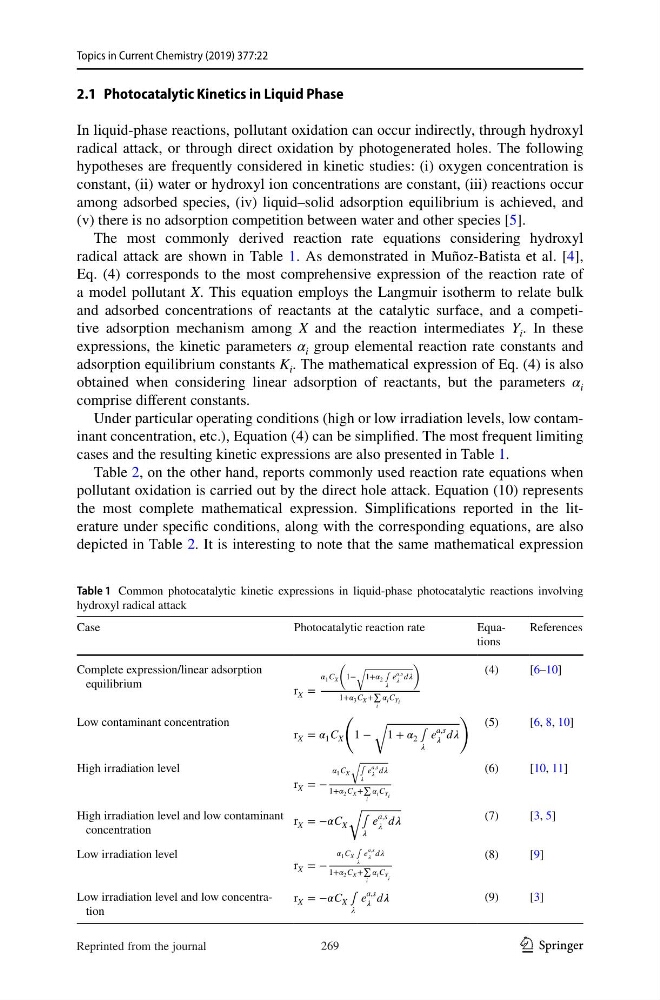
The most commonly derived reaction rate equations considering hydroxyl
radical attack are shown in Table 1. As demonstrated in Muñoz-Batista et al. [4],
Eq. (4) corresponds to the most comprehensive expression of the reaction rate of
a model pollutant X. This equation employs the Langmuir isotherm to relate bulk
and adsorbed concentrations of reactants at the catalytic surface, and a competitive adsorption mechanism among X and the reaction intermediates Y i . In these
expressions, the kinetic parameters α i group elemental reaction rate constants and
adsorption equilibrium constants K i . The mathematical expression of Eq. (4) is also
obtained when considering linear adsorption of reactants, but the parameters α i
comprise different constants.
Under particular operating conditions (high or low irradiation levels, low contaminant concentration, etc.), Equation (4) can be simplified. The most frequent limiting
cases and the resulting kinetic expressions are also presented in Table 1.
Table 2, on the other hand, reports commonly used reaction rate equations when
pollutant oxidation is carried out by the direct hole attack. Equation (10) represents
the most complete mathematical expression. Simplifications reported in the literature under specific conditions, along with the corresponding equations, are also
depicted in Table 2. It is interesting to note that the same mathematical expression
Table 1 Common photocatalytic kinetic expressions in liquid-phase photocatalytic reactions involving
hydroxyl radical attack
Case
Photocatalytic reaction rate
Equations
References
Complete expression/linear adsorption
equilibrium
r X =
1 C X
�
1−
�
1+ 2 ∫
e
a,s
d
�
1+ 3 C X +
∑
i
i C Y i
(4)
[6–10]
Low contaminant concentration
r X = 1 C X
1 −
√
1 + 2 ∫
e
a,s
d
(5)
[6, 8, 10]
High irradiation level
r X = −
1 C X
�
∫
e
a,s
d
1+ 2 C X +
∑
i
i C Y i
(6)
[10, 11]
High irradiation level and low contaminant
concentration
r X = −C X
√
∫
e
a,s
d
(7)
[3, 5]
Low irradiation level
r X = −
1 C X ∫
e
a,s
d
1+ 2 C X +
∑
i
i C Y i
(8)
[9]
Low irradiation level and low concentration
r X = −C X ∫
e
a,s
d
(9)
[3]
269
Reprinted from the journal
Topics in Current Chemistry (2019) 377:22
2.1 Photocatalytic Kinetics in Liquid Phase
In liquid-phase reactions, pollutant oxidation can occur indirectly, through hydroxyl
radical attack, or through direct oxidation by photogenerated holes. The following
hypotheses are frequently considered in kinetic studies: (i) oxygen concentration is
constant, (ii) water or hydroxyl ion concentrations are constant, (iii) reactions occur
among adsorbed species, (iv) liquid–solid adsorption equilibrium is achieved, and
(v) there is no adsorption competition between water and other species [5].
The most commonly derived reaction rate equations considering hydroxyl
radical attack are shown in Table 1. As demonstrated in Muñoz-Batista et al. [4],
Eq. (4) corresponds to the most comprehensive expression of the reaction rate of
a model pollutant X. This equation employs the Langmuir isotherm to relate bulk
and adsorbed concentrations of reactants at the catalytic surface, and a competitive adsorption mechanism among X and the reaction intermediates Y i . In these
expressions, the kinetic parameters α i group elemental reaction rate constants and
adsorption equilibrium constants K i . The mathematical expression of Eq. (4) is also
obtained when considering linear adsorption of reactants, but the parameters α i
comprise different constants.
Under particular operating conditions (high or low irradiation levels, low contaminant concentration, etc.), Equation (4) can be simplified. The most frequent limiting
cases and the resulting kinetic expressions are also presented in Table 1.
Table 2, on the other hand, reports commonly used reaction rate equations when
pollutant oxidation is carried out by the direct hole attack. Equation (10) represents
the most complete mathematical expression. Simplifications reported in the literature under specific conditions, along with the corresponding equations, are also
depicted in Table 2. It is interesting to note that the same mathematical expression
Table 1 Common photocatalytic kinetic expressions in liquid-phase photocatalytic reactions involving
hydroxyl radical attack
Case
Photocatalytic reaction rate
Equations
References
Complete expression/linear adsorption
equilibrium
r X =
1 C X
�
1−
�
1+ 2 ∫
e
a,s
d
�
1+ 3 C X +
∑
i
i C Y i
(4)
[6–10]
Low contaminant concentration
r X = 1 C X
1 −
√
1 + 2 ∫
e
a,s
d
(5)
[6, 8, 10]
High irradiation level
r X = −
1 C X
�
∫
e
a,s
d
1+ 2 C X +
∑
i
i C Y i
(6)
[10, 11]
High irradiation level and low contaminant
concentration
r X = −C X
√
∫
e
a,s
d
(7)
[3, 5]
Low irradiation level
r X = −
1 C X ∫
e
a,s
d
1+ 2 C X +
∑
i
i C Y i
(8)
[9]
Low irradiation level and low concentration
r X = −C X ∫
e
a,s
d
(9)
[3]
269
Reprinted from the journal