

Topics in Current Chemistry (2019) 377:22
1 3
equations can, in certain cases, matches with commonly used empirical reaction rate
expressions.
Photocatalytic oxidation reactions start with the activation of the catalyst (a solid
semiconductor) by absorption of radiation of a certain wavelength and energy. When
the semiconductor energy band gap is exceeded, electron–hole pairs are generated
in the solid particles of the catalyst and migrate to the surface, where (i) adsorbed
water or hydroxyl ions can trap holes, generating hydroxyl radicals; (ii) adsorbed
molecular oxygen can trap electrons, producing the superoxide radical anion; or (iii)
the photogenerated electron–hole pairs can recombine, releasing heat.
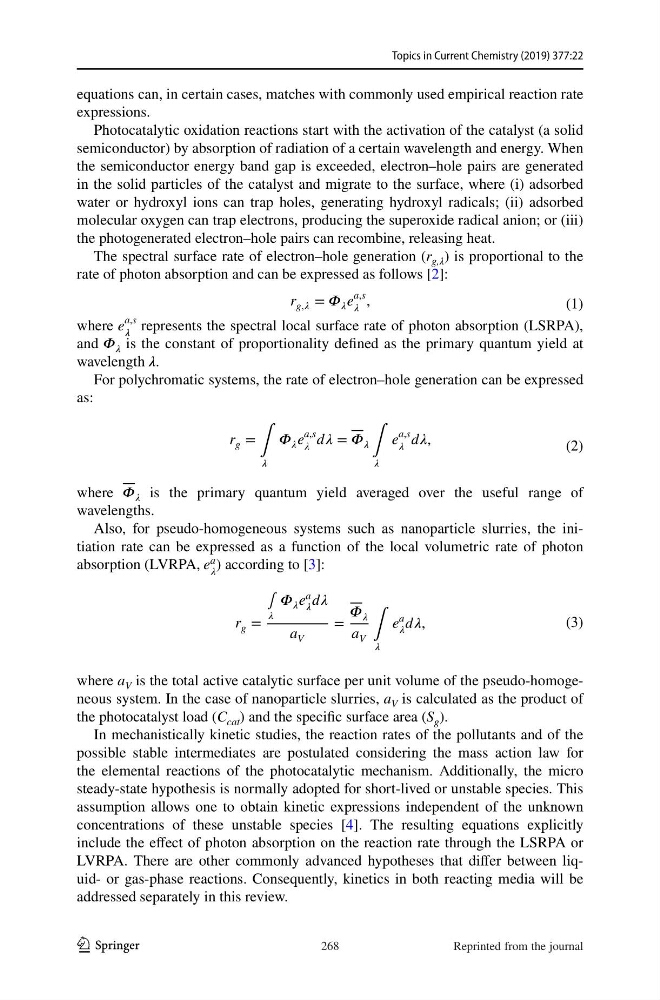
The spectral surface rate of electron–hole generation (r g,λ ) is proportional to the
rate of photon absorption and can be expressed as follows [2]:
where e
a,s
represents the spectral local surface rate of photon absorption (LSRPA),
and is the constant of proportionality defined as the primary quantum yield at
wavelength .
For polychromatic systems, the rate of electron–hole generation can be expressed
as:
where is the primary quantum yield averaged over the useful range of
wavelengths.
Also, for pseudo-homogeneous systems such as nanoparticle slurries, the initiation rate can be expressed as a function of the local volumetric rate of photon
absorption (LVRPA, e
a
) according to [3]:
where a V is the total active catalytic surface per unit volume of the pseudo-homogeneous system. In the case of nanoparticle slurries, a V is calculated as the product of
the photocatalyst load (C cat ) and the specific surface area (S g ).
In mechanistically kinetic studies, the reaction rates of the pollutants and of the
possible stable intermediates are postulated considering the mass action law for
the elemental reactions of the photocatalytic mechanism. Additionally, the micro
steady-state hypothesis is normally adopted for short-lived or unstable species. This
assumption allows one to obtain kinetic expressions independent of the unknown
concentrations of these unstable species [4]. The resulting equations explicitly
include the effect of photon absorption on the reaction rate through the LSRPA or
LVRPA. There are other commonly advanced hypotheses that differ between liquid- or gas-phase reactions. Consequently, kinetics in both reacting media will be
addressed separately in this review.
(1)
r g, = e
a,s
,
(2)
r g = ∫
e
a,s
d = ∫
e
a,s
d,
(3)
r g =
∫
e
a
d
a V
=
a V �
e
a
d,
268
Reprinted from the journal
1 3
equations can, in certain cases, matches with commonly used empirical reaction rate
expressions.
Photocatalytic oxidation reactions start with the activation of the catalyst (a solid
semiconductor) by absorption of radiation of a certain wavelength and energy. When
the semiconductor energy band gap is exceeded, electron–hole pairs are generated
in the solid particles of the catalyst and migrate to the surface, where (i) adsorbed
water or hydroxyl ions can trap holes, generating hydroxyl radicals; (ii) adsorbed
molecular oxygen can trap electrons, producing the superoxide radical anion; or (iii)
the photogenerated electron–hole pairs can recombine, releasing heat.
The spectral surface rate of electron–hole generation (r g,λ ) is proportional to the
rate of photon absorption and can be expressed as follows [2]:
where e
a,s
represents the spectral local surface rate of photon absorption (LSRPA),
and is the constant of proportionality defined as the primary quantum yield at
wavelength .
For polychromatic systems, the rate of electron–hole generation can be expressed
as:
where is the primary quantum yield averaged over the useful range of
wavelengths.
Also, for pseudo-homogeneous systems such as nanoparticle slurries, the initiation rate can be expressed as a function of the local volumetric rate of photon
absorption (LVRPA, e
a
) according to [3]:
where a V is the total active catalytic surface per unit volume of the pseudo-homogeneous system. In the case of nanoparticle slurries, a V is calculated as the product of
the photocatalyst load (C cat ) and the specific surface area (S g ).
In mechanistically kinetic studies, the reaction rates of the pollutants and of the
possible stable intermediates are postulated considering the mass action law for
the elemental reactions of the photocatalytic mechanism. Additionally, the micro
steady-state hypothesis is normally adopted for short-lived or unstable species. This
assumption allows one to obtain kinetic expressions independent of the unknown
concentrations of these unstable species [4]. The resulting equations explicitly
include the effect of photon absorption on the reaction rate through the LSRPA or
LVRPA. There are other commonly advanced hypotheses that differ between liquid- or gas-phase reactions. Consequently, kinetics in both reacting media will be
addressed separately in this review.
(1)
r g, = e
a,s
,
(2)
r g = ∫
e
a,s
d = ∫
e
a,s
d,
(3)
r g =
∫
e
a
d
a V
=
a V �
e
a
d,
268
Reprinted from the journal