

Topics in Current Chemistry (2020) 378:7
1 3
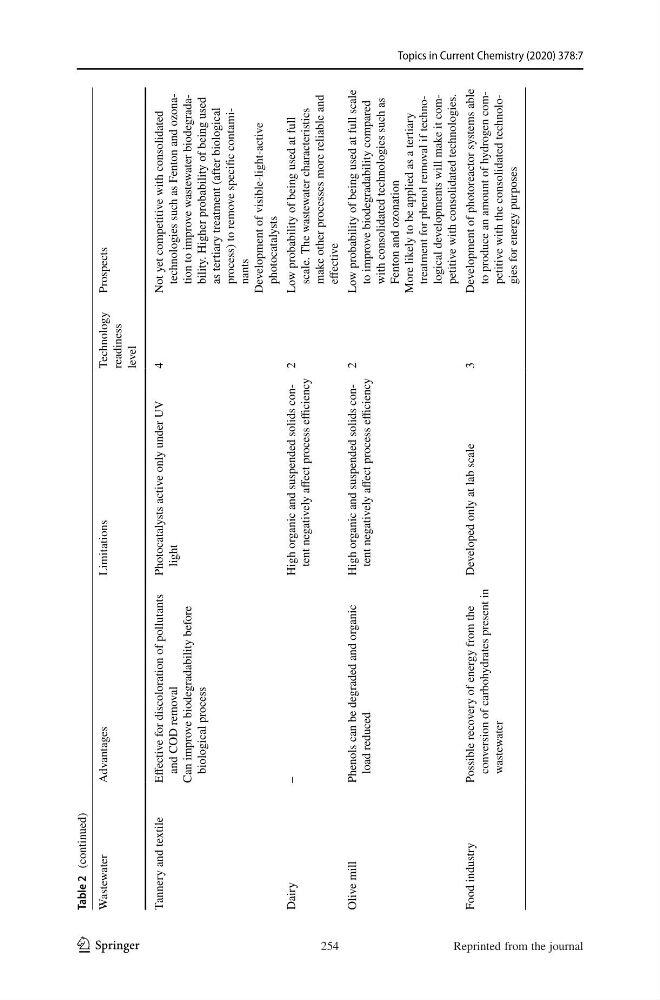
Table 2
(continued)
Wastewater
Advantages
Limitations
Technology
readiness
level
Prospects
Tannery and textile
Effective for discoloration of pollutants
and COD removal
Can improve biodegradability before
biological process
Photocatalysts active only under UV
light
4
Not yet competitive with consolidated
technologies such as Fenton and ozonation to improve wastewater biodegradability. Higher probability of being used
as tertiary treatment (after biological
process) to remove specific contaminants
Development of visible-light-active
photocatalysts
Dairy
–
High organic and suspended solids content negatively affect process efficiency
2
Low probability of being used at full
scale. The wastewater characteristics
make other processes more reliable and
effective
Olive mill
Phenols can be degraded and organic
load reduced
High organic and suspended solids content negatively affect process efficiency
2
Low probability of being used at full scale
to improve biodegradability compared
with consolidated technologies such as
Fenton and ozonation
More likely to be applied as a tertiary
treatment for phenol removal if technological developments will make it competitive with consolidated technologies.
Food industry
Possible recovery of energy from the
conversion of carbohydrates present in
wastewater
Developed only at lab scale
3
Development of photoreactor systems able
to produce an amount of hydrogen competitive with the consolidated technologies for energy purposes
254
Reprinted from the journal
1 3
Table 2
(continued)
Wastewater
Advantages
Limitations
Technology
readiness
level
Prospects
Tannery and textile
Effective for discoloration of pollutants
and COD removal
Can improve biodegradability before
biological process
Photocatalysts active only under UV
light
4
Not yet competitive with consolidated
technologies such as Fenton and ozonation to improve wastewater biodegradability. Higher probability of being used
as tertiary treatment (after biological
process) to remove specific contaminants
Development of visible-light-active
photocatalysts
Dairy
–
High organic and suspended solids content negatively affect process efficiency
2
Low probability of being used at full
scale. The wastewater characteristics
make other processes more reliable and
effective
Olive mill
Phenols can be degraded and organic
load reduced
High organic and suspended solids content negatively affect process efficiency
2
Low probability of being used at full scale
to improve biodegradability compared
with consolidated technologies such as
Fenton and ozonation
More likely to be applied as a tertiary
treatment for phenol removal if technological developments will make it competitive with consolidated technologies.
Food industry
Possible recovery of energy from the
conversion of carbohydrates present in
wastewater
Developed only at lab scale
3
Development of photoreactor systems able
to produce an amount of hydrogen competitive with the consolidated technologies for energy purposes
254
Reprinted from the journal