

1 3
Topics in Current Chemistry (2020) 378:7
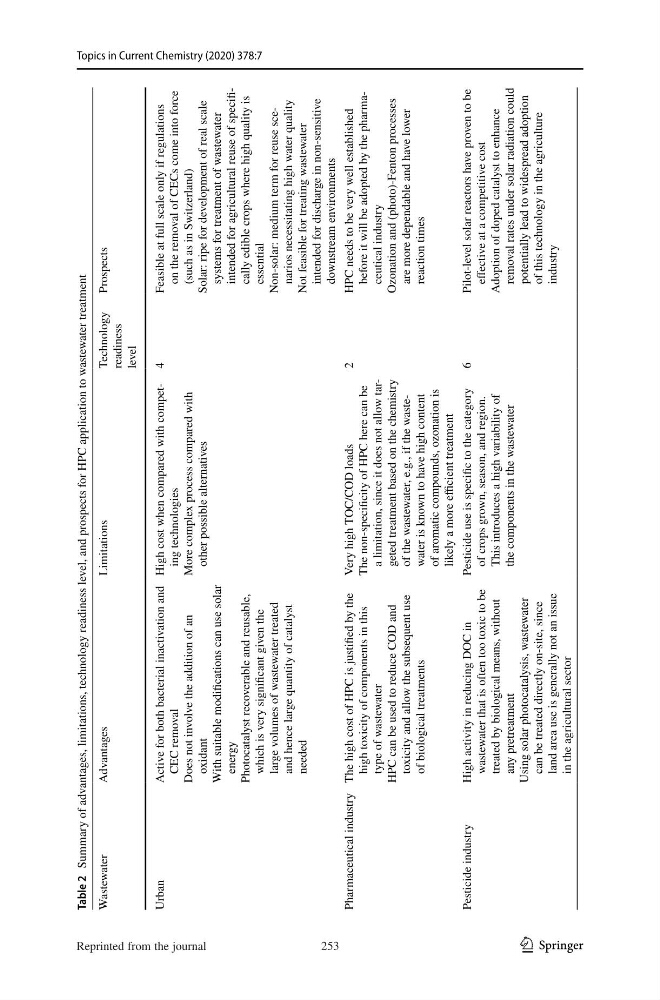
Table 2
Summary of advantages, limitations, technology readiness level, and prospects for HPC application to wastewater treatment
Wastewater
Advantages
Limitations
Technology
readiness
level
Prospects
Urban
Active for both bacterial inactivation and
CEC removal
Does not involve the addition of an
oxidant
With suitable modifications can use solar
energy
Photocatalyst recoverable and reusable,
which is very significant given the
large volumes of wastewater treated
and hence large quantity of catalyst
needed
High cost when compared with competing technologies
More complex process compared with
other possible alternatives
4
Feasible at full scale only if regulations
on the removal of CECs come into force
(such as in Switzerland)
Solar: ripe for development of real scale
systems for treatment of wastewater
intended for agricultural reuse of specifically edible crops where high quality is
essential
Non-solar: medium term for reuse scenarios necessitating high water quality
Not feasible for treating wastewater
intended for discharge in non-sensitive
downstream environments
Pharmaceutical industry The high cost of HPC is justified by the
high toxicity of components in this
type of wastewater
HPC can be used to reduce COD and
toxicity and allow the subsequent use
of biological treatments
Very high TOC/COD loads
The non-specificity of HPC here can be
a limitation, since it does not allow targeted treatment based on the chemistry
of the wastewater, e.g., if the wastewater is known to have high content
of aromatic compounds, ozonation is
likely a more efficient treatment
2
HPC needs to be very well established
before it will be adopted by the pharmaceutical industry
Ozonation and (photo)-Fenton processes
are more dependable and have lower
reaction times
Pesticide industry
High activity in reducing DOC in
wastewater that is often too toxic to be
treated by biological means, without
any pretreatment
Using solar photocatalysis, wastewater
can be treated directly on-site, since
land area use is generally not an issue
in the agricultural sector
Pesticide use is specific to the category
of crops grown, season, and region.
This introduces a high variability of
the components in the wastewater
6
Pilot-level solar reactors have proven to be
effective at a competitive cost
Adoption of doped catalyst to enhance
removal rates under solar radiation could
potentially lead to widespread adoption
of this technology in the agriculture
industry
253
Reprinted from the journal
Topics in Current Chemistry (2020) 378:7
Table 2
Summary of advantages, limitations, technology readiness level, and prospects for HPC application to wastewater treatment
Wastewater
Advantages
Limitations
Technology
readiness
level
Prospects
Urban
Active for both bacterial inactivation and
CEC removal
Does not involve the addition of an
oxidant
With suitable modifications can use solar
energy
Photocatalyst recoverable and reusable,
which is very significant given the
large volumes of wastewater treated
and hence large quantity of catalyst
needed
High cost when compared with competing technologies
More complex process compared with
other possible alternatives
4
Feasible at full scale only if regulations
on the removal of CECs come into force
(such as in Switzerland)
Solar: ripe for development of real scale
systems for treatment of wastewater
intended for agricultural reuse of specifically edible crops where high quality is
essential
Non-solar: medium term for reuse scenarios necessitating high water quality
Not feasible for treating wastewater
intended for discharge in non-sensitive
downstream environments
Pharmaceutical industry The high cost of HPC is justified by the
high toxicity of components in this
type of wastewater
HPC can be used to reduce COD and
toxicity and allow the subsequent use
of biological treatments
Very high TOC/COD loads
The non-specificity of HPC here can be
a limitation, since it does not allow targeted treatment based on the chemistry
of the wastewater, e.g., if the wastewater is known to have high content
of aromatic compounds, ozonation is
likely a more efficient treatment
2
HPC needs to be very well established
before it will be adopted by the pharmaceutical industry
Ozonation and (photo)-Fenton processes
are more dependable and have lower
reaction times
Pesticide industry
High activity in reducing DOC in
wastewater that is often too toxic to be
treated by biological means, without
any pretreatment
Using solar photocatalysis, wastewater
can be treated directly on-site, since
land area use is generally not an issue
in the agricultural sector
Pesticide use is specific to the category
of crops grown, season, and region.
This introduces a high variability of
the components in the wastewater
6
Pilot-level solar reactors have proven to be
effective at a competitive cost
Adoption of doped catalyst to enhance
removal rates under solar radiation could
potentially lead to widespread adoption
of this technology in the agriculture
industry
253
Reprinted from the journal