

1 3
Topics in Current Chemistry (2020) 378:3
carbon modified the surface of ZnO, generating a large number of oxygen vacancies,
and hence LC/ZnO was found to be positively charged. RhB, positively charged in
water, was consequently firmly adsorbed on the surface of the lignin-based carbon
due to the electrostatic adsorption between the positive and negative charges. Such
electrostatic interaction hindered the movement of positive RhB toward the surface
of ZnO, where it would be degraded. In turn, MO, negatively charged in water, did
not interact with the lignin-based carbon, easily passing to the surface of ZnO to be
directly degraded. The reported photocatalyst with selective degradation of positive
and negative organic dyes may have great application prospects for photoelectric
conversion and catalysis [91].
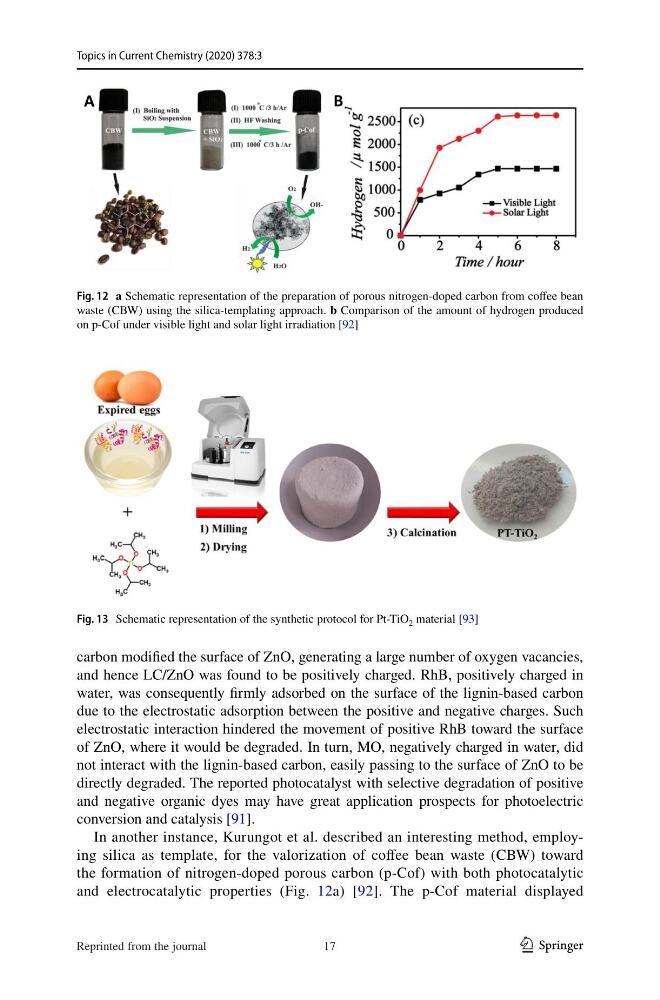
In another instance, Kurungot et al. described an interesting method, employing silica as template, for the valorization of coffee bean waste (CBW) toward
the formation of nitrogen-doped porous carbon (p-Cof) with both photocatalytic
and electrocatalytic properties (Fig. 12a) [92]. The p-Cof material displayed
Fig. 12 a Schematic representation of the preparation of porous nitrogen-doped carbon from coffee bean
waste (CBW) using the silica-templating approach. b Comparison of the amount of hydrogen produced
on p-Cof under visible light and solar light irradiation [92]
Fig. 13 Schematic representation of the synthetic protocol for Pt-TiO 2 material [93]
17
Reprinted from the journal
Topics in Current Chemistry (2020) 378:3
carbon modified the surface of ZnO, generating a large number of oxygen vacancies,
and hence LC/ZnO was found to be positively charged. RhB, positively charged in
water, was consequently firmly adsorbed on the surface of the lignin-based carbon
due to the electrostatic adsorption between the positive and negative charges. Such
electrostatic interaction hindered the movement of positive RhB toward the surface
of ZnO, where it would be degraded. In turn, MO, negatively charged in water, did
not interact with the lignin-based carbon, easily passing to the surface of ZnO to be
directly degraded. The reported photocatalyst with selective degradation of positive
and negative organic dyes may have great application prospects for photoelectric
conversion and catalysis [91].
In another instance, Kurungot et al. described an interesting method, employing silica as template, for the valorization of coffee bean waste (CBW) toward
the formation of nitrogen-doped porous carbon (p-Cof) with both photocatalytic
and electrocatalytic properties (Fig. 12a) [92]. The p-Cof material displayed
Fig. 12 a Schematic representation of the preparation of porous nitrogen-doped carbon from coffee bean
waste (CBW) using the silica-templating approach. b Comparison of the amount of hydrogen produced
on p-Cof under visible light and solar light irradiation [92]
Fig. 13 Schematic representation of the synthetic protocol for Pt-TiO 2 material [93]
17
Reprinted from the journal