

1 3
Topics in Current Chemistry (2020) 378:7
Fixing the rate of oxidant to the [DOC] (concentration of DOC) thus aids in
stabilizing the reaction rate.
The performance of the catalyst in the application of HPC to water/wastewater treatment peaks at a certain catalyst load. A further increase in catalyst
loading would be counterproductive, resulting in reduced efficiency due to the
increased opacity of the aqueous matrix. Other factors such as light intensity can
be increased, but only up to a certain threshold of saturation. Additionally, commonly used low-pressure mercury lamps are not dimmable, and increasing the
intensity would require increasing the number of active bulbs. Moreover, adsorption and electrostatic forces should not be underestimated in heterogeneous photocatalytic process. HPC involves reaction between two materials in different
states of matter, and pollutant adsorption on the surface of the catalyst has a drastic effect on removal efficiency. This is because radicals are generated at the semiconductor–water interface, and these species have a very short half-life due to
their very high reactivity. Having compounds adsorbed at the site of radical generation increases the probability of reaction of these radicals with the adsorbed
species. This is also applicable for HPC for water disinfection, as E. coli and other
Gram-negative bacteria are negatively charged due to the ionized phosphoryl and
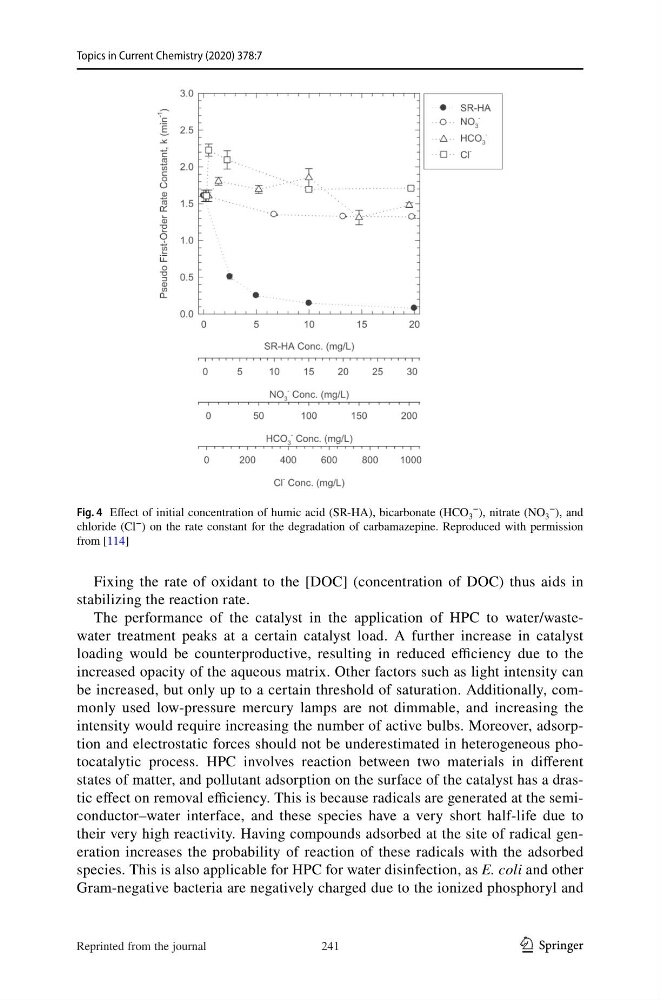
Fig. 4 Effect of initial concentration of humic acid (SR-HA), bicarbonate (HCO 3
− ), nitrate (NO 3
− ), and
chloride (Cl
−
) on the rate constant for the degradation of carbamazepine. Reproduced with permission
from [114]
241
Reprinted from the journal
Topics in Current Chemistry (2020) 378:7
Fixing the rate of oxidant to the [DOC] (concentration of DOC) thus aids in
stabilizing the reaction rate.
The performance of the catalyst in the application of HPC to water/wastewater treatment peaks at a certain catalyst load. A further increase in catalyst
loading would be counterproductive, resulting in reduced efficiency due to the
increased opacity of the aqueous matrix. Other factors such as light intensity can
be increased, but only up to a certain threshold of saturation. Additionally, commonly used low-pressure mercury lamps are not dimmable, and increasing the
intensity would require increasing the number of active bulbs. Moreover, adsorption and electrostatic forces should not be underestimated in heterogeneous photocatalytic process. HPC involves reaction between two materials in different
states of matter, and pollutant adsorption on the surface of the catalyst has a drastic effect on removal efficiency. This is because radicals are generated at the semiconductor–water interface, and these species have a very short half-life due to
their very high reactivity. Having compounds adsorbed at the site of radical generation increases the probability of reaction of these radicals with the adsorbed
species. This is also applicable for HPC for water disinfection, as E. coli and other
Gram-negative bacteria are negatively charged due to the ionized phosphoryl and
Fig. 4 Effect of initial concentration of humic acid (SR-HA), bicarbonate (HCO 3
− ), nitrate (NO 3
− ), and
chloride (Cl
−
) on the rate constant for the degradation of carbamazepine. Reproduced with permission
from [114]
241
Reprinted from the journal