

Topics in Current Chemistry (2020) 378:7
1 3
current requirements. The need to achieve higher requirements could outweigh
the limitations of HPC when compared with other available treatments, especially
when considering degradation of organic chemical pollutants, toxic disinfection
by-product formation, and antibiotic resistance concerns in wastewater reuse.
4.1.2 Variability in Wastewater Loads and Its Effect on Treatment
As for challenges of a technical nature, the variability in wastewater in terms of organic
contaminant load (COD/DOC) has major effects on the process and the duration
required for treatment. ROS generated by photocatalysis, such as hydroxyl radicals,
are highly reactive but also highly unselective. This translates to reactions between any
form of organic matter, whether harmless humic acids or chemical pollutants that are
the target of the treatment. Choi et al. measured the pseudo-first-order rate constants of
degradation for acetaminophen and carbamazepine in distilled water and real wastewater from different wastewater treatment plants (WWTPs) having different DOC loads
[114]. Relative to distilled water, i.e., where DOC is entirely due to the contaminants
of interest, real wastewater showed slower degradation of these two drugs by factors
of 3–6. While concentrations of ions such as bicarbonate, chloride, and nitrate in low
milligrams-per-liter quantities have a negligible effect on the rate constant, humic acid
load drastically reduces the rate of removal (Fig. 4). It should also be noted that slowing
of removal kinetics is not linear with DOC load, but rather plateaus after a certain load
DOC [114].
The rate constants of hydroxyl radicals, the dominant radical in HPC, with most
organic compounds approach the theoretical maximum imposed by diffusion-controlled reaction kinetics [115]. This means that while there are differences in reactivity
between different organic compounds in water, these differences tend to be mostly of
the same order of magnitude (log k OH 9.5 ± 1) [116]. As CECs occur at concentrations
many orders of magnitude lower than interfering substances, but both have a rate constant within one order of magnitude, this results in a very small fraction of the ROS
probabilistically reacting with CECs as dictated by competitive kinetics between the
ROS formed and organic compounds in the water phase. The reduction in the rate of
pollutant removal due to high contaminant load and/or the presence of scavengers is a
well-established fact [117]. However, such an interfering effect can be overcome to a
certain extent in some AOPs, such as ozonation or UVC/H 2 O 2 , where the concentration of the oxidant can be increased to achieve a suitable ratio between oxidant and
total DOC load. By increasing the oxidant load (ozone, hydrogen peroxide, etc.), the
concentration of hydroxyl radicals increases, yield a higher rate. The rate constant (k) is
not affected by the concentration of reactants; thus, at the same temperature, increasing
the concentration of the reactants increases the overall reaction rate of both CECs and
DOC (since they compete for reaction with ·OH as per Eqs. 2 and 3).
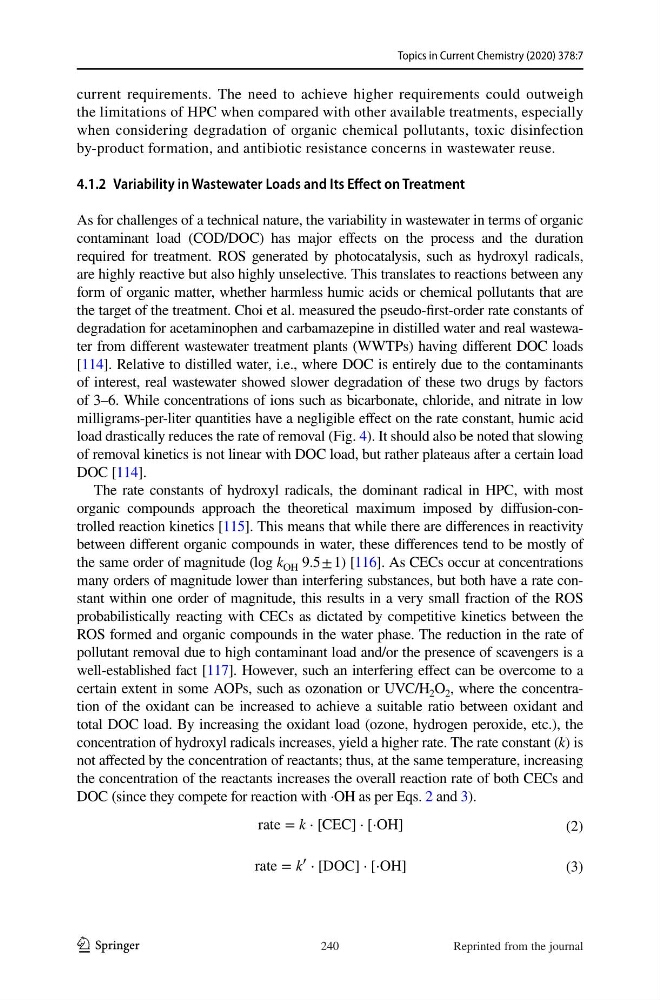
(2)
rate = k ⋅ [CEC] ⋅ [⋅OH]
(3)
rate = k
�
⋅ [DOC] ⋅ [⋅OH]
240
Reprinted from the journal
1 3
current requirements. The need to achieve higher requirements could outweigh
the limitations of HPC when compared with other available treatments, especially
when considering degradation of organic chemical pollutants, toxic disinfection
by-product formation, and antibiotic resistance concerns in wastewater reuse.
4.1.2 Variability in Wastewater Loads and Its Effect on Treatment
As for challenges of a technical nature, the variability in wastewater in terms of organic
contaminant load (COD/DOC) has major effects on the process and the duration
required for treatment. ROS generated by photocatalysis, such as hydroxyl radicals,
are highly reactive but also highly unselective. This translates to reactions between any
form of organic matter, whether harmless humic acids or chemical pollutants that are
the target of the treatment. Choi et al. measured the pseudo-first-order rate constants of
degradation for acetaminophen and carbamazepine in distilled water and real wastewater from different wastewater treatment plants (WWTPs) having different DOC loads
[114]. Relative to distilled water, i.e., where DOC is entirely due to the contaminants
of interest, real wastewater showed slower degradation of these two drugs by factors
of 3–6. While concentrations of ions such as bicarbonate, chloride, and nitrate in low
milligrams-per-liter quantities have a negligible effect on the rate constant, humic acid
load drastically reduces the rate of removal (Fig. 4). It should also be noted that slowing
of removal kinetics is not linear with DOC load, but rather plateaus after a certain load
DOC [114].
The rate constants of hydroxyl radicals, the dominant radical in HPC, with most
organic compounds approach the theoretical maximum imposed by diffusion-controlled reaction kinetics [115]. This means that while there are differences in reactivity
between different organic compounds in water, these differences tend to be mostly of
the same order of magnitude (log k OH 9.5 ± 1) [116]. As CECs occur at concentrations
many orders of magnitude lower than interfering substances, but both have a rate constant within one order of magnitude, this results in a very small fraction of the ROS
probabilistically reacting with CECs as dictated by competitive kinetics between the
ROS formed and organic compounds in the water phase. The reduction in the rate of
pollutant removal due to high contaminant load and/or the presence of scavengers is a
well-established fact [117]. However, such an interfering effect can be overcome to a
certain extent in some AOPs, such as ozonation or UVC/H 2 O 2 , where the concentration of the oxidant can be increased to achieve a suitable ratio between oxidant and
total DOC load. By increasing the oxidant load (ozone, hydrogen peroxide, etc.), the
concentration of hydroxyl radicals increases, yield a higher rate. The rate constant (k) is
not affected by the concentration of reactants; thus, at the same temperature, increasing
the concentration of the reactants increases the overall reaction rate of both CECs and
DOC (since they compete for reaction with ·OH as per Eqs. 2 and 3).
(2)
rate = k ⋅ [CEC] ⋅ [⋅OH]
(3)
rate = k
�
⋅ [DOC] ⋅ [⋅OH]
240
Reprinted from the journal