

Topics in Current Chemistry (2020) 378:7
1 3
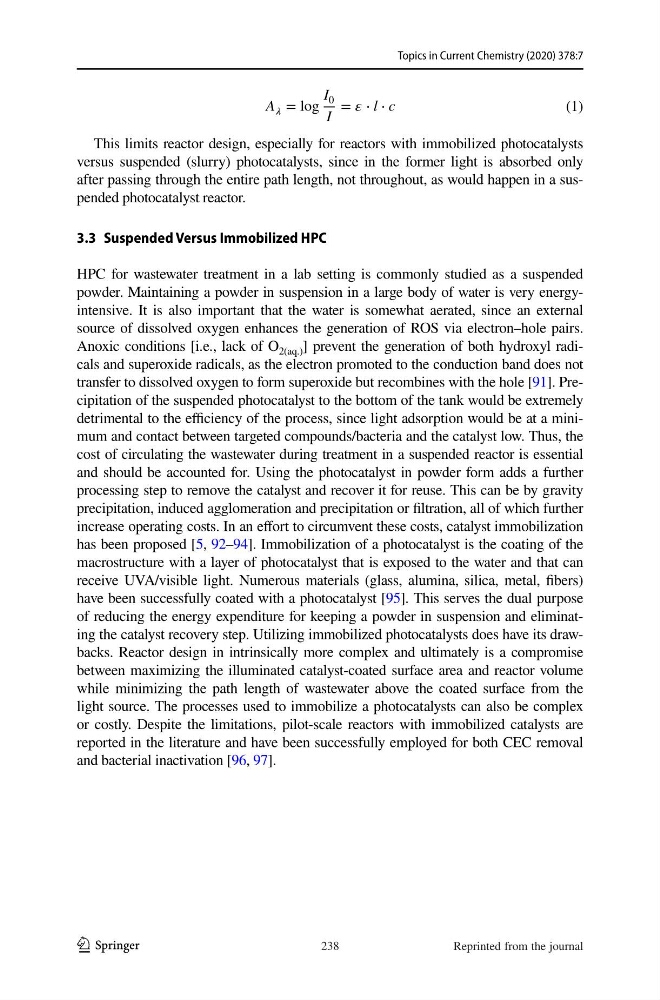
This limits reactor design, especially for reactors with immobilized photocatalysts
versus suspended (slurry) photocatalysts, since in the former light is absorbed only
after passing through the entire path length, not throughout, as would happen in a suspended photocatalyst reactor.
3.3 Suspended Versus Immobilized HPC
HPC for wastewater treatment in a lab setting is commonly studied as a suspended
powder. Maintaining a powder in suspension in a large body of water is very energyintensive. It is also important that the water is somewhat aerated, since an external
source of dissolved oxygen enhances the generation of ROS via electron–hole pairs.
Anoxic conditions [i.e., lack of O 2(aq.) ] prevent the generation of both hydroxyl radicals and superoxide radicals, as the electron promoted to the conduction band does not
transfer to dissolved oxygen to form superoxide but recombines with the hole [91]. Precipitation of the suspended photocatalyst to the bottom of the tank would be extremely
detrimental to the efficiency of the process, since light adsorption would be at a minimum and contact between targeted compounds/bacteria and the catalyst low. Thus, the
cost of circulating the wastewater during treatment in a suspended reactor is essential
and should be accounted for. Using the photocatalyst in powder form adds a further
processing step to remove the catalyst and recover it for reuse. This can be by gravity
precipitation, induced agglomeration and precipitation or filtration, all of which further
increase operating costs. In an effort to circumvent these costs, catalyst immobilization
has been proposed [5, 92–94]. Immobilization of a photocatalyst is the coating of the
macrostructure with a layer of photocatalyst that is exposed to the water and that can
receive UVA/visible light. Numerous materials (glass, alumina, silica, metal, fibers)
have been successfully coated with a photocatalyst [95]. This serves the dual purpose
of reducing the energy expenditure for keeping a powder in suspension and eliminating the catalyst recovery step. Utilizing immobilized photocatalysts does have its drawbacks. Reactor design in intrinsically more complex and ultimately is a compromise
between maximizing the illuminated catalyst-coated surface area and reactor volume
while minimizing the path length of wastewater above the coated surface from the
light source. The processes used to immobilize a photocatalysts can also be complex
or costly. Despite the limitations, pilot-scale reactors with immobilized catalysts are
reported in the literature and have been successfully employed for both CEC removal
and bacterial inactivation [96, 97].
(1)
A = log
I 0
I
= ⋅ l ⋅ c
238
Reprinted from the journal
1 3
This limits reactor design, especially for reactors with immobilized photocatalysts
versus suspended (slurry) photocatalysts, since in the former light is absorbed only
after passing through the entire path length, not throughout, as would happen in a suspended photocatalyst reactor.
3.3 Suspended Versus Immobilized HPC
HPC for wastewater treatment in a lab setting is commonly studied as a suspended
powder. Maintaining a powder in suspension in a large body of water is very energyintensive. It is also important that the water is somewhat aerated, since an external
source of dissolved oxygen enhances the generation of ROS via electron–hole pairs.
Anoxic conditions [i.e., lack of O 2(aq.) ] prevent the generation of both hydroxyl radicals and superoxide radicals, as the electron promoted to the conduction band does not
transfer to dissolved oxygen to form superoxide but recombines with the hole [91]. Precipitation of the suspended photocatalyst to the bottom of the tank would be extremely
detrimental to the efficiency of the process, since light adsorption would be at a minimum and contact between targeted compounds/bacteria and the catalyst low. Thus, the
cost of circulating the wastewater during treatment in a suspended reactor is essential
and should be accounted for. Using the photocatalyst in powder form adds a further
processing step to remove the catalyst and recover it for reuse. This can be by gravity
precipitation, induced agglomeration and precipitation or filtration, all of which further
increase operating costs. In an effort to circumvent these costs, catalyst immobilization
has been proposed [5, 92–94]. Immobilization of a photocatalyst is the coating of the
macrostructure with a layer of photocatalyst that is exposed to the water and that can
receive UVA/visible light. Numerous materials (glass, alumina, silica, metal, fibers)
have been successfully coated with a photocatalyst [95]. This serves the dual purpose
of reducing the energy expenditure for keeping a powder in suspension and eliminating the catalyst recovery step. Utilizing immobilized photocatalysts does have its drawbacks. Reactor design in intrinsically more complex and ultimately is a compromise
between maximizing the illuminated catalyst-coated surface area and reactor volume
while minimizing the path length of wastewater above the coated surface from the
light source. The processes used to immobilize a photocatalysts can also be complex
or costly. Despite the limitations, pilot-scale reactors with immobilized catalysts are
reported in the literature and have been successfully employed for both CEC removal
and bacterial inactivation [96, 97].
(1)
A = log
I 0
I
= ⋅ l ⋅ c
238
Reprinted from the journal