

1 3
Topics in Current Chemistry (2020) 378:7
wastewater matrix [86]. Taking UV/H 2 O 2 AOPs as an example, the photolytic
decomposition of H 2 O 2 is characterized by a quite high Φ and
·
OH production
yield [87], making HPC not so competitive in terms of energy efficiency. However, it is worth noting that TiO 2 can also be effective under sunlight, and more
effective than sunlight/H 2 O 2 [88].
3.2 Interfering Substances
A wastewater matrix can significantly affect HPC efficiency due to the presence
of natural organic matter (NOM), carbonate species, and other background constituents that can scavenge ROS and absorb light [89, 90]. Indeed, HPC is susceptible to the differences in the light absorption factors of the wastewater. The
UVA or solar radiation supplied to the reactor needs to travel through a column
of water (path length). The presence of total suspended solids (TSS) and numerous soluble substances in the wastewater results in a loss of transmittance, via
absorption but also scattering and reflection. This results in energy loss from light
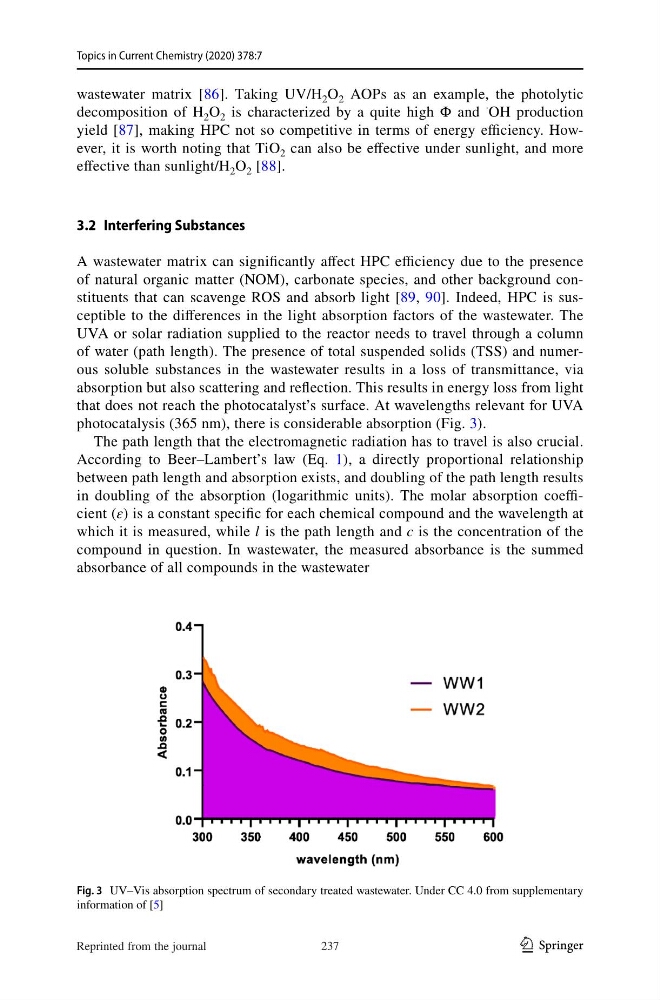
that does not reach the photocatalyst’s surface. At wavelengths relevant for UVA
photocatalysis (365 nm), there is considerable absorption (Fig. 3).
The path length that the electromagnetic radiation has to travel is also crucial.
According to Beer–Lambert’s law (Eq. 1), a directly proportional relationship
between path length and absorption exists, and doubling of the path length results
in doubling of the absorption (logarithmic units). The molar absorption coefficient (ε) is a constant specific for each chemical compound and the wavelength at
which it is measured, while l is the path length and c is the concentration of the
compound in question. In wastewater, the measured absorbance is the summed
absorbance of all compounds in the wastewater
Fig. 3 UV–Vis absorption spectrum of secondary treated wastewater. Under CC 4.0 from supplementary
information of [5]
237
Reprinted from the journal
Topics in Current Chemistry (2020) 378:7
wastewater matrix [86]. Taking UV/H 2 O 2 AOPs as an example, the photolytic
decomposition of H 2 O 2 is characterized by a quite high Φ and
·
OH production
yield [87], making HPC not so competitive in terms of energy efficiency. However, it is worth noting that TiO 2 can also be effective under sunlight, and more
effective than sunlight/H 2 O 2 [88].
3.2 Interfering Substances
A wastewater matrix can significantly affect HPC efficiency due to the presence
of natural organic matter (NOM), carbonate species, and other background constituents that can scavenge ROS and absorb light [89, 90]. Indeed, HPC is susceptible to the differences in the light absorption factors of the wastewater. The
UVA or solar radiation supplied to the reactor needs to travel through a column
of water (path length). The presence of total suspended solids (TSS) and numerous soluble substances in the wastewater results in a loss of transmittance, via
absorption but also scattering and reflection. This results in energy loss from light
that does not reach the photocatalyst’s surface. At wavelengths relevant for UVA
photocatalysis (365 nm), there is considerable absorption (Fig. 3).
The path length that the electromagnetic radiation has to travel is also crucial.
According to Beer–Lambert’s law (Eq. 1), a directly proportional relationship
between path length and absorption exists, and doubling of the path length results
in doubling of the absorption (logarithmic units). The molar absorption coefficient (ε) is a constant specific for each chemical compound and the wavelength at
which it is measured, while l is the path length and c is the concentration of the
compound in question. In wastewater, the measured absorbance is the summed
absorbance of all compounds in the wastewater
Fig. 3 UV–Vis absorption spectrum of secondary treated wastewater. Under CC 4.0 from supplementary
information of [5]
237
Reprinted from the journal