

1 3
Topics in Current Chemistry (2020) 378:3
6 Biomass‑templated Materials
The template method is an effective and simple strategy for obtaining nanostructures with different morphologies and large surface areas. Most of the reported
approaches in this sense consist of two steps: first, the desired materials or precursors assemble around the surface of a template via chemical or physical adherence
to form transitional composites, and then the templates are selectively removed from
the composite structures. If the template is fully converted to the desired material, it
is called a sacrificial template.
A wide range of composite materials have been synthesized through biomass
valorization [3, 86]. Biomass waste can represent an alternative to the typical carbonaceous materials, resulting in both cheaper and more effective catalytic systems with tunable properties. From an environmental point of view, and following the same ideas described in previous sections, it is especially interesting to
search for new materials that both enable optimization of photo(catalytic) properties and reuse of waste, and allow the use of environmentally friendly synthetic
procedures. These two concepts have been applied to obtain materials that show
high efficiency in photocatalytic reactions under solar irradiation or under efficient illumination sources, facilitating the development of industrial applications
of photocatalysis as a green technology.
The sacrificial template method has also been used to design photocatalytic
materials. In this way, it is possible to synthesize multiple photocatalysts with
adequate morphological and desired optical and electronic properties [87]. One
study reported that ZnO with a controlled morphology was obtained by solidstate grinding of a zinc precursor [Zn(NO 3 ) 2 ] with polysaccharides including a
biomass-derived agar extracted from macroalgae [88]. The obtained materials
showed promising photocatalytic phenol photodegradation activity similar to
commercial P25 titania.
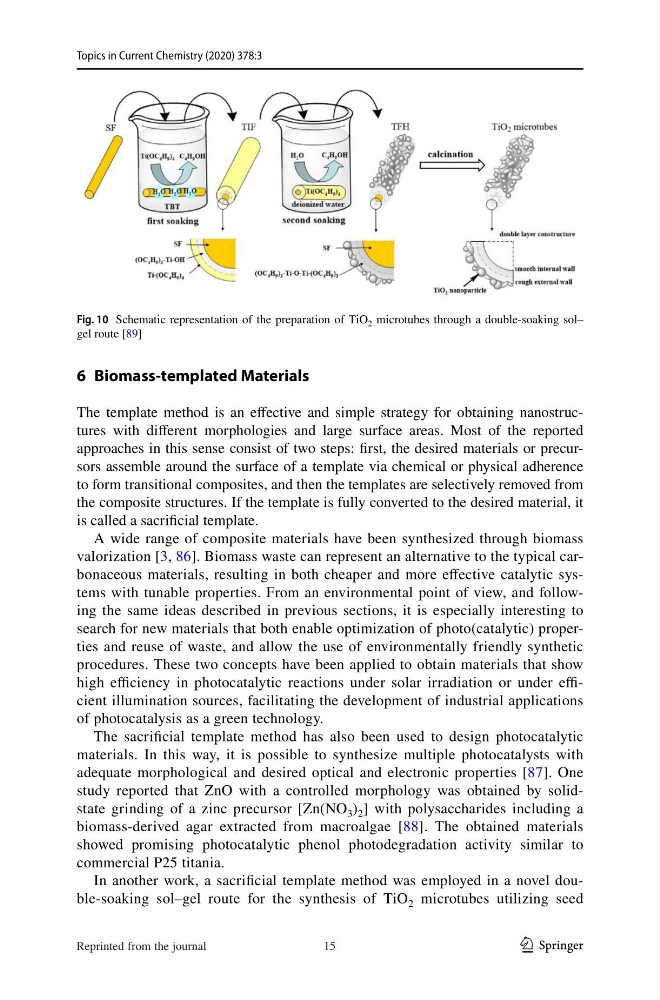
In another work, a sacrificial template method was employed in a novel double-soaking sol–gel route for the synthesis of TiO 2 microtubes utilizing seed
Fig. 10 Schematic representation of the preparation of TiO 2 microtubes through a double-soaking sol–
gel route [89]
15
Reprinted from the journal
Topics in Current Chemistry (2020) 378:3
6 Biomass‑templated Materials
The template method is an effective and simple strategy for obtaining nanostructures with different morphologies and large surface areas. Most of the reported
approaches in this sense consist of two steps: first, the desired materials or precursors assemble around the surface of a template via chemical or physical adherence
to form transitional composites, and then the templates are selectively removed from
the composite structures. If the template is fully converted to the desired material, it
is called a sacrificial template.
A wide range of composite materials have been synthesized through biomass
valorization [3, 86]. Biomass waste can represent an alternative to the typical carbonaceous materials, resulting in both cheaper and more effective catalytic systems with tunable properties. From an environmental point of view, and following the same ideas described in previous sections, it is especially interesting to
search for new materials that both enable optimization of photo(catalytic) properties and reuse of waste, and allow the use of environmentally friendly synthetic
procedures. These two concepts have been applied to obtain materials that show
high efficiency in photocatalytic reactions under solar irradiation or under efficient illumination sources, facilitating the development of industrial applications
of photocatalysis as a green technology.
The sacrificial template method has also been used to design photocatalytic
materials. In this way, it is possible to synthesize multiple photocatalysts with
adequate morphological and desired optical and electronic properties [87]. One
study reported that ZnO with a controlled morphology was obtained by solidstate grinding of a zinc precursor [Zn(NO 3 ) 2 ] with polysaccharides including a
biomass-derived agar extracted from macroalgae [88]. The obtained materials
showed promising photocatalytic phenol photodegradation activity similar to
commercial P25 titania.
In another work, a sacrificial template method was employed in a novel double-soaking sol–gel route for the synthesis of TiO 2 microtubes utilizing seed
Fig. 10 Schematic representation of the preparation of TiO 2 microtubes through a double-soaking sol–
gel route [89]
15
Reprinted from the journal