

Topics in Current Chemistry (2019) 377:27
1 3
catalyst resulted in a highly effective light energy harvesting system able to catalyze
dehydrogenation of FA under visible-light irradiation without any additive.
As for the case of thermal catalysts used in the FA decomposition [47, 49], the
beneficial role of N-doped materials in achieved enhanced performances has also
been indicated for photocatalytic processes. In this context, the photocatalytic activity of N-doped carbon quantum dots (NCQDs) in the production of H 2 from FA was
evaluated by Li et al. [113]. In that study, NCQDs of an average diameter of 2.5 nm
were obtained from shrimp waste by hydrothermal treatment and washing, and their
photoactivity was evaluated using external sunlight irradiation.
As can be seen from the results summarized above, diverse strategies are being
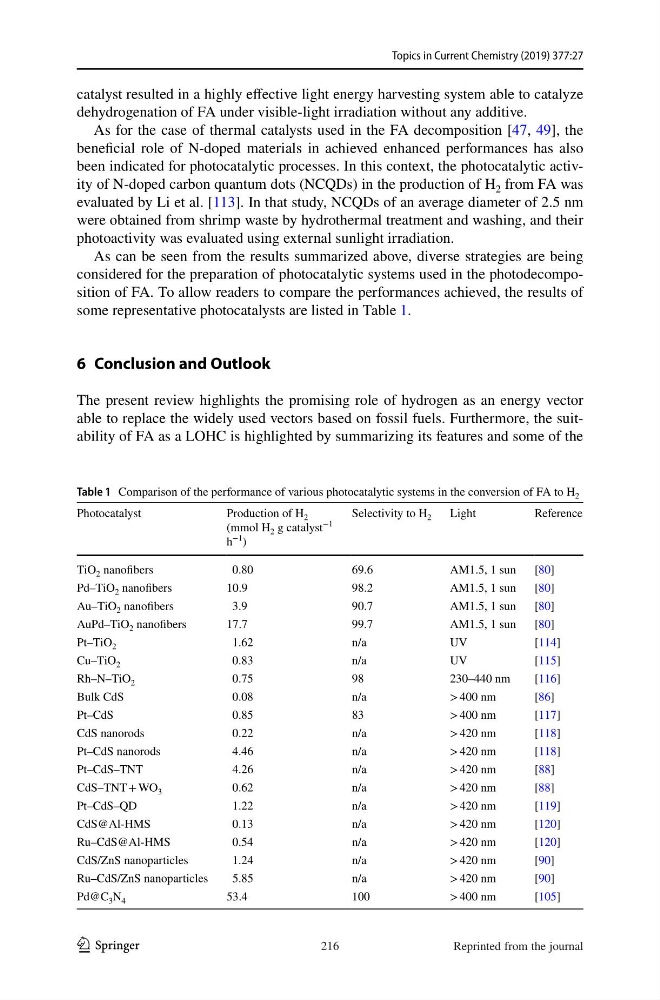
considered for the preparation of photocatalytic systems used in the photodecomposition of FA. To allow readers to compare the performances achieved, the results of
some representative photocatalysts are listed in Table 1.
6 Conclusion and Outlook
The present review highlights the promising role of hydrogen as an energy vector
able to replace the widely used vectors based on fossil fuels. Furthermore, the suitability of FA as a LOHC is highlighted by summarizing its features and some of the
Table 1 Comparison of the performance of various photocatalytic systems in the conversion of FA to H 2
Photocatalyst
Production of H 2
(mmol H 2 g catalyst
−1
h
−1 )
Selectivity to H 2
Light
Reference
TiO 2 nanofibers
0.80
69.6
AM1.5, 1 sun
[80]
Pd–TiO 2 nanofibers
10.9
98.2
AM1.5, 1 sun
[80]
Au–TiO 2 nanofibers
3.9
90.7
AM1.5, 1 sun
[80]
AuPd–TiO 2 nanofibers
17.7
99.7
AM1.5, 1 sun
[80]
Pt–TiO 2
1.62
n/a
UV
[114]
Cu–TiO 2
0.83
n/a
UV
[115]
Rh–N–TiO 2
0.75
98
230–440 nm
[116]
Bulk CdS
0.08
n/a
> 400 nm
[86]
Pt–CdS
0.85
83
> 400 nm
[117]
CdS nanorods
0.22
n/a
> 420 nm
[118]
Pt–CdS nanorods
4.46
n/a
> 420 nm
[118]
Pt–CdS–TNT
4.26
n/a
> 420 nm
[88]
CdS–TNT + WO 3
0.62
n/a
> 420 nm
[88]
Pt–CdS–QD
1.22
n/a
> 420 nm
[119]
CdS@Al-HMS
0.13
n/a
> 420 nm
[120]
Ru–CdS@Al-HMS
0.54
n/a
> 420 nm
[120]
CdS/ZnS nanoparticles
1.24
n/a
> 420 nm
[90]
Ru–CdS/ZnS nanoparticles
5.85
n/a
> 420 nm
[90]
Pd@C 3 N 4
53.4
100
> 400 nm
[105]
216
Reprinted from the journal
1 3
catalyst resulted in a highly effective light energy harvesting system able to catalyze
dehydrogenation of FA under visible-light irradiation without any additive.
As for the case of thermal catalysts used in the FA decomposition [47, 49], the
beneficial role of N-doped materials in achieved enhanced performances has also
been indicated for photocatalytic processes. In this context, the photocatalytic activity of N-doped carbon quantum dots (NCQDs) in the production of H 2 from FA was
evaluated by Li et al. [113]. In that study, NCQDs of an average diameter of 2.5 nm
were obtained from shrimp waste by hydrothermal treatment and washing, and their
photoactivity was evaluated using external sunlight irradiation.
As can be seen from the results summarized above, diverse strategies are being
considered for the preparation of photocatalytic systems used in the photodecomposition of FA. To allow readers to compare the performances achieved, the results of
some representative photocatalysts are listed in Table 1.
6 Conclusion and Outlook
The present review highlights the promising role of hydrogen as an energy vector
able to replace the widely used vectors based on fossil fuels. Furthermore, the suitability of FA as a LOHC is highlighted by summarizing its features and some of the
Table 1 Comparison of the performance of various photocatalytic systems in the conversion of FA to H 2
Photocatalyst
Production of H 2
(mmol H 2 g catalyst
−1
h
−1 )
Selectivity to H 2
Light
Reference
TiO 2 nanofibers
0.80
69.6
AM1.5, 1 sun
[80]
Pd–TiO 2 nanofibers
10.9
98.2
AM1.5, 1 sun
[80]
Au–TiO 2 nanofibers
3.9
90.7
AM1.5, 1 sun
[80]
AuPd–TiO 2 nanofibers
17.7
99.7
AM1.5, 1 sun
[80]
Pt–TiO 2
1.62
n/a
UV
[114]
Cu–TiO 2
0.83
n/a
UV
[115]
Rh–N–TiO 2
0.75
98
230–440 nm
[116]
Bulk CdS
0.08
n/a
> 400 nm
[86]
Pt–CdS
0.85
83
> 400 nm
[117]
CdS nanorods
0.22
n/a
> 420 nm
[118]
Pt–CdS nanorods
4.46
n/a
> 420 nm
[118]
Pt–CdS–TNT
4.26
n/a
> 420 nm
[88]
CdS–TNT + WO 3
0.62
n/a
> 420 nm
[88]
Pt–CdS–QD
1.22
n/a
> 420 nm
[119]
CdS@Al-HMS
0.13
n/a
> 420 nm
[120]
Ru–CdS@Al-HMS
0.54
n/a
> 420 nm
[120]
CdS/ZnS nanoparticles
1.24
n/a
> 420 nm
[90]
Ru–CdS/ZnS nanoparticles
5.85
n/a
> 420 nm
[90]
Pd@C 3 N 4
53.4
100
> 400 nm
[105]
216
Reprinted from the journal