

1 3
Topics in Current Chemistry (2020) 378:3
resulting CQDs were soluble in water to form a stable solution for months without precipitation. A composite material based on the prepared CQDs and ZnO was
employed as photocatalyst for degradation of naphthol blue-black azo dye under UV
irradiation (Fig. 7d), with outstanding results [81].
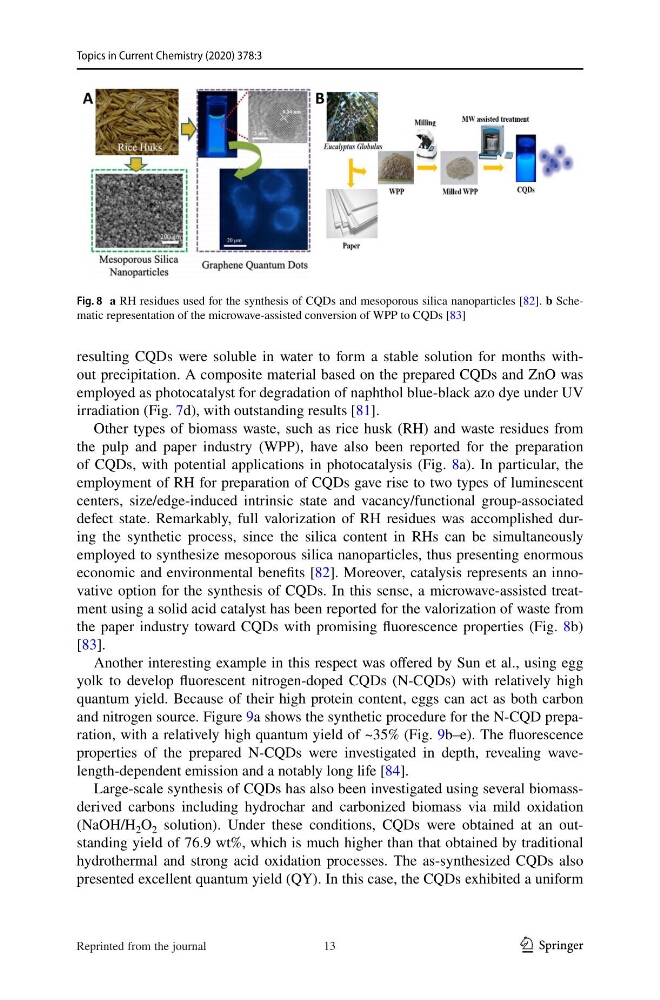
Other types of biomass waste, such as rice husk (RH) and waste residues from
the pulp and paper industry (WPP), have also been reported for the preparation
of CQDs, with potential applications in photocatalysis (Fig. 8a). In particular, the
employment of RH for preparation of CQDs gave rise to two types of luminescent
centers, size/edge-induced intrinsic state and vacancy/functional group-associated
defect state. Remarkably, full valorization of RH residues was accomplished during the synthetic process, since the silica content in RHs can be simultaneously
employed to synthesize mesoporous silica nanoparticles, thus presenting enormous
economic and environmental benefits [82]. Moreover, catalysis represents an innovative option for the synthesis of CQDs. In this sense, a microwave-assisted treatment using a solid acid catalyst has been reported for the valorization of waste from
the paper industry toward CQDs with promising fluorescence properties (Fig. 8b)
[83].
Another interesting example in this respect was offered by Sun et al., using egg
yolk to develop fluorescent nitrogen-doped CQDs (N-CQDs) with relatively high
quantum yield. Because of their high protein content, eggs can act as both carbon
and nitrogen source. Figure 9a shows the synthetic procedure for the N-CQD preparation, with a relatively high quantum yield of ~35% (Fig. 9b–e). The fluorescence
properties of the prepared N-CQDs were investigated in depth, revealing wavelength-dependent emission and a notably long life [84].
Large-scale synthesis of CQDs has also been investigated using several biomassderived carbons including hydrochar and carbonized biomass via mild oxidation
(NaOH/H 2 O 2 solution). Under these conditions, CQDs were obtained at an outstanding yield of 76.9 wt%, which is much higher than that obtained by traditional
hydrothermal and strong acid oxidation processes. The as-synthesized CQDs also
presented excellent quantum yield (QY). In this case, the CQDs exhibited a uniform
Fig. 8 a RH residues used for the synthesis of CQDs and mesoporous silica nanoparticles [82]. b Schematic representation of the microwave-assisted conversion of WPP to CQDs [83]
13
Reprinted from the journal
Topics in Current Chemistry (2020) 378:3
resulting CQDs were soluble in water to form a stable solution for months without precipitation. A composite material based on the prepared CQDs and ZnO was
employed as photocatalyst for degradation of naphthol blue-black azo dye under UV
irradiation (Fig. 7d), with outstanding results [81].
Other types of biomass waste, such as rice husk (RH) and waste residues from
the pulp and paper industry (WPP), have also been reported for the preparation
of CQDs, with potential applications in photocatalysis (Fig. 8a). In particular, the
employment of RH for preparation of CQDs gave rise to two types of luminescent
centers, size/edge-induced intrinsic state and vacancy/functional group-associated
defect state. Remarkably, full valorization of RH residues was accomplished during the synthetic process, since the silica content in RHs can be simultaneously
employed to synthesize mesoporous silica nanoparticles, thus presenting enormous
economic and environmental benefits [82]. Moreover, catalysis represents an innovative option for the synthesis of CQDs. In this sense, a microwave-assisted treatment using a solid acid catalyst has been reported for the valorization of waste from
the paper industry toward CQDs with promising fluorescence properties (Fig. 8b)
[83].
Another interesting example in this respect was offered by Sun et al., using egg
yolk to develop fluorescent nitrogen-doped CQDs (N-CQDs) with relatively high
quantum yield. Because of their high protein content, eggs can act as both carbon
and nitrogen source. Figure 9a shows the synthetic procedure for the N-CQD preparation, with a relatively high quantum yield of ~35% (Fig. 9b–e). The fluorescence
properties of the prepared N-CQDs were investigated in depth, revealing wavelength-dependent emission and a notably long life [84].
Large-scale synthesis of CQDs has also been investigated using several biomassderived carbons including hydrochar and carbonized biomass via mild oxidation
(NaOH/H 2 O 2 solution). Under these conditions, CQDs were obtained at an outstanding yield of 76.9 wt%, which is much higher than that obtained by traditional
hydrothermal and strong acid oxidation processes. The as-synthesized CQDs also
presented excellent quantum yield (QY). In this case, the CQDs exhibited a uniform
Fig. 8 a RH residues used for the synthesis of CQDs and mesoporous silica nanoparticles [82]. b Schematic representation of the microwave-assisted conversion of WPP to CQDs [83]
13
Reprinted from the journal