

1 3
Topics in Current Chemistry (2019) 377:27
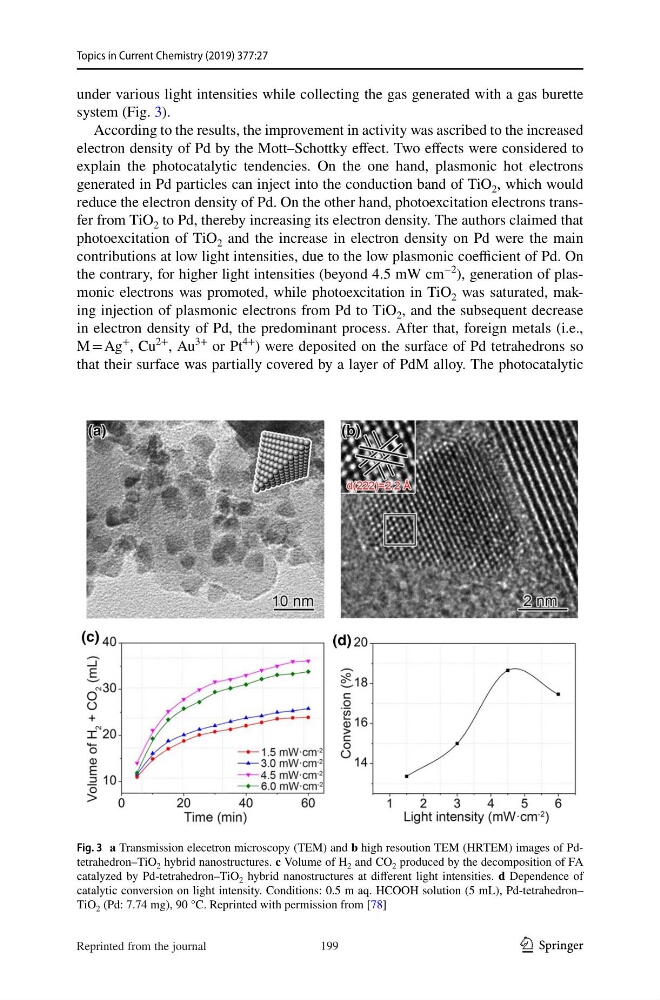
under various light intensities while collecting the gas generated with a gas burette
system (Fig. 3).
According to the results, the improvement in activity was ascribed to the increased
electron density of Pd by the Mott–Schottky effect. Two effects were considered to
explain the photocatalytic tendencies. On the one hand, plasmonic hot electrons
generated in Pd particles can inject into the conduction band of TiO 2 , which would
reduce the electron density of Pd. On the other hand, photoexcitation electrons transfer from TiO 2 to Pd, thereby increasing its electron density. The authors claimed that
photoexcitation of TiO 2 and the increase in electron density on Pd were the main
contributions at low light intensities, due to the low plasmonic coefficient of Pd. On
the contrary, for higher light intensities (beyond 4.5 mW cm
−2
), generation of plasmonic electrons was promoted, while photoexcitation in TiO 2 was saturated, making injection of plasmonic electrons from Pd to TiO 2 , and the subsequent decrease
in electron density of Pd, the predominant process. After that, foreign metals (i.e.,
M = Ag
+
, Cu
2+
, Au
3+
or Pt
4+
) were deposited on the surface of Pd tetrahedrons so
that their surface was partially covered by a layer of PdM alloy. The photocatalytic
Fig. 3 a Transmission elecetron microscopy (TEM) and b high resoution TEM (HRTEM) images of Pdtetrahedron–TiO 2 hybrid nanostructures. c Volume of H 2 and CO 2 produced by the decomposition of FA
catalyzed by Pd-tetrahedron–TiO 2 hybrid nanostructures at different light intensities. d Dependence of
catalytic conversion on light intensity. Conditions: 0.5 m aq. HCOOH solution (5 mL), Pd-tetrahedron–
TiO 2 (Pd: 7.74 mg), 90 °C. Reprinted with permission from [78]
199
Reprinted from the journal
Topics in Current Chemistry (2019) 377:27
under various light intensities while collecting the gas generated with a gas burette
system (Fig. 3).
According to the results, the improvement in activity was ascribed to the increased
electron density of Pd by the Mott–Schottky effect. Two effects were considered to
explain the photocatalytic tendencies. On the one hand, plasmonic hot electrons
generated in Pd particles can inject into the conduction band of TiO 2 , which would
reduce the electron density of Pd. On the other hand, photoexcitation electrons transfer from TiO 2 to Pd, thereby increasing its electron density. The authors claimed that
photoexcitation of TiO 2 and the increase in electron density on Pd were the main
contributions at low light intensities, due to the low plasmonic coefficient of Pd. On
the contrary, for higher light intensities (beyond 4.5 mW cm
−2
), generation of plasmonic electrons was promoted, while photoexcitation in TiO 2 was saturated, making injection of plasmonic electrons from Pd to TiO 2 , and the subsequent decrease
in electron density of Pd, the predominant process. After that, foreign metals (i.e.,
M = Ag
+
, Cu
2+
, Au
3+
or Pt
4+
) were deposited on the surface of Pd tetrahedrons so
that their surface was partially covered by a layer of PdM alloy. The photocatalytic
Fig. 3 a Transmission elecetron microscopy (TEM) and b high resoution TEM (HRTEM) images of Pdtetrahedron–TiO 2 hybrid nanostructures. c Volume of H 2 and CO 2 produced by the decomposition of FA
catalyzed by Pd-tetrahedron–TiO 2 hybrid nanostructures at different light intensities. d Dependence of
catalytic conversion on light intensity. Conditions: 0.5 m aq. HCOOH solution (5 mL), Pd-tetrahedron–
TiO 2 (Pd: 7.74 mg), 90 °C. Reprinted with permission from [78]
199
Reprinted from the journal