

Topics in Current Chemistry (2018) 376:42
1 3
Acknowledgements This work was supported by the National Natural Science Foundation of China
(51672056), the China Postdoctoral Science Foundation (2018M630307), the Heilongjiang Postdoctoral
Scientific Research Developmental Fund (LBH-Q16044), and the Fundamental Research Funds for the
Central Universities (HEUCF181007). G.X. Wang is thankful for the financial support from Outstanding
Youth Talent Project of Dalian (Grant No. 2017RJ03) and CAS Youth Innovation Promotion (Grant No.
2015145).
References
1. Omer AM (2008) Energy, environment and sustainable development. Renew Sustain Energy
Rev 12(9):2265–2300. https ://doi.org/10.1016/j.rser.2007.05.001
2. Satyapal S, Petrovic J, Read C, Thomas G, Ordaz G (2007) The U.S. Department of Energy’s National hydrogen storage project: progress towards meeting hydrogen-powered vehicle
requirements. Catal Today 120(3–4):246–256. https ://doi.org/10.1016/j.catto d.2006.09.022
3. Faungnawakij KTY, Shimoda N, Fukunaga T, Kikuchi R, Eguchi K (2007) Hydrogen production from dimethyl ether steam reforming over composite catalysts of copper ferrite spinel and
alumina. Appl Catal B 74:144–151. https ://doi.org/10.1016/j.apcat b.2007.02.010
4. Barbir F (2005) PEM electrolysis for production of hydrogen from renewable energy sources.
Sol Energy 78(5):661–669. https ://doi.org/10.1016/j.solen er.2004.09.003
5. Christopher K, Dimitrios R (2012) A review on exergy comparison of hydrogen production methods from renewable energy sources. Energy Environ Sci 5(5):6640. https ://doi.
org/10.1039/c2ee0 1098d
6. Jiao Y, Zheng Y, Jaroniec M, Qiao SZ (2015) Design of electrocatalysts for oxygen- and
hydrogen-involving energy conversion reactions. Chem Soc Rev 44(8):2060–2086. https ://doi.
org/10.1039/c4cs0 0470a
7. Zheng Y, Jiao Y, Zhu Y, Li LH, Han Y, Chen Y, Du A, Jaroniec M, Qiao SZ (2014) Hydrogen
evolution by a metal-free electrocatalyst. Nat Commun 5:3783. https ://doi.org/10.1038/ncomm
s4783
8. Rahimpour MR, Mottaghi HR, Barmaki MM (2010) Hydrogen production from urea wastewater using a combination of urea thermal hydrolyser–desorber loop and a hydrogen-permselective membrane reactor. Fuel Process Technol 91(6):600–612. https ://doi.org/10.1016/j.fupro
c.2010.01.006
9. Edrisi A, Mansoori Z, Dabir B (2016) Urea synthesis using chemical looping process—technoeconomic evaluation of a novel plant configuration for a green production. Int J Greenhouse Gas
Control 44:42–51. https ://doi.org/10.1016/j.ijggc .2015.10.020
10. Lan R, Tao S, Irvine JTS (2010) A direct urea fuel cell—power from fertiliser and waste. Energy
Environ Sci 3(4):438. https ://doi.org/10.1039/b9247 86f
11. Rollinson AN, Rickett GL, Lea-Langton A, Dupont V, Twigg MV (2011) Hydrogen from urea–
water and ammonia–water solutions. Appl Catal B 106(3–4):304–315. https ://doi.org/10.1016/j.
apcat b.2011.05.031
12. Simka W, Piotrowski J, Robak A, Nawrat G (2009) Electrochemical treatment of aqueous solutions
containing urea. J Appl Electrochem 39(7):1137–1143. https ://doi.org/10.1007/s1080 0-008-9771-4
13. Mahalik K, Sahu JN, Patwardhan AV, Meikap BC (2010) Kinetic studies on hydrolysis of urea in
a semi-batch reactor at atmospheric pressure for safe use of ammonia in a power plant for flue gas
conditioning. J Hazard Mater 175(1–3):629–637. https ://doi.org/10.1016/j.jhazm at.2009.10.053
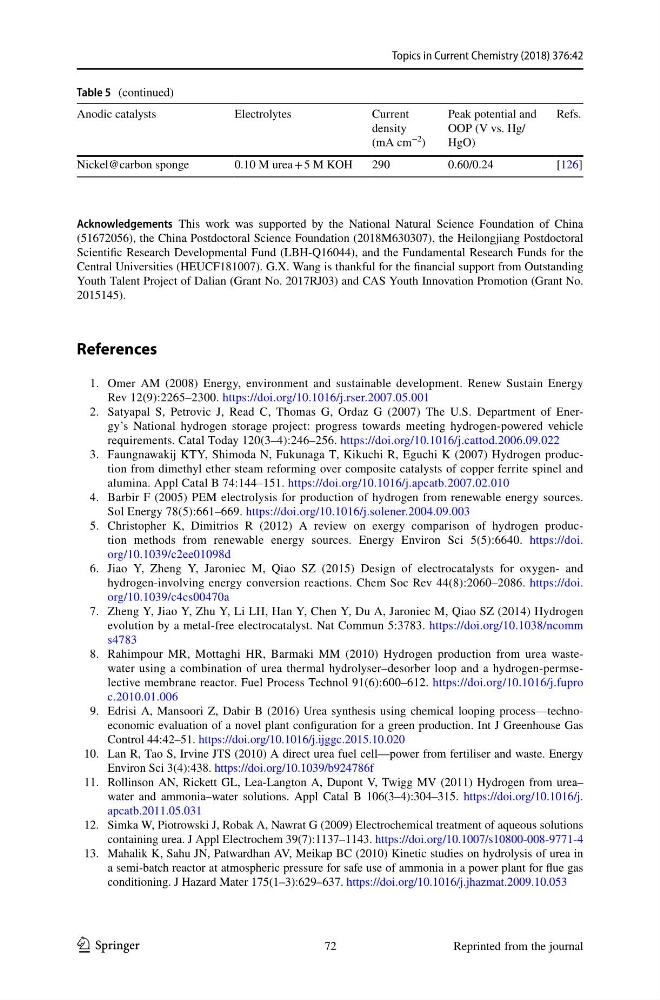
Table 5 (continued)
Anodic catalysts
Electrolytes
Current
density
(mA cm
−2 )
Peak potential and
OOP (V vs. Hg/
HgO)
Refs.
Nickel@carbon sponge
0.10 M urea + 5 M KOH
290
0.60/0.24
[126]
Reprinted from the journal
72
1 3
Acknowledgements This work was supported by the National Natural Science Foundation of China
(51672056), the China Postdoctoral Science Foundation (2018M630307), the Heilongjiang Postdoctoral
Scientific Research Developmental Fund (LBH-Q16044), and the Fundamental Research Funds for the
Central Universities (HEUCF181007). G.X. Wang is thankful for the financial support from Outstanding
Youth Talent Project of Dalian (Grant No. 2017RJ03) and CAS Youth Innovation Promotion (Grant No.
2015145).
References
1. Omer AM (2008) Energy, environment and sustainable development. Renew Sustain Energy
Rev 12(9):2265–2300. https ://doi.org/10.1016/j.rser.2007.05.001
2. Satyapal S, Petrovic J, Read C, Thomas G, Ordaz G (2007) The U.S. Department of Energy’s National hydrogen storage project: progress towards meeting hydrogen-powered vehicle
requirements. Catal Today 120(3–4):246–256. https ://doi.org/10.1016/j.catto d.2006.09.022
3. Faungnawakij KTY, Shimoda N, Fukunaga T, Kikuchi R, Eguchi K (2007) Hydrogen production from dimethyl ether steam reforming over composite catalysts of copper ferrite spinel and
alumina. Appl Catal B 74:144–151. https ://doi.org/10.1016/j.apcat b.2007.02.010
4. Barbir F (2005) PEM electrolysis for production of hydrogen from renewable energy sources.
Sol Energy 78(5):661–669. https ://doi.org/10.1016/j.solen er.2004.09.003
5. Christopher K, Dimitrios R (2012) A review on exergy comparison of hydrogen production methods from renewable energy sources. Energy Environ Sci 5(5):6640. https ://doi.
org/10.1039/c2ee0 1098d
6. Jiao Y, Zheng Y, Jaroniec M, Qiao SZ (2015) Design of electrocatalysts for oxygen- and
hydrogen-involving energy conversion reactions. Chem Soc Rev 44(8):2060–2086. https ://doi.
org/10.1039/c4cs0 0470a
7. Zheng Y, Jiao Y, Zhu Y, Li LH, Han Y, Chen Y, Du A, Jaroniec M, Qiao SZ (2014) Hydrogen
evolution by a metal-free electrocatalyst. Nat Commun 5:3783. https ://doi.org/10.1038/ncomm
s4783
8. Rahimpour MR, Mottaghi HR, Barmaki MM (2010) Hydrogen production from urea wastewater using a combination of urea thermal hydrolyser–desorber loop and a hydrogen-permselective membrane reactor. Fuel Process Technol 91(6):600–612. https ://doi.org/10.1016/j.fupro
c.2010.01.006
9. Edrisi A, Mansoori Z, Dabir B (2016) Urea synthesis using chemical looping process—technoeconomic evaluation of a novel plant configuration for a green production. Int J Greenhouse Gas
Control 44:42–51. https ://doi.org/10.1016/j.ijggc .2015.10.020
10. Lan R, Tao S, Irvine JTS (2010) A direct urea fuel cell—power from fertiliser and waste. Energy
Environ Sci 3(4):438. https ://doi.org/10.1039/b9247 86f
11. Rollinson AN, Rickett GL, Lea-Langton A, Dupont V, Twigg MV (2011) Hydrogen from urea–
water and ammonia–water solutions. Appl Catal B 106(3–4):304–315. https ://doi.org/10.1016/j.
apcat b.2011.05.031
12. Simka W, Piotrowski J, Robak A, Nawrat G (2009) Electrochemical treatment of aqueous solutions
containing urea. J Appl Electrochem 39(7):1137–1143. https ://doi.org/10.1007/s1080 0-008-9771-4
13. Mahalik K, Sahu JN, Patwardhan AV, Meikap BC (2010) Kinetic studies on hydrolysis of urea in
a semi-batch reactor at atmospheric pressure for safe use of ammonia in a power plant for flue gas
conditioning. J Hazard Mater 175(1–3):629–637. https ://doi.org/10.1016/j.jhazm at.2009.10.053
Table 5 (continued)
Anodic catalysts
Electrolytes
Current
density
(mA cm
−2 )
Peak potential and
OOP (V vs. Hg/
HgO)
Refs.
Nickel@carbon sponge
0.10 M urea + 5 M KOH
290
0.60/0.24
[126]
Reprinted from the journal
72