

Topics in Current Chemistry (2018) 376:42
1 3
pore channels with a size of 300–500 nm. The pore size of NiO nanosheets was
mainly distributed between 2 and 50 nm, and most of them were mesopores with
a size of 4 nm, providing a larger open space and expediting the transport of urea,
gases, and electrolyte. In 1 M KOH solution that contains 0.33 M urea, the NiO
nanosheet/Ni foam demonstrated an enhanced current of 400 mA cm
−2
and a relatively lower OOP of 0.27 V (vs. Ag/AgCl) by comparison with NiO bulk/Ni
foam and NiO nanosheet/SS (stainless-steel film), implying the catalytic activity
of NiO strongly depended on their configuration and substrate. Yue et al. [99]
recently reported a versatile nickel oxide-hybrid nanoarray catalyst that grown
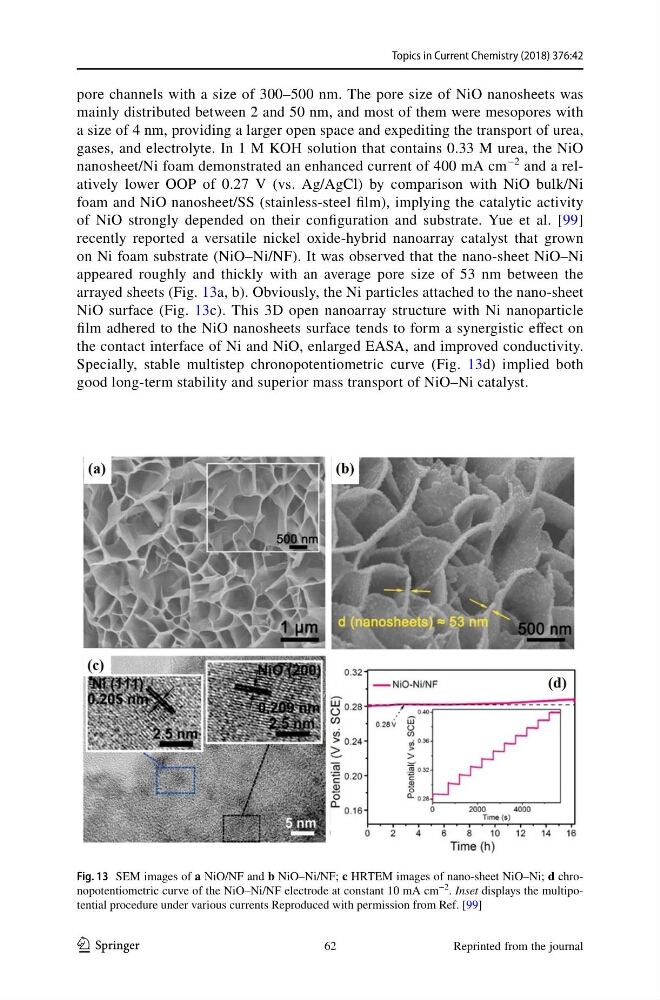
on Ni foam substrate (NiO–Ni/NF). It was observed that the nano-sheet NiO–Ni
appeared roughly and thickly with an average pore size of 53 nm between the
arrayed sheets (Fig. 13a, b). Obviously, the Ni particles attached to the nano-sheet
NiO surface (Fig. 13c). This 3D open nanoarray structure with Ni nanoparticle
film adhered to the NiO nanosheets surface tends to form a synergistic effect on
the contact interface of Ni and NiO, enlarged EASA, and improved conductivity.
Specially, stable multistep chronopotentiometric curve (Fig. 13d) implied both
good long-term stability and superior mass transport of NiO–Ni catalyst.
Fig. 13 SEM images of a NiO/NF and b NiO–Ni/NF; c HRTEM images of nano-sheet NiO–Ni; d chronopotentiometric curve of the NiO–Ni/NF electrode at constant 10 mA cm
−2
. Inset displays the multipotential procedure under various currents Reproduced with permission from Ref. [99]
Reprinted from the journal
62
1 3
pore channels with a size of 300–500 nm. The pore size of NiO nanosheets was
mainly distributed between 2 and 50 nm, and most of them were mesopores with
a size of 4 nm, providing a larger open space and expediting the transport of urea,
gases, and electrolyte. In 1 M KOH solution that contains 0.33 M urea, the NiO
nanosheet/Ni foam demonstrated an enhanced current of 400 mA cm
−2
and a relatively lower OOP of 0.27 V (vs. Ag/AgCl) by comparison with NiO bulk/Ni
foam and NiO nanosheet/SS (stainless-steel film), implying the catalytic activity
of NiO strongly depended on their configuration and substrate. Yue et al. [99]
recently reported a versatile nickel oxide-hybrid nanoarray catalyst that grown
on Ni foam substrate (NiO–Ni/NF). It was observed that the nano-sheet NiO–Ni
appeared roughly and thickly with an average pore size of 53 nm between the
arrayed sheets (Fig. 13a, b). Obviously, the Ni particles attached to the nano-sheet
NiO surface (Fig. 13c). This 3D open nanoarray structure with Ni nanoparticle
film adhered to the NiO nanosheets surface tends to form a synergistic effect on
the contact interface of Ni and NiO, enlarged EASA, and improved conductivity.
Specially, stable multistep chronopotentiometric curve (Fig. 13d) implied both
good long-term stability and superior mass transport of NiO–Ni catalyst.
Fig. 13 SEM images of a NiO/NF and b NiO–Ni/NF; c HRTEM images of nano-sheet NiO–Ni; d chronopotentiometric curve of the NiO–Ni/NF electrode at constant 10 mA cm
−2
. Inset displays the multipotential procedure under various currents Reproduced with permission from Ref. [99]
Reprinted from the journal
62