

1 3
Topics in Current Chemistry (2018) 376:42
was observed that as the proportion of Co increased, the fragments of the Ni/Co
hydroxide gradually decreased until the Co molar fraction reached 43% (atom%),
forming an advantageous network structure while largely reducing the OOP by
up to 150 mV. Nevertheless, when the molar fraction of Co was higher than 73%,
its structure became suddenly tight with the surface area sharply dropped. On the
other hand, the doping of other corresponding transition metal elements was further
reflected in Xu et al.’s work [97]. Systematically, a series of various nickel-based
bimetallic hydroxides (Ni–M hydroxide; M = Fe, Co, Cu, Cr, Mn, Zn, respectively)
were fabricated on carbon cloth via one-step hydrothermal growth to investigate
the effect of different element compositions on urea electro-oxidation performance.
Consequently, the Ni-M bimetallic hydroxides showed several distinct morphologies
as the Ni–Zn and Ni–Mn nanosheet, Ni–Co and Ni–Cu nanowire, as well as Ni–Cr
and Ni–Fe nanoparticle. Correspondingly, the Ni-M hydroxides with their respective
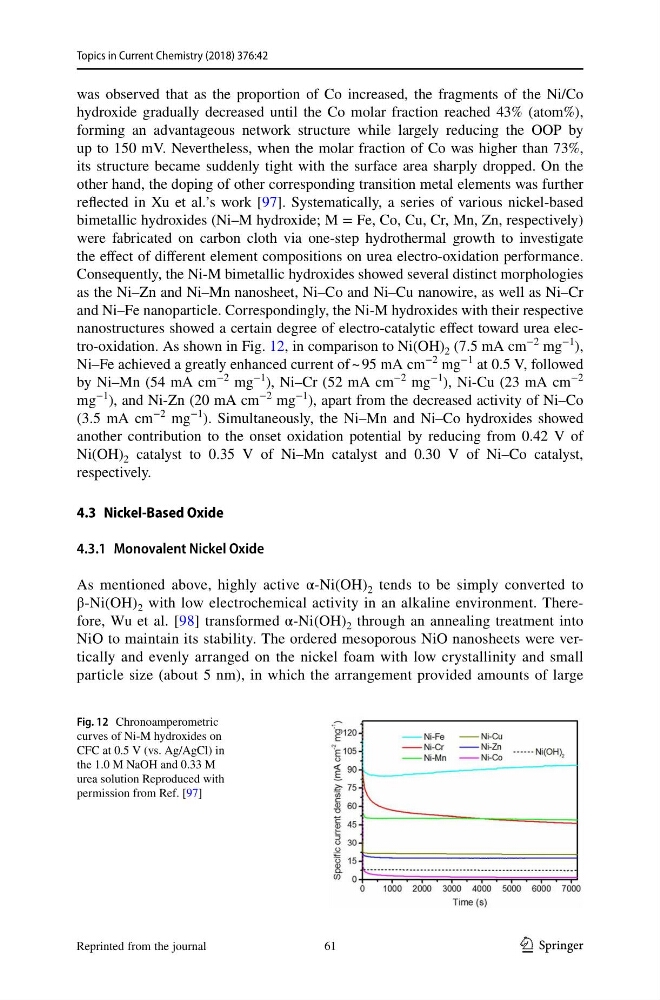
nanostructures showed a certain degree of electro-catalytic effect toward urea electro-oxidation. As shown in Fig. 12, in comparison to Ni(OH) 2 (7.5 mA cm
−2
mg
−1
),
Ni–Fe achieved a greatly enhanced current of ~ 95 mA cm
−2
mg
−1
at 0.5 V, followed
by Ni–Mn (54 mA cm
−2
mg
−1
), Ni–Cr (52 mA cm
−2
mg
−1
), Ni-Cu (23 mA cm
−2
mg
−1
), and Ni-Zn (20 mA cm
−2
mg
−1
), apart from the decreased activity of Ni–Co
(3.5 mA cm
−2
mg
−1
). Simultaneously, the Ni–Mn and Ni–Co hydroxides showed
another contribution to the onset oxidation potential by reducing from 0.42 V of
Ni(OH) 2 catalyst to 0.35 V of Ni–Mn catalyst and 0.30 V of Ni–Co catalyst,
respectively.
4.3 Nickel‑Based Oxide
4.3.1 Monovalent Nickel Oxide
As mentioned above, highly active α-Ni(OH) 2 tends to be simply converted to
β-Ni(OH) 2 with low electrochemical activity in an alkaline environment. Therefore, Wu et al. [98] transformed α-Ni(OH) 2 through an annealing treatment into
NiO to maintain its stability. The ordered mesoporous NiO nanosheets were vertically and evenly arranged on the nickel foam with low crystallinity and small
particle size (about 5 nm), in which the arrangement provided amounts of large
Fig. 12 Chronoamperometric
curves of Ni-M hydroxides on
CFC at 0.5 V (vs. Ag/AgCl) in
the 1.0 M NaOH and 0.33 M
urea solution Reproduced with
permission from Ref. [97]
Reprinted from the journal
61
Topics in Current Chemistry (2018) 376:42
was observed that as the proportion of Co increased, the fragments of the Ni/Co
hydroxide gradually decreased until the Co molar fraction reached 43% (atom%),
forming an advantageous network structure while largely reducing the OOP by
up to 150 mV. Nevertheless, when the molar fraction of Co was higher than 73%,
its structure became suddenly tight with the surface area sharply dropped. On the
other hand, the doping of other corresponding transition metal elements was further
reflected in Xu et al.’s work [97]. Systematically, a series of various nickel-based
bimetallic hydroxides (Ni–M hydroxide; M = Fe, Co, Cu, Cr, Mn, Zn, respectively)
were fabricated on carbon cloth via one-step hydrothermal growth to investigate
the effect of different element compositions on urea electro-oxidation performance.
Consequently, the Ni-M bimetallic hydroxides showed several distinct morphologies
as the Ni–Zn and Ni–Mn nanosheet, Ni–Co and Ni–Cu nanowire, as well as Ni–Cr
and Ni–Fe nanoparticle. Correspondingly, the Ni-M hydroxides with their respective
nanostructures showed a certain degree of electro-catalytic effect toward urea electro-oxidation. As shown in Fig. 12, in comparison to Ni(OH) 2 (7.5 mA cm
−2
mg
−1
),
Ni–Fe achieved a greatly enhanced current of ~ 95 mA cm
−2
mg
−1
at 0.5 V, followed
by Ni–Mn (54 mA cm
−2
mg
−1
), Ni–Cr (52 mA cm
−2
mg
−1
), Ni-Cu (23 mA cm
−2
mg
−1
), and Ni-Zn (20 mA cm
−2
mg
−1
), apart from the decreased activity of Ni–Co
(3.5 mA cm
−2
mg
−1
). Simultaneously, the Ni–Mn and Ni–Co hydroxides showed
another contribution to the onset oxidation potential by reducing from 0.42 V of
Ni(OH) 2 catalyst to 0.35 V of Ni–Mn catalyst and 0.30 V of Ni–Co catalyst,
respectively.
4.3 Nickel‑Based Oxide
4.3.1 Monovalent Nickel Oxide
As mentioned above, highly active α-Ni(OH) 2 tends to be simply converted to
β-Ni(OH) 2 with low electrochemical activity in an alkaline environment. Therefore, Wu et al. [98] transformed α-Ni(OH) 2 through an annealing treatment into
NiO to maintain its stability. The ordered mesoporous NiO nanosheets were vertically and evenly arranged on the nickel foam with low crystallinity and small
particle size (about 5 nm), in which the arrangement provided amounts of large
Fig. 12 Chronoamperometric
curves of Ni-M hydroxides on
CFC at 0.5 V (vs. Ag/AgCl) in
the 1.0 M NaOH and 0.33 M
urea solution Reproduced with
permission from Ref. [97]
Reprinted from the journal
61