

Topics in Current Chemistry (2019) 377:11
1 3
4 In Situ XAS Study of Ethanol Oxidation
Metallic nanoparticles have gained special attention in heterogeneous catalysis,
electrochemistry, and fuel cells because the catalytic phenomenon occurs mostly
on the surface of the active catalyst, which is often made of one or more precious
metals and their amount should be limited due to the rarity and its cost. Besides
a large surface-to volume ratio necessary for active catalyst with minimal precious
metals, nanoparticles have unique physical and chemical properties, which may further enhance the activity in supported metal catalysis [99]. However, their small size
makes them difficult to characterize by ordinary techniques like transmission electron microscopy (TEM), XRD, or chemisorption. Instead, EXAFS became the technique of choice for the characterization because of its unique ability to: (a) elucidate
the distances between atoms, (b) reveal the average particle size or particles smaller
than ca. 3 nm (unlike XRD), (c) provide details on the shape of the nanoparticle
(unlike chemisorption or XRD), as well as because (d) it can be used under in situ or
in operando conditions (unlike TEM).
The content, and consequently the cost, of nanoparticle catalysts containing precious metals in fuel cells can be further reduced if they are mixed with non-noble
metals while maintaining the electrochemical activity. Alternatively, the non-noble
metal can provide the support for the active noble metal catalyst that is made in a
thin shell surrounding the non-noble metal core of the nanoparticle. This type of
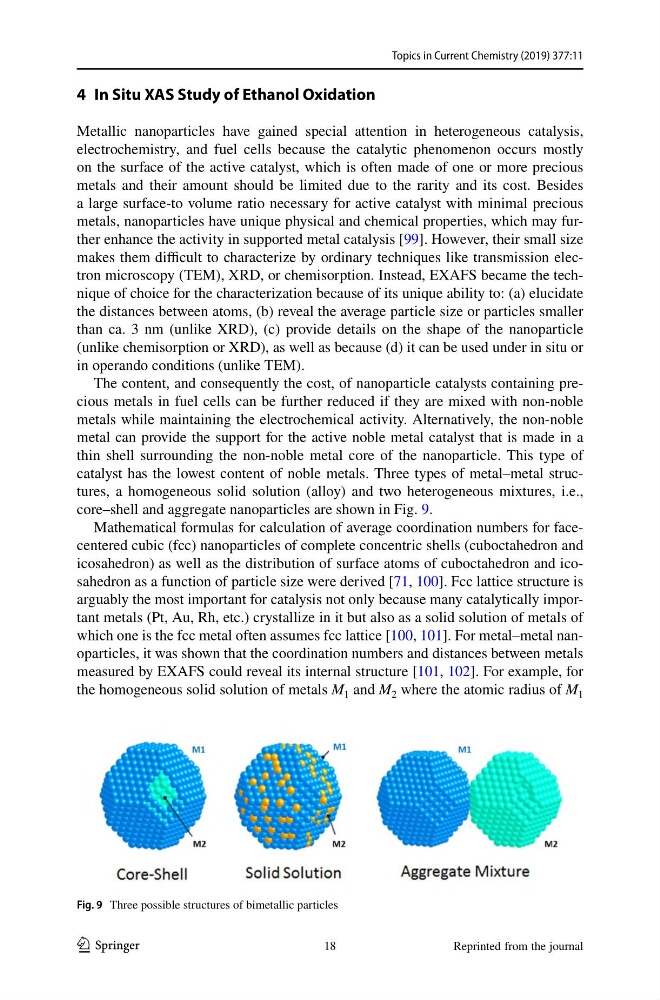
catalyst has the lowest content of noble metals. Three types of metal–metal structures, a homogeneous solid solution (alloy) and two heterogeneous mixtures, i.e.,
core–shell and aggregate nanoparticles are shown in Fig. 9.
Mathematical formulas for calculation of average coordination numbers for facecentered cubic (fcc) nanoparticles of complete concentric shells (cuboctahedron and
icosahedron) as well as the distribution of surface atoms of cuboctahedron and icosahedron as a function of particle size were derived [71, 100]. Fcc lattice structure is
arguably the most important for catalysis not only because many catalytically important metals (Pt, Au, Rh, etc.) crystallize in it but also as a solid solution of metals of
which one is the fcc metal often assumes fcc lattice [100, 101]. For metal–metal nanoparticles, it was shown that the coordination numbers and distances between metals
measured by EXAFS could reveal its internal structure [101, 102]. For example, for
the homogeneous solid solution of metals M 1 and M 2 where the atomic radius of M 1
Fig. 9 Three possible structures of bimetallic particles
Reprinted from the journal
18
1 3
4 In Situ XAS Study of Ethanol Oxidation
Metallic nanoparticles have gained special attention in heterogeneous catalysis,
electrochemistry, and fuel cells because the catalytic phenomenon occurs mostly
on the surface of the active catalyst, which is often made of one or more precious
metals and their amount should be limited due to the rarity and its cost. Besides
a large surface-to volume ratio necessary for active catalyst with minimal precious
metals, nanoparticles have unique physical and chemical properties, which may further enhance the activity in supported metal catalysis [99]. However, their small size
makes them difficult to characterize by ordinary techniques like transmission electron microscopy (TEM), XRD, or chemisorption. Instead, EXAFS became the technique of choice for the characterization because of its unique ability to: (a) elucidate
the distances between atoms, (b) reveal the average particle size or particles smaller
than ca. 3 nm (unlike XRD), (c) provide details on the shape of the nanoparticle
(unlike chemisorption or XRD), as well as because (d) it can be used under in situ or
in operando conditions (unlike TEM).
The content, and consequently the cost, of nanoparticle catalysts containing precious metals in fuel cells can be further reduced if they are mixed with non-noble
metals while maintaining the electrochemical activity. Alternatively, the non-noble
metal can provide the support for the active noble metal catalyst that is made in a
thin shell surrounding the non-noble metal core of the nanoparticle. This type of
catalyst has the lowest content of noble metals. Three types of metal–metal structures, a homogeneous solid solution (alloy) and two heterogeneous mixtures, i.e.,
core–shell and aggregate nanoparticles are shown in Fig. 9.
Mathematical formulas for calculation of average coordination numbers for facecentered cubic (fcc) nanoparticles of complete concentric shells (cuboctahedron and
icosahedron) as well as the distribution of surface atoms of cuboctahedron and icosahedron as a function of particle size were derived [71, 100]. Fcc lattice structure is
arguably the most important for catalysis not only because many catalytically important metals (Pt, Au, Rh, etc.) crystallize in it but also as a solid solution of metals of
which one is the fcc metal often assumes fcc lattice [100, 101]. For metal–metal nanoparticles, it was shown that the coordination numbers and distances between metals
measured by EXAFS could reveal its internal structure [101, 102]. For example, for
the homogeneous solid solution of metals M 1 and M 2 where the atomic radius of M 1
Fig. 9 Three possible structures of bimetallic particles
Reprinted from the journal
18