

1 3
Topics in Current Chemistry (2019) 377:11
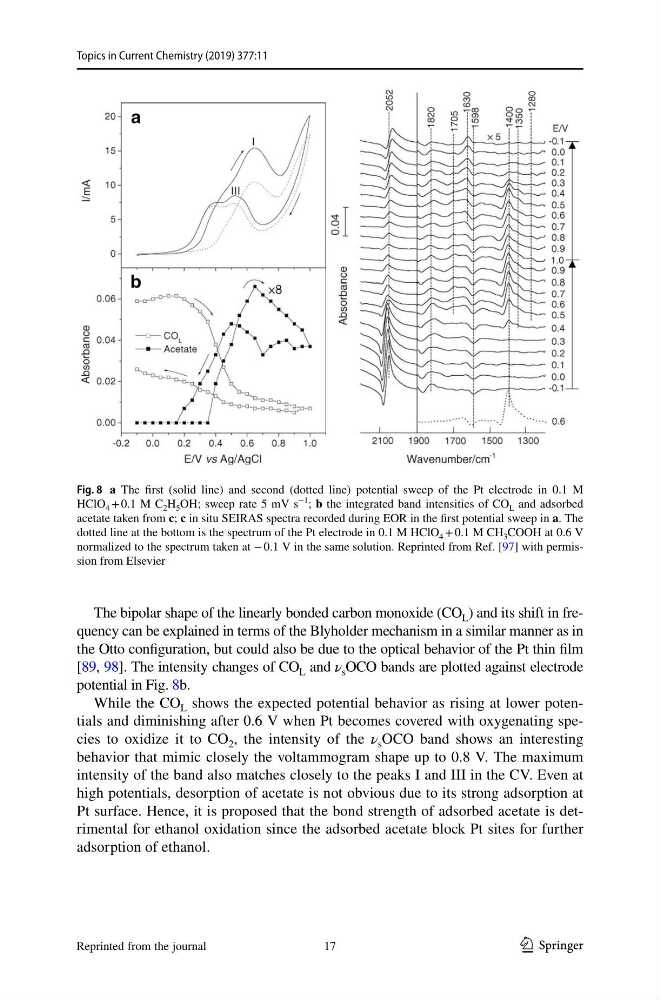
The bipolar shape of the linearly bonded carbon monoxide (CO L ) and its shift in frequency can be explained in terms of the Blyholder mechanism in a similar manner as in
the Otto configuration, but could also be due to the optical behavior of the Pt thin film
[89, 98]. The intensity changes of CO L and ν s OCO bands are plotted against electrode
potential in Fig. 8b.
While the CO L shows the expected potential behavior as rising at lower potentials and diminishing after 0.6 V when Pt becomes covered with oxygenating species to oxidize it to CO 2 , the intensity of the ν s OCO band shows an interesting
behavior that mimic closely the voltammogram shape up to 0.8 V. The maximum
intensity of the band also matches closely to the peaks I and III in the CV. Even at
high potentials, desorption of acetate is not obvious due to its strong adsorption at
Pt surface. Hence, it is proposed that the bond strength of adsorbed acetate is detrimental for ethanol oxidation since the adsorbed acetate block Pt sites for further
adsorption of ethanol.
Fig. 8 a The first (solid line) and second (dotted line) potential sweep of the Pt electrode in 0.1 M
HClO 4 + 0.1 M C 2 H 5 OH; sweep rate 5 mV s
−1
; b the integrated band intensities of CO L and adsorbed
acetate taken from c; c in situ SEIRAS spectra recorded during EOR in the first potential sweep in a. The
dotted line at the bottom is the spectrum of the Pt electrode in 0.1 M HClO 4 + 0.1 M CH 3 COOH at 0.6 V
normalized to the spectrum taken at − 0.1 V in the same solution. Reprinted from Ref. [97] with permission from Elsevier
Reprinted from the journal
17
Topics in Current Chemistry (2019) 377:11
The bipolar shape of the linearly bonded carbon monoxide (CO L ) and its shift in frequency can be explained in terms of the Blyholder mechanism in a similar manner as in
the Otto configuration, but could also be due to the optical behavior of the Pt thin film
[89, 98]. The intensity changes of CO L and ν s OCO bands are plotted against electrode
potential in Fig. 8b.
While the CO L shows the expected potential behavior as rising at lower potentials and diminishing after 0.6 V when Pt becomes covered with oxygenating species to oxidize it to CO 2 , the intensity of the ν s OCO band shows an interesting
behavior that mimic closely the voltammogram shape up to 0.8 V. The maximum
intensity of the band also matches closely to the peaks I and III in the CV. Even at
high potentials, desorption of acetate is not obvious due to its strong adsorption at
Pt surface. Hence, it is proposed that the bond strength of adsorbed acetate is detrimental for ethanol oxidation since the adsorbed acetate block Pt sites for further
adsorption of ethanol.
Fig. 8 a The first (solid line) and second (dotted line) potential sweep of the Pt electrode in 0.1 M
HClO 4 + 0.1 M C 2 H 5 OH; sweep rate 5 mV s
−1
; b the integrated band intensities of CO L and adsorbed
acetate taken from c; c in situ SEIRAS spectra recorded during EOR in the first potential sweep in a. The
dotted line at the bottom is the spectrum of the Pt electrode in 0.1 M HClO 4 + 0.1 M CH 3 COOH at 0.6 V
normalized to the spectrum taken at − 0.1 V in the same solution. Reprinted from Ref. [97] with permission from Elsevier
Reprinted from the journal
17