

Topics in Current Chemistry (2018) 376:43
1 3
An alternative approach to expanding the number of electrochemically interfaced
enzymes (i.e. dehydrogenases) has been to employ secondary and tertiary isomeraseand transferase-based cycles to utilize oxidized fragments for regenerating the parent
biofuel. Zhang and coworkers designed an electrometabolic pathway constructed from
a series of four codependent enzyme cascades to electrochemically oxidize complex
(oligo)saccharides to CO 2 [16–18]. All four cascade sequences were comprised of
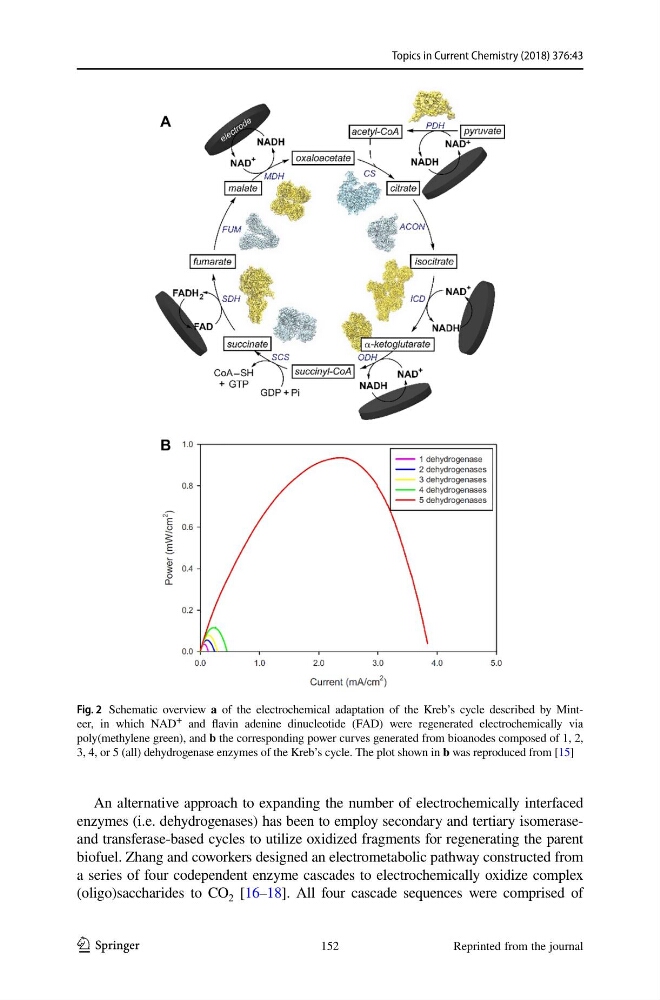
Fig. 2 Schematic overview a of the electrochemical adaptation of the Kreb’s cycle described by Minteer, in which NAD
+ and flavin adenine dinucleotide (FAD) were regenerated electrochemically via
poly(methylene green), and b the corresponding power curves generated from bioanodes composed of 1, 2,
3, 4, or 5 (all) dehydrogenase enzymes of the Kreb’s cycle. The plot shown in b was reproduced from [15]
Reprinted from the journal
152
1 3
An alternative approach to expanding the number of electrochemically interfaced
enzymes (i.e. dehydrogenases) has been to employ secondary and tertiary isomeraseand transferase-based cycles to utilize oxidized fragments for regenerating the parent
biofuel. Zhang and coworkers designed an electrometabolic pathway constructed from
a series of four codependent enzyme cascades to electrochemically oxidize complex
(oligo)saccharides to CO 2 [16–18]. All four cascade sequences were comprised of
Fig. 2 Schematic overview a of the electrochemical adaptation of the Kreb’s cycle described by Minteer, in which NAD
+ and flavin adenine dinucleotide (FAD) were regenerated electrochemically via
poly(methylene green), and b the corresponding power curves generated from bioanodes composed of 1, 2,
3, 4, or 5 (all) dehydrogenase enzymes of the Kreb’s cycle. The plot shown in b was reproduced from [15]
Reprinted from the journal
152