

1 3
Topics in Current Chemistry (2018) 376:43
to be implemented simultaneously, and thus making metabolic enzymes ideal as a
platform around which to design oxidative cascades.
2 Enzymatic Cascades for Electrometabolic (Oligo)Saccharide
Oxidation Pathways
The majority of metabolic enzymes responsible for oxidation steps are dehydrogenase enzymes that utilize nicotinamide adenine dinucleotide (NAD
+
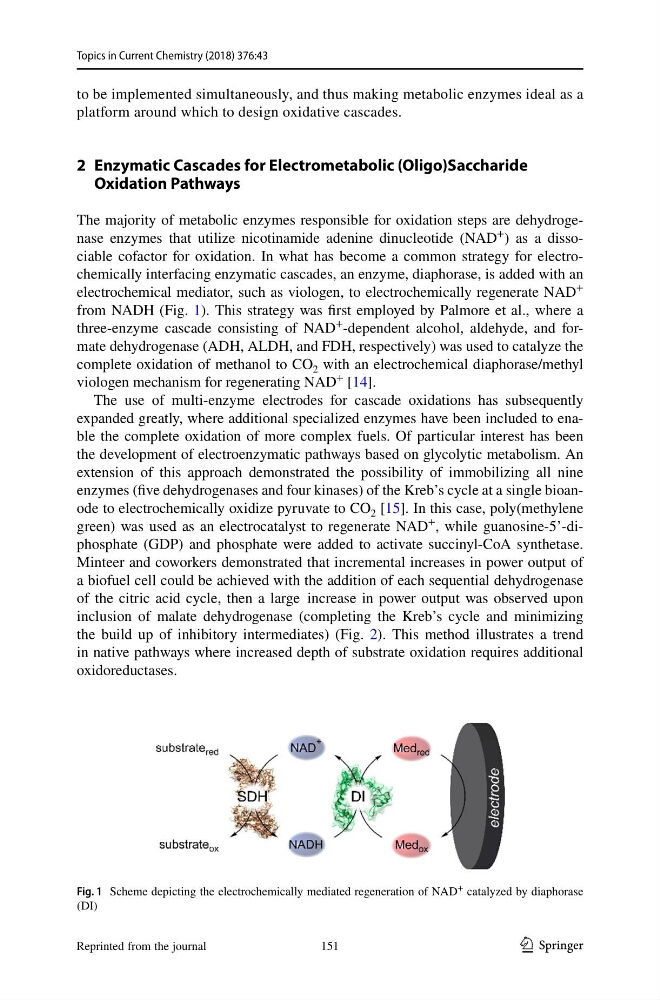
) as a dissociable cofactor for oxidation. In what has become a common strategy for electrochemically interfacing enzymatic cascades, an enzyme, diaphorase, is added with an
electrochemical mediator, such as viologen, to electrochemically regenerate NAD
+
from NADH (Fig. 1). This strategy was first employed by Palmore et al., where a
three-enzyme cascade consisting of NAD
+
-dependent alcohol, aldehyde, and formate dehydrogenase (ADH, ALDH, and FDH, respectively) was used to catalyze the
complete oxidation of methanol to CO 2 with an electrochemical diaphorase/methyl
viologen mechanism for regenerating NAD
+
[14].
The use of multi-enzyme electrodes for cascade oxidations has subsequently
expanded greatly, where additional specialized enzymes have been included to enable the complete oxidation of more complex fuels. Of particular interest has been
the development of electroenzymatic pathways based on glycolytic metabolism. An
extension of this approach demonstrated the possibility of immobilizing all nine
enzymes (five dehydrogenases and four kinases) of the Kreb’s cycle at a single bioanode to electrochemically oxidize pyruvate to CO 2 [15]. In this case, poly(methylene
green) was used as an electrocatalyst to regenerate NAD
+
, while guanosine-5’-diphosphate (GDP) and phosphate were added to activate succinyl-CoA synthetase.
Minteer and coworkers demonstrated that incremental increases in power output of
a biofuel cell could be achieved with the addition of each sequential dehydrogenase
of the citric acid cycle, then a large increase in power output was observed upon
inclusion of malate dehydrogenase (completing the Kreb’s cycle and minimizing
the build up of inhibitory intermediates) (Fig. 2). This method illustrates a trend
in native pathways where increased depth of substrate oxidation requires additional
oxidoreductases.
Fig. 1 Scheme depicting the electrochemically mediated regeneration of NAD
+ catalyzed by diaphorase
(DI)
Reprinted from the journal
151
Topics in Current Chemistry (2018) 376:43
to be implemented simultaneously, and thus making metabolic enzymes ideal as a
platform around which to design oxidative cascades.
2 Enzymatic Cascades for Electrometabolic (Oligo)Saccharide
Oxidation Pathways
The majority of metabolic enzymes responsible for oxidation steps are dehydrogenase enzymes that utilize nicotinamide adenine dinucleotide (NAD
+
) as a dissociable cofactor for oxidation. In what has become a common strategy for electrochemically interfacing enzymatic cascades, an enzyme, diaphorase, is added with an
electrochemical mediator, such as viologen, to electrochemically regenerate NAD
+
from NADH (Fig. 1). This strategy was first employed by Palmore et al., where a
three-enzyme cascade consisting of NAD
+
-dependent alcohol, aldehyde, and formate dehydrogenase (ADH, ALDH, and FDH, respectively) was used to catalyze the
complete oxidation of methanol to CO 2 with an electrochemical diaphorase/methyl
viologen mechanism for regenerating NAD
+
[14].
The use of multi-enzyme electrodes for cascade oxidations has subsequently
expanded greatly, where additional specialized enzymes have been included to enable the complete oxidation of more complex fuels. Of particular interest has been
the development of electroenzymatic pathways based on glycolytic metabolism. An
extension of this approach demonstrated the possibility of immobilizing all nine
enzymes (five dehydrogenases and four kinases) of the Kreb’s cycle at a single bioanode to electrochemically oxidize pyruvate to CO 2 [15]. In this case, poly(methylene
green) was used as an electrocatalyst to regenerate NAD
+
, while guanosine-5’-diphosphate (GDP) and phosphate were added to activate succinyl-CoA synthetase.
Minteer and coworkers demonstrated that incremental increases in power output of
a biofuel cell could be achieved with the addition of each sequential dehydrogenase
of the citric acid cycle, then a large increase in power output was observed upon
inclusion of malate dehydrogenase (completing the Kreb’s cycle and minimizing
the build up of inhibitory intermediates) (Fig. 2). This method illustrates a trend
in native pathways where increased depth of substrate oxidation requires additional
oxidoreductases.
Fig. 1 Scheme depicting the electrochemically mediated regeneration of NAD
+ catalyzed by diaphorase
(DI)
Reprinted from the journal
151