

Topics in Current Chemistry (2019) 377:4
1 3
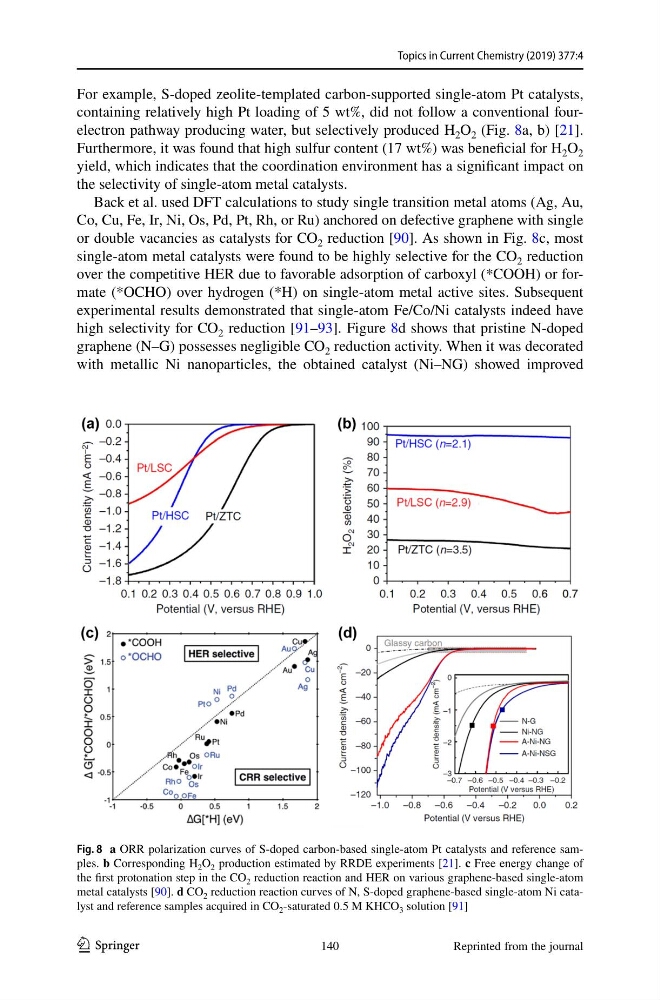
For example, S-doped zeolite-templated carbon-supported single-atom Pt catalysts,
containing relatively high Pt loading of 5 wt%, did not follow a conventional fourelectron pathway producing water, but selectively produced H 2 O 2 (Fig. 8a, b) [21].
Furthermore, it was found that high sulfur content (17 wt%) was beneficial for H 2 O 2
yield, which indicates that the coordination environment has a significant impact on
the selectivity of single-atom metal catalysts.
Back et al. used DFT calculations to study single transition metal atoms (Ag, Au,
Co, Cu, Fe, Ir, Ni, Os, Pd, Pt, Rh, or Ru) anchored on defective graphene with single
or double vacancies as catalysts for CO 2 reduction [90]. As shown in Fig. 8c, most
single-atom metal catalysts were found to be highly selective for the CO 2 reduction
over the competitive HER due to favorable adsorption of carboxyl (*COOH) or formate (*OCHO) over hydrogen (*H) on single-atom metal active sites. Subsequent
experimental results demonstrated that single-atom Fe/Co/Ni catalysts indeed have
high selectivity for CO 2 reduction [91–93]. Figure 8d shows that pristine N-doped
graphene (N–G) possesses negligible CO 2 reduction activity. When it was decorated
with metallic Ni nanoparticles, the obtained catalyst (Ni–NG) showed improved
Fig. 8 a ORR polarization curves of S-doped carbon-based single-atom Pt catalysts and reference samples. b Corresponding H 2 O 2 production estimated by RRDE experiments [21]. c Free energy change of
the first protonation step in the CO 2 reduction reaction and HER on various graphene-based single-atom
metal catalysts [90]. d CO 2 reduction reaction curves of N, S-doped graphene-based single-atom Ni catalyst and reference samples acquired in CO 2 -saturated 0.5 M KHCO 3 solution [91]
Reprinted from the journal
140
1 3
For example, S-doped zeolite-templated carbon-supported single-atom Pt catalysts,
containing relatively high Pt loading of 5 wt%, did not follow a conventional fourelectron pathway producing water, but selectively produced H 2 O 2 (Fig. 8a, b) [21].
Furthermore, it was found that high sulfur content (17 wt%) was beneficial for H 2 O 2
yield, which indicates that the coordination environment has a significant impact on
the selectivity of single-atom metal catalysts.
Back et al. used DFT calculations to study single transition metal atoms (Ag, Au,
Co, Cu, Fe, Ir, Ni, Os, Pd, Pt, Rh, or Ru) anchored on defective graphene with single
or double vacancies as catalysts for CO 2 reduction [90]. As shown in Fig. 8c, most
single-atom metal catalysts were found to be highly selective for the CO 2 reduction
over the competitive HER due to favorable adsorption of carboxyl (*COOH) or formate (*OCHO) over hydrogen (*H) on single-atom metal active sites. Subsequent
experimental results demonstrated that single-atom Fe/Co/Ni catalysts indeed have
high selectivity for CO 2 reduction [91–93]. Figure 8d shows that pristine N-doped
graphene (N–G) possesses negligible CO 2 reduction activity. When it was decorated
with metallic Ni nanoparticles, the obtained catalyst (Ni–NG) showed improved
Fig. 8 a ORR polarization curves of S-doped carbon-based single-atom Pt catalysts and reference samples. b Corresponding H 2 O 2 production estimated by RRDE experiments [21]. c Free energy change of
the first protonation step in the CO 2 reduction reaction and HER on various graphene-based single-atom
metal catalysts [90]. d CO 2 reduction reaction curves of N, S-doped graphene-based single-atom Ni catalyst and reference samples acquired in CO 2 -saturated 0.5 M KHCO 3 solution [91]
Reprinted from the journal
140