

1 3
Topics in Current Chemistry (2019) 377:4
stability in comparison with the state-of-the-art commercial Pt/C catalysts [34].
Liang et al. synthesized a novel type of catalyst using single cobalt atoms coordinated with N-doped carbon (CoN x /C) by the pyrolysis of Co–N 4 macrocycles or
Co/o-phenylenediamine composites and using silica colloids as a hard template
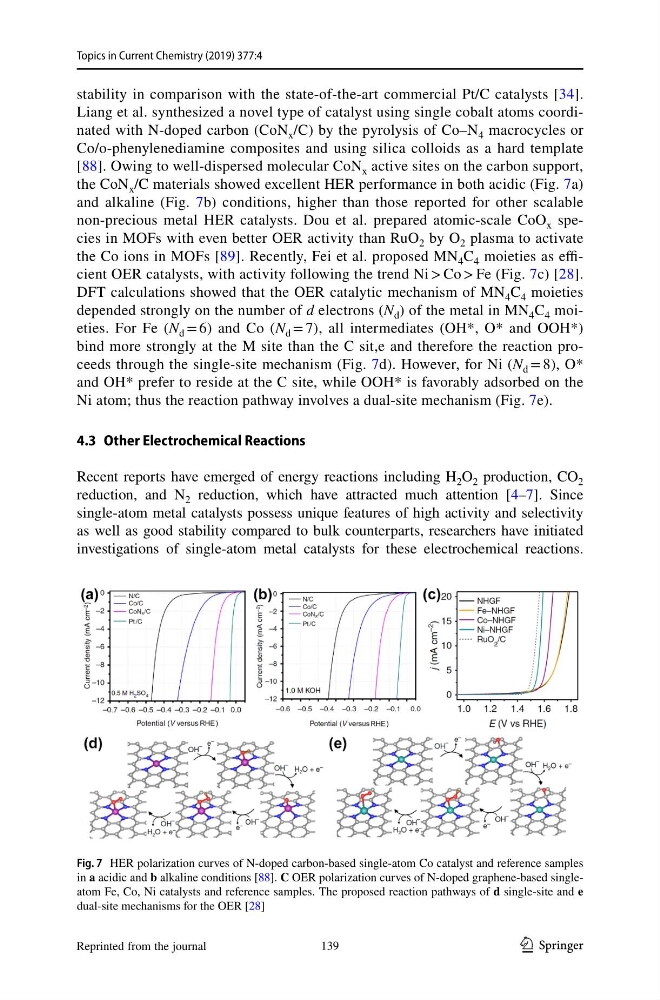
[88]. Owing to well-dispersed molecular CoN x active sites on the carbon support,
the CoN x /C materials showed excellent HER performance in both acidic (Fig. 7a)
and alkaline (Fig. 7b) conditions, higher than those reported for other scalable
non-precious metal HER catalysts. Dou et al. prepared atomic-scale CoO x species in MOFs with even better OER activity than RuO 2 by O 2 plasma to activate
the Co ions in MOFs [89]. Recently, Fei et al. proposed MN 4 C 4 moieties as efficient OER catalysts, with activity following the trend Ni > Co > Fe (Fig. 7c) [28].
DFT calculations showed that the OER catalytic mechanism of MN 4 C 4 moieties
depended strongly on the number of d electrons (N d ) of the metal in MN 4 C 4 moieties. For Fe (N d = 6) and Co (N d = 7), all intermediates (OH*, O* and OOH*)
bind more strongly at the M site than the C sit,e and therefore the reaction proceeds through the single-site mechanism (Fig. 7d). However, for Ni (N d = 8), O*
and OH* prefer to reside at the C site, while OOH* is favorably adsorbed on the
Ni atom; thus the reaction pathway involves a dual-site mechanism (Fig. 7e).
4.3 Other Electrochemical Reactions
Recent reports have emerged of energy reactions including H 2 O 2 production, CO 2
reduction, and N 2 reduction, which have attracted much attention [4–7]. Since
single-atom metal catalysts possess unique features of high activity and selectivity
as well as good stability compared to bulk counterparts, researchers have initiated
investigations of single-atom metal catalysts for these electrochemical reactions.
Fig. 7 HER polarization curves of N-doped carbon-based single-atom Co catalyst and reference samples
in a acidic and b alkaline conditions [88]. C OER polarization curves of N-doped graphene-based singleatom Fe, Co, Ni catalysts and reference samples. The proposed reaction pathways of d single-site and e
dual-site mechanisms for the OER [28]
Reprinted from the journal
139
Topics in Current Chemistry (2019) 377:4
stability in comparison with the state-of-the-art commercial Pt/C catalysts [34].
Liang et al. synthesized a novel type of catalyst using single cobalt atoms coordinated with N-doped carbon (CoN x /C) by the pyrolysis of Co–N 4 macrocycles or
Co/o-phenylenediamine composites and using silica colloids as a hard template
[88]. Owing to well-dispersed molecular CoN x active sites on the carbon support,
the CoN x /C materials showed excellent HER performance in both acidic (Fig. 7a)
and alkaline (Fig. 7b) conditions, higher than those reported for other scalable
non-precious metal HER catalysts. Dou et al. prepared atomic-scale CoO x species in MOFs with even better OER activity than RuO 2 by O 2 plasma to activate
the Co ions in MOFs [89]. Recently, Fei et al. proposed MN 4 C 4 moieties as efficient OER catalysts, with activity following the trend Ni > Co > Fe (Fig. 7c) [28].
DFT calculations showed that the OER catalytic mechanism of MN 4 C 4 moieties
depended strongly on the number of d electrons (N d ) of the metal in MN 4 C 4 moieties. For Fe (N d = 6) and Co (N d = 7), all intermediates (OH*, O* and OOH*)
bind more strongly at the M site than the C sit,e and therefore the reaction proceeds through the single-site mechanism (Fig. 7d). However, for Ni (N d = 8), O*
and OH* prefer to reside at the C site, while OOH* is favorably adsorbed on the
Ni atom; thus the reaction pathway involves a dual-site mechanism (Fig. 7e).
4.3 Other Electrochemical Reactions
Recent reports have emerged of energy reactions including H 2 O 2 production, CO 2
reduction, and N 2 reduction, which have attracted much attention [4–7]. Since
single-atom metal catalysts possess unique features of high activity and selectivity
as well as good stability compared to bulk counterparts, researchers have initiated
investigations of single-atom metal catalysts for these electrochemical reactions.
Fig. 7 HER polarization curves of N-doped carbon-based single-atom Co catalyst and reference samples
in a acidic and b alkaline conditions [88]. C OER polarization curves of N-doped graphene-based singleatom Fe, Co, Ni catalysts and reference samples. The proposed reaction pathways of d single-site and e
dual-site mechanisms for the OER [28]
Reprinted from the journal
139