

1 3
Topics in Current Chemistry (2019) 377:4
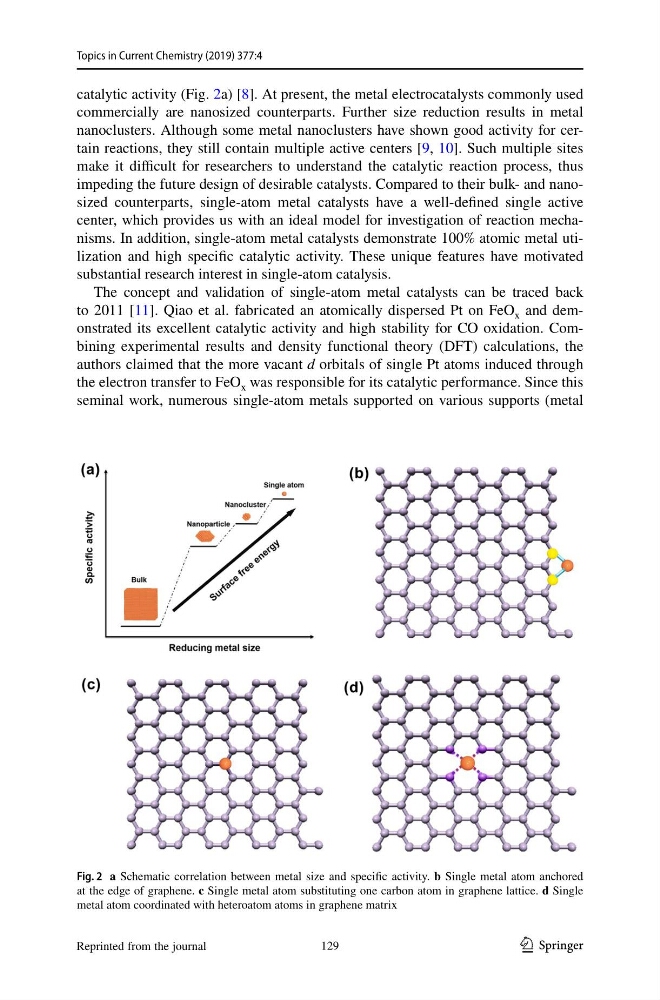
catalytic activity (Fig. 2a) [8]. At present, the metal electrocatalysts commonly used
commercially are nanosized counterparts. Further size reduction results in metal
nanoclusters. Although some metal nanoclusters have shown good activity for certain reactions, they still contain multiple active centers [9, 10]. Such multiple sites
make it difficult for researchers to understand the catalytic reaction process, thus
impeding the future design of desirable catalysts. Compared to their bulk- and nanosized counterparts, single-atom metal catalysts have a well-defined single active
center, which provides us with an ideal model for investigation of reaction mechanisms. In addition, single-atom metal catalysts demonstrate 100% atomic metal utilization and high specific catalytic activity. These unique features have motivated
substantial research interest in single-atom catalysis.
The concept and validation of single-atom metal catalysts can be traced back
to 2011 [11]. Qiao et al. fabricated an atomically dispersed Pt on FeO x and demonstrated its excellent catalytic activity and high stability for CO oxidation. Combining experimental results and density functional theory (DFT) calculations, the
authors claimed that the more vacant d orbitals of single Pt atoms induced through
the electron transfer to FeO x was responsible for its catalytic performance. Since this
seminal work, numerous single-atom metals supported on various supports (metal
Fig. 2 a Schematic correlation between metal size and specific activity. b Single metal atom anchored
at the edge of graphene. c Single metal atom substituting one carbon atom in graphene lattice. d Single
metal atom coordinated with heteroatom atoms in graphene matrix
Reprinted from the journal
129
Topics in Current Chemistry (2019) 377:4
catalytic activity (Fig. 2a) [8]. At present, the metal electrocatalysts commonly used
commercially are nanosized counterparts. Further size reduction results in metal
nanoclusters. Although some metal nanoclusters have shown good activity for certain reactions, they still contain multiple active centers [9, 10]. Such multiple sites
make it difficult for researchers to understand the catalytic reaction process, thus
impeding the future design of desirable catalysts. Compared to their bulk- and nanosized counterparts, single-atom metal catalysts have a well-defined single active
center, which provides us with an ideal model for investigation of reaction mechanisms. In addition, single-atom metal catalysts demonstrate 100% atomic metal utilization and high specific catalytic activity. These unique features have motivated
substantial research interest in single-atom catalysis.
The concept and validation of single-atom metal catalysts can be traced back
to 2011 [11]. Qiao et al. fabricated an atomically dispersed Pt on FeO x and demonstrated its excellent catalytic activity and high stability for CO oxidation. Combining experimental results and density functional theory (DFT) calculations, the
authors claimed that the more vacant d orbitals of single Pt atoms induced through
the electron transfer to FeO x was responsible for its catalytic performance. Since this
seminal work, numerous single-atom metals supported on various supports (metal
Fig. 2 a Schematic correlation between metal size and specific activity. b Single metal atom anchored
at the edge of graphene. c Single metal atom substituting one carbon atom in graphene lattice. d Single
metal atom coordinated with heteroatom atoms in graphene matrix
Reprinted from the journal
129