

Topics in Current Chemistry (2019) 377:4
1 3
1 Introduction
The exploitation of clean and renewable energy technologies as alternatives to traditional fossil fuels has become a compelling need, given the effects of rapid energy
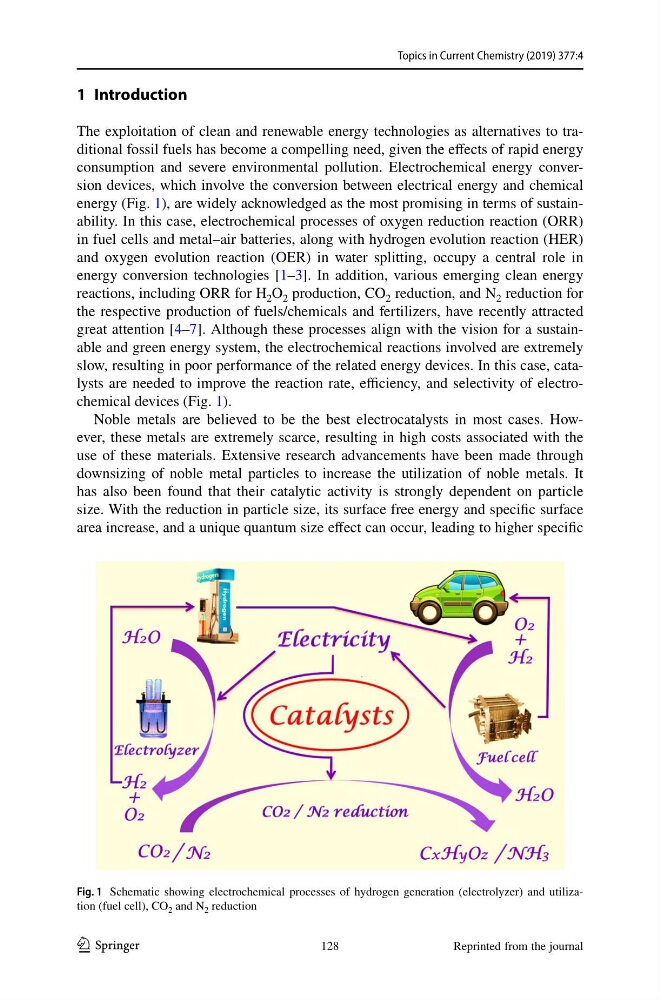
consumption and severe environmental pollution. Electrochemical energy conversion devices, which involve the conversion between electrical energy and chemical
energy (Fig. 1), are widely acknowledged as the most promising in terms of sustainability. In this case, electrochemical processes of oxygen reduction reaction (ORR)
in fuel cells and metal–air batteries, along with hydrogen evolution reaction (HER)
and oxygen evolution reaction (OER) in water splitting, occupy a central role in
energy conversion technologies [1–3]. In addition, various emerging clean energy
reactions, including ORR for H 2 O 2 production, CO 2 reduction, and N 2 reduction for
the respective production of fuels/chemicals and fertilizers, have recently attracted
great attention [4–7]. Although these processes align with the vision for a sustainable and green energy system, the electrochemical reactions involved are extremely
slow, resulting in poor performance of the related energy devices. In this case, catalysts are needed to improve the reaction rate, efficiency, and selectivity of electrochemical devices (Fig. 1).
Noble metals are believed to be the best electrocatalysts in most cases. However, these metals are extremely scarce, resulting in high costs associated with the
use of these materials. Extensive research advancements have been made through
downsizing of noble metal particles to increase the utilization of noble metals. It
has also been found that their catalytic activity is strongly dependent on particle
size. With the reduction in particle size, its surface free energy and specific surface
area increase, and a unique quantum size effect can occur, leading to higher specific
Fig. 1 Schematic showing electrochemical processes of hydrogen generation (electrolyzer) and utilization (fuel cell), CO 2 and N 2 reduction
Reprinted from the journal
128
1 3
1 Introduction
The exploitation of clean and renewable energy technologies as alternatives to traditional fossil fuels has become a compelling need, given the effects of rapid energy
consumption and severe environmental pollution. Electrochemical energy conversion devices, which involve the conversion between electrical energy and chemical
energy (Fig. 1), are widely acknowledged as the most promising in terms of sustainability. In this case, electrochemical processes of oxygen reduction reaction (ORR)
in fuel cells and metal–air batteries, along with hydrogen evolution reaction (HER)
and oxygen evolution reaction (OER) in water splitting, occupy a central role in
energy conversion technologies [1–3]. In addition, various emerging clean energy
reactions, including ORR for H 2 O 2 production, CO 2 reduction, and N 2 reduction for
the respective production of fuels/chemicals and fertilizers, have recently attracted
great attention [4–7]. Although these processes align with the vision for a sustainable and green energy system, the electrochemical reactions involved are extremely
slow, resulting in poor performance of the related energy devices. In this case, catalysts are needed to improve the reaction rate, efficiency, and selectivity of electrochemical devices (Fig. 1).
Noble metals are believed to be the best electrocatalysts in most cases. However, these metals are extremely scarce, resulting in high costs associated with the
use of these materials. Extensive research advancements have been made through
downsizing of noble metal particles to increase the utilization of noble metals. It
has also been found that their catalytic activity is strongly dependent on particle
size. With the reduction in particle size, its surface free energy and specific surface
area increase, and a unique quantum size effect can occur, leading to higher specific
Fig. 1 Schematic showing electrochemical processes of hydrogen generation (electrolyzer) and utilization (fuel cell), CO 2 and N 2 reduction
Reprinted from the journal
128