

Topics in Current Chemistry (2018) 376:41
1 3
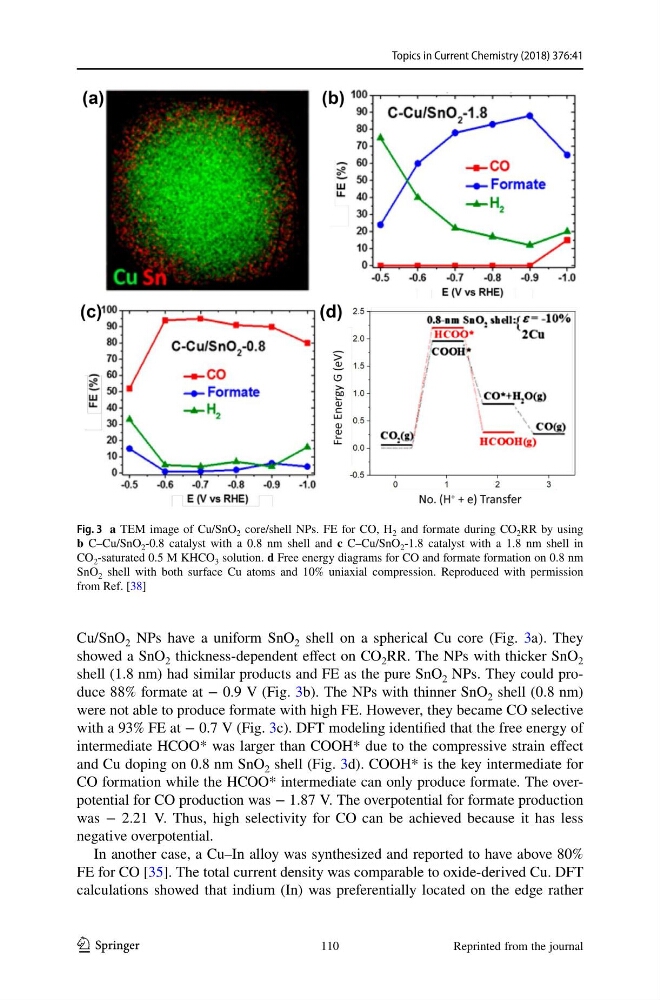
Cu/SnO 2 NPs have a uniform SnO 2 shell on a spherical Cu core (Fig. 3a). They
showed a SnO 2 thickness-dependent effect on CO 2 RR. The NPs with thicker SnO 2
shell (1.8 nm) had similar products and FE as the pure SnO 2 NPs. They could produce 88% formate at − 0.9 V (Fig. 3b). The NPs with thinner SnO 2 shell (0.8 nm)
were not able to produce formate with high FE. However, they became CO selective
with a 93% FE at − 0.7 V (Fig. 3c). DFT modeling identified that the free energy of
intermediate HCOO* was larger than COOH* due to the compressive strain effect
and Cu doping on 0.8 nm SnO 2 shell (Fig. 3d). COOH* is the key intermediate for
CO formation while the HCOO* intermediate can only produce formate. The overpotential for CO production was − 1.87 V. The overpotential for formate production
was − 2.21 V. Thus, high selectivity for CO can be achieved because it has less
negative overpotential.
In another case, a Cu–In alloy was synthesized and reported to have above 80%
FE for CO [35]. The total current density was comparable to oxide-derived Cu. DFT
calculations showed that indium (In) was preferentially located on the edge rather
Fig. 3 a TEM image of Cu/SnO 2 core/shell NPs. FE for CO, H 2 and formate during CO 2 RR by using
b C–Cu/SnO 2 -0.8 catalyst with a 0.8 nm shell and c C–Cu/SnO 2 -1.8 catalyst with a 1.8 nm shell in
CO 2 -saturated 0.5 M KHCO 3 solution. d Free energy diagrams for CO and formate formation on 0.8 nm
SnO 2 shell with both surface Cu atoms and 10% uniaxial compression. Reproduced with permission
from Ref. [38]
Reprinted from the journal
110
1 3
Cu/SnO 2 NPs have a uniform SnO 2 shell on a spherical Cu core (Fig. 3a). They
showed a SnO 2 thickness-dependent effect on CO 2 RR. The NPs with thicker SnO 2
shell (1.8 nm) had similar products and FE as the pure SnO 2 NPs. They could produce 88% formate at − 0.9 V (Fig. 3b). The NPs with thinner SnO 2 shell (0.8 nm)
were not able to produce formate with high FE. However, they became CO selective
with a 93% FE at − 0.7 V (Fig. 3c). DFT modeling identified that the free energy of
intermediate HCOO* was larger than COOH* due to the compressive strain effect
and Cu doping on 0.8 nm SnO 2 shell (Fig. 3d). COOH* is the key intermediate for
CO formation while the HCOO* intermediate can only produce formate. The overpotential for CO production was − 1.87 V. The overpotential for formate production
was − 2.21 V. Thus, high selectivity for CO can be achieved because it has less
negative overpotential.
In another case, a Cu–In alloy was synthesized and reported to have above 80%
FE for CO [35]. The total current density was comparable to oxide-derived Cu. DFT
calculations showed that indium (In) was preferentially located on the edge rather
Fig. 3 a TEM image of Cu/SnO 2 core/shell NPs. FE for CO, H 2 and formate during CO 2 RR by using
b C–Cu/SnO 2 -0.8 catalyst with a 0.8 nm shell and c C–Cu/SnO 2 -1.8 catalyst with a 1.8 nm shell in
CO 2 -saturated 0.5 M KHCO 3 solution. d Free energy diagrams for CO and formate formation on 0.8 nm
SnO 2 shell with both surface Cu atoms and 10% uniaxial compression. Reproduced with permission
from Ref. [38]
Reprinted from the journal
110