

1 3
Topics in Current Chemistry (2018) 376:41
as COOH, CO and H, increases the CO formation and suppresses the methane
formation.
Utilizing the strain effect is another strategy to tune the surface d-band center.
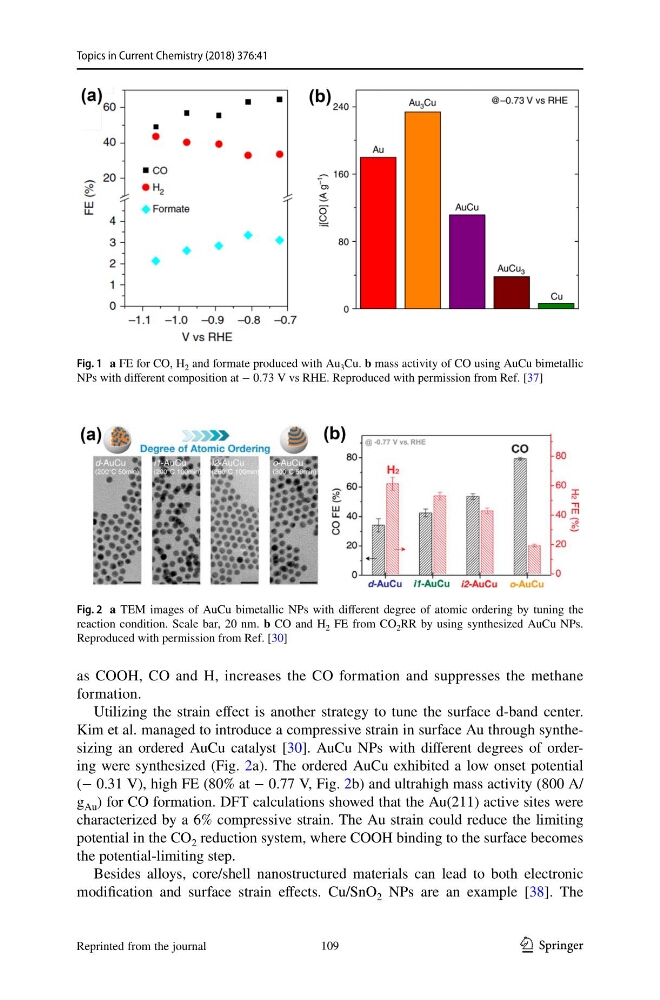
Kim et al. managed to introduce a compressive strain in surface Au through synthesizing an ordered AuCu catalyst [30]. AuCu NPs with different degrees of ordering were synthesized (Fig. 2a). The ordered AuCu exhibited a low onset potential
(− 0.31 V), high FE (80% at − 0.77 V, Fig. 2b) and ultrahigh mass activity (800 A/
g Au ) for CO formation. DFT calculations showed that the Au(211) active sites were
characterized by a 6% compressive strain. The Au strain could reduce the limiting
potential in the CO 2 reduction system, where COOH binding to the surface becomes
the potential-limiting step.
Besides alloys, core/shell nanostructured materials can lead to both electronic
modification and surface strain effects. Cu/SnO 2 NPs are an example [38]. The
Fig. 1 a FE for CO, H 2 and formate produced with Au 3 Cu. b mass activity of CO using AuCu bimetallic
NPs with different composition at − 0.73 V vs RHE. Reproduced with permission from Ref. [37]
Fig. 2 a TEM images of AuCu bimetallic NPs with different degree of atomic ordering by tuning the
reaction condition. Scale bar, 20 nm. b CO and H 2 FE from CO 2 RR by using synthesized AuCu NPs.
Reproduced with permission from Ref. [30]
Reprinted from the journal
109
Topics in Current Chemistry (2018) 376:41
as COOH, CO and H, increases the CO formation and suppresses the methane
formation.
Utilizing the strain effect is another strategy to tune the surface d-band center.
Kim et al. managed to introduce a compressive strain in surface Au through synthesizing an ordered AuCu catalyst [30]. AuCu NPs with different degrees of ordering were synthesized (Fig. 2a). The ordered AuCu exhibited a low onset potential
(− 0.31 V), high FE (80% at − 0.77 V, Fig. 2b) and ultrahigh mass activity (800 A/
g Au ) for CO formation. DFT calculations showed that the Au(211) active sites were
characterized by a 6% compressive strain. The Au strain could reduce the limiting
potential in the CO 2 reduction system, where COOH binding to the surface becomes
the potential-limiting step.
Besides alloys, core/shell nanostructured materials can lead to both electronic
modification and surface strain effects. Cu/SnO 2 NPs are an example [38]. The
Fig. 1 a FE for CO, H 2 and formate produced with Au 3 Cu. b mass activity of CO using AuCu bimetallic
NPs with different composition at − 0.73 V vs RHE. Reproduced with permission from Ref. [37]
Fig. 2 a TEM images of AuCu bimetallic NPs with different degree of atomic ordering by tuning the
reaction condition. Scale bar, 20 nm. b CO and H 2 FE from CO 2 RR by using synthesized AuCu NPs.
Reproduced with permission from Ref. [30]
Reprinted from the journal
109