

1 3
Topics in Current Chemistry (2019) 377:5
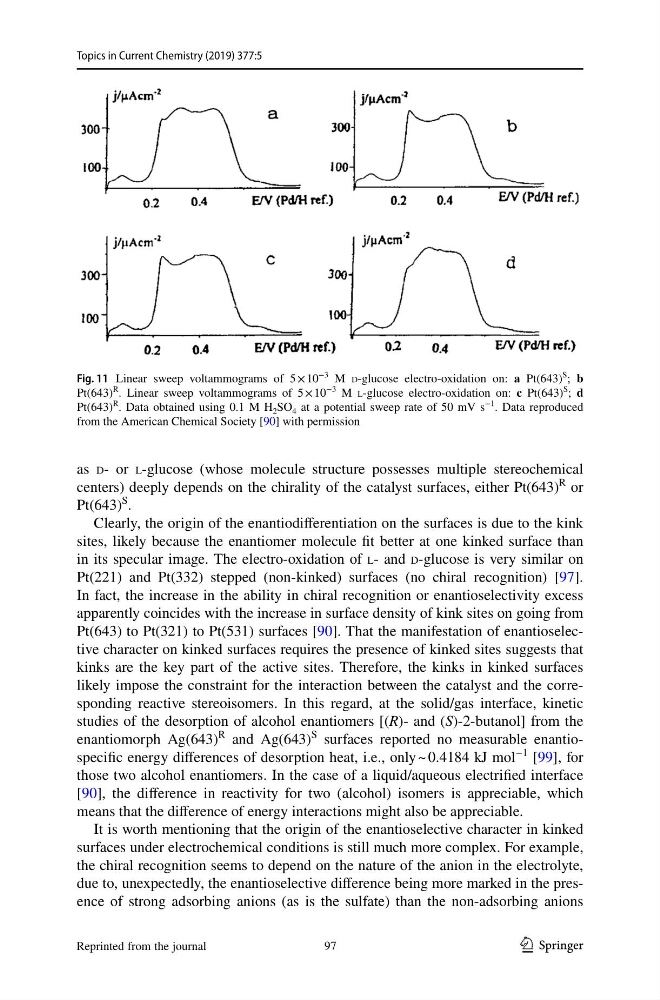
as d- or l-glucose (whose molecule structure possesses multiple stereochemical
centers) deeply depends on the chirality of the catalyst surfaces, either Pt(643)
R
or
Pt(643)
S
.
Clearly, the origin of the enantiodifferentiation on the surfaces is due to the kink
sites, likely because the enantiomer molecule fit better at one kinked surface than
in its specular image. The electro-oxidation of l- and d-glucose is very similar on
Pt(221) and Pt(332) stepped (non-kinked) surfaces (no chiral recognition) [97].
In fact, the increase in the ability in chiral recognition or enantioselectivity excess
apparently coincides with the increase in surface density of kink sites on going from
Pt(643) to Pt(321) to Pt(531) surfaces [90]. That the manifestation of enantioselective character on kinked surfaces requires the presence of kinked sites suggests that
kinks are the key part of the active sites. Therefore, the kinks in kinked surfaces
likely impose the constraint for the interaction between the catalyst and the corresponding reactive stereoisomers. In this regard, at the solid/gas interface, kinetic
studies of the desorption of alcohol enantiomers [(R)- and (S)-2-butanol] from the
enantiomorph Ag(643)
R
and Ag(643)
S
surfaces reported no measurable enantiospecific energy differences of desorption heat, i.e., only ~ 0.4184 kJ mol
−1
[99], for
those two alcohol enantiomers. In the case of a liquid/aqueous electrified interface
[90], the difference in reactivity for two (alcohol) isomers is appreciable, which
means that the difference of energy interactions might also be appreciable.
It is worth mentioning that the origin of the enantioselective character in kinked
surfaces under electrochemical conditions is still much more complex. For example,
the chiral recognition seems to depend on the nature of the anion in the electrolyte,
due to, unexpectedly, the enantioselective difference being more marked in the presence of strong adsorbing anions (as is the sulfate) than the non-adsorbing anions
Fig. 11 Linear sweep voltammograms of 5 × 10
−3 M d-glucose electro-oxidation on: a Pt(643)
S ; b
Pt(643)
R . Linear sweep voltammograms of 5 × 10
−3 M l-glucose electro-oxidation on: c Pt(643)
S ; d
Pt(643)
R . Data obtained using 0.1 M H 2 SO 4 at a potential sweep rate of 50 mV s
−1 . Data reproduced
from the American Chemical Society [90] with permission
Reprinted from the journal
97
Topics in Current Chemistry (2019) 377:5
as d- or l-glucose (whose molecule structure possesses multiple stereochemical
centers) deeply depends on the chirality of the catalyst surfaces, either Pt(643)
R
or
Pt(643)
S
.
Clearly, the origin of the enantiodifferentiation on the surfaces is due to the kink
sites, likely because the enantiomer molecule fit better at one kinked surface than
in its specular image. The electro-oxidation of l- and d-glucose is very similar on
Pt(221) and Pt(332) stepped (non-kinked) surfaces (no chiral recognition) [97].
In fact, the increase in the ability in chiral recognition or enantioselectivity excess
apparently coincides with the increase in surface density of kink sites on going from
Pt(643) to Pt(321) to Pt(531) surfaces [90]. That the manifestation of enantioselective character on kinked surfaces requires the presence of kinked sites suggests that
kinks are the key part of the active sites. Therefore, the kinks in kinked surfaces
likely impose the constraint for the interaction between the catalyst and the corresponding reactive stereoisomers. In this regard, at the solid/gas interface, kinetic
studies of the desorption of alcohol enantiomers [(R)- and (S)-2-butanol] from the
enantiomorph Ag(643)
R
and Ag(643)
S
surfaces reported no measurable enantiospecific energy differences of desorption heat, i.e., only ~ 0.4184 kJ mol
−1
[99], for
those two alcohol enantiomers. In the case of a liquid/aqueous electrified interface
[90], the difference in reactivity for two (alcohol) isomers is appreciable, which
means that the difference of energy interactions might also be appreciable.
It is worth mentioning that the origin of the enantioselective character in kinked
surfaces under electrochemical conditions is still much more complex. For example,
the chiral recognition seems to depend on the nature of the anion in the electrolyte,
due to, unexpectedly, the enantioselective difference being more marked in the presence of strong adsorbing anions (as is the sulfate) than the non-adsorbing anions
Fig. 11 Linear sweep voltammograms of 5 × 10
−3 M d-glucose electro-oxidation on: a Pt(643)
S ; b
Pt(643)
R . Linear sweep voltammograms of 5 × 10
−3 M l-glucose electro-oxidation on: c Pt(643)
S ; d
Pt(643)
R . Data obtained using 0.1 M H 2 SO 4 at a potential sweep rate of 50 mV s
−1 . Data reproduced
from the American Chemical Society [90] with permission
Reprinted from the journal
97