

Topics in Current Chemistry (2019) 377:5
1 3
[94, 95]. Inherently, the electro-deposited material seems to retain a chiral character after removal of the template molecules [94, 95]. However, in view of its
well-defined surface structure, for understanding underlying factors controlling
the chiral properties, the chiral surfaces must be designed, and in this case, the
intrinsically chiral single crystal kinked surface is a suitable template for electrocatalytic studies.
As highlighted above, the enantiodifferentiation with kinked surfaces is due to
the kink sites; consequently, they are the origin of the difference in electro-catalytic
activity and discrimination of possible reaction pathway at this kind of surface. The
first experimental example of enantiospecific interaction/adsorption of chirality on
single crystal electrodes was provided in 1999 [97] for the electro-oxidation of dand l-glucose at the Pt(643)
R
and its enantiomorph Pt(643)
S
surfaces, respectively,
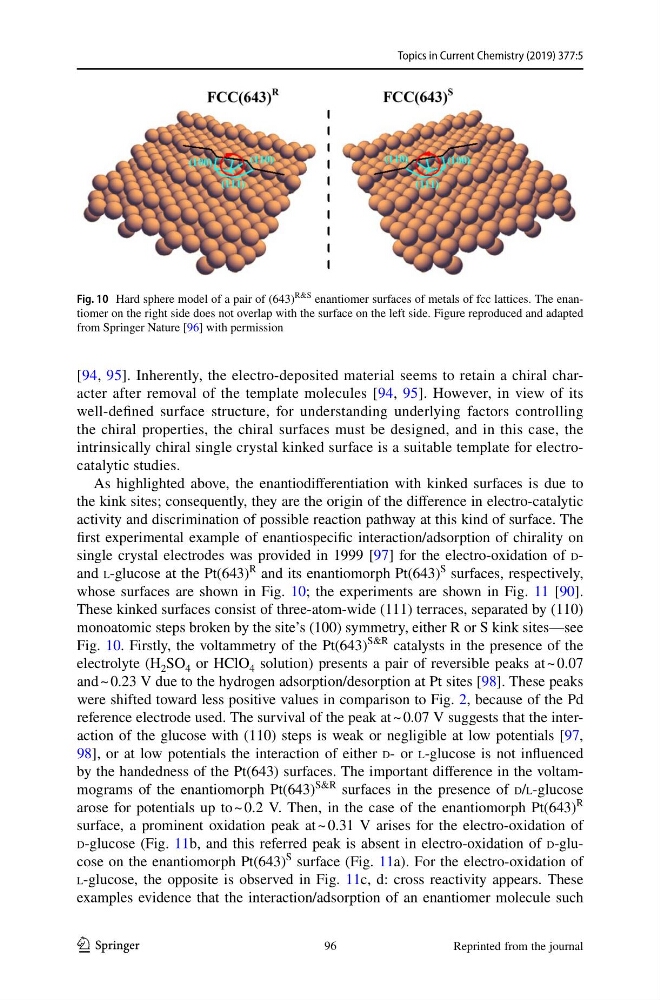
whose surfaces are shown in Fig. 10; the experiments are shown in Fig. 11 [90].
These kinked surfaces consist of three-atom-wide (111) terraces, separated by (110)
monoatomic steps broken by the site’s (100) symmetry, either R or S kink sites—see
Fig. 10. Firstly, the voltammetry of the Pt(643)
S&R
catalysts in the presence of the
electrolyte (H 2 SO 4 or HClO 4 solution) presents a pair of reversible peaks at ~ 0.07
and ~ 0.23 V due to the hydrogen adsorption/desorption at Pt sites [98]. These peaks
were shifted toward less positive values in comparison to Fig. 2, because of the Pd
reference electrode used. The survival of the peak at ~ 0.07 V suggests that the interaction of the glucose with (110) steps is weak or negligible at low potentials [97,
98], or at low potentials the interaction of either d- or l-glucose is not influenced
by the handedness of the Pt(643) surfaces. The important difference in the voltammograms of the enantiomorph Pt(643)
S&R
surfaces in the presence of d/l-glucose
arose for potentials up to ~ 0.2 V. Then, in the case of the enantiomorph Pt(643)
R
surface, a prominent oxidation peak at ~ 0.31 V arises for the electro-oxidation of
d-glucose (Fig. 11b, and this referred peak is absent in electro-oxidation of d-glucose on the enantiomorph Pt(643)
S
surface (Fig. 11a). For the electro-oxidation of
l-glucose, the opposite is observed in Fig. 11c, d: cross reactivity appears. These
examples evidence that the interaction/adsorption of an enantiomer molecule such
Fig. 10 Hard sphere model of a pair of (643)
R&S enantiomer surfaces of metals of fcc lattices. The enantiomer on the right side does not overlap with the surface on the left side. Figure reproduced and adapted
from Springer Nature [96] with permission
Reprinted from the journal
96
1 3
[94, 95]. Inherently, the electro-deposited material seems to retain a chiral character after removal of the template molecules [94, 95]. However, in view of its
well-defined surface structure, for understanding underlying factors controlling
the chiral properties, the chiral surfaces must be designed, and in this case, the
intrinsically chiral single crystal kinked surface is a suitable template for electrocatalytic studies.
As highlighted above, the enantiodifferentiation with kinked surfaces is due to
the kink sites; consequently, they are the origin of the difference in electro-catalytic
activity and discrimination of possible reaction pathway at this kind of surface. The
first experimental example of enantiospecific interaction/adsorption of chirality on
single crystal electrodes was provided in 1999 [97] for the electro-oxidation of dand l-glucose at the Pt(643)
R
and its enantiomorph Pt(643)
S
surfaces, respectively,
whose surfaces are shown in Fig. 10; the experiments are shown in Fig. 11 [90].
These kinked surfaces consist of three-atom-wide (111) terraces, separated by (110)
monoatomic steps broken by the site’s (100) symmetry, either R or S kink sites—see
Fig. 10. Firstly, the voltammetry of the Pt(643)
S&R
catalysts in the presence of the
electrolyte (H 2 SO 4 or HClO 4 solution) presents a pair of reversible peaks at ~ 0.07
and ~ 0.23 V due to the hydrogen adsorption/desorption at Pt sites [98]. These peaks
were shifted toward less positive values in comparison to Fig. 2, because of the Pd
reference electrode used. The survival of the peak at ~ 0.07 V suggests that the interaction of the glucose with (110) steps is weak or negligible at low potentials [97,
98], or at low potentials the interaction of either d- or l-glucose is not influenced
by the handedness of the Pt(643) surfaces. The important difference in the voltammograms of the enantiomorph Pt(643)
S&R
surfaces in the presence of d/l-glucose
arose for potentials up to ~ 0.2 V. Then, in the case of the enantiomorph Pt(643)
R
surface, a prominent oxidation peak at ~ 0.31 V arises for the electro-oxidation of
d-glucose (Fig. 11b, and this referred peak is absent in electro-oxidation of d-glucose on the enantiomorph Pt(643)
S
surface (Fig. 11a). For the electro-oxidation of
l-glucose, the opposite is observed in Fig. 11c, d: cross reactivity appears. These
examples evidence that the interaction/adsorption of an enantiomer molecule such
Fig. 10 Hard sphere model of a pair of (643)
R&S enantiomer surfaces of metals of fcc lattices. The enantiomer on the right side does not overlap with the surface on the left side. Figure reproduced and adapted
from Springer Nature [96] with permission
Reprinted from the journal
96