

1 3
Topics in Current Chemistry (2019) 377:5
attenuated total reflection infrared (ATR-IR) spectroscopy identified bridgebonded NO ads species on the Pt surface in alkaline media as a catalytic poison (a
band due to the NH 2 wagging mode of N 2 H 4 was detected).
Studies employing Pt basal planes, namely, the Pt(111), Pt(110) and Pt(100),
in alkaline media, showed that the electrochemical oxidation reaction of ammonia
is extremely structure-sensitive and takes place almost exclusively on sites with
(100) symmetry [82]. In line with this statement, different voltammetric profiles
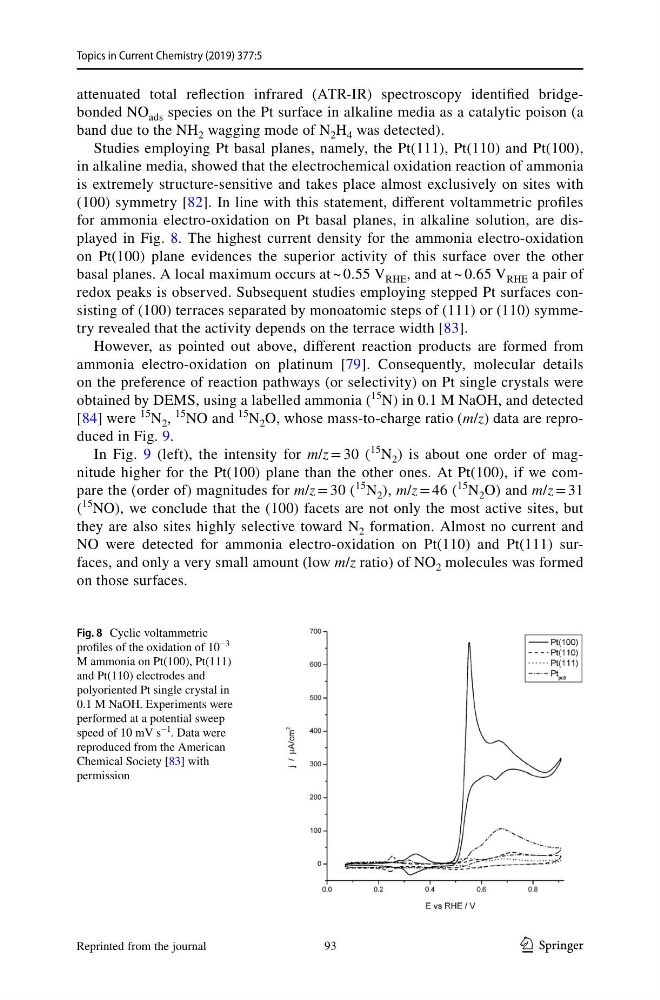
for ammonia electro-oxidation on Pt basal planes, in alkaline solution, are displayed in Fig. 8. The highest current density for the ammonia electro-oxidation
on Pt(100) plane evidences the superior activity of this surface over the other
basal planes. A local maximum occurs at ~ 0.55 V RHE , and at ~ 0.65 V RHE a pair of
redox peaks is observed. Subsequent studies employing stepped Pt surfaces consisting of (100) terraces separated by monoatomic steps of (111) or (110) symmetry revealed that the activity depends on the terrace width [83].
However, as pointed out above, different reaction products are formed from
ammonia electro-oxidation on platinum [79]. Consequently, molecular details
on the preference of reaction pathways (or selectivity) on Pt single crystals were
obtained by DEMS, using a labelled ammonia (
15
N) in 0.1 M NaOH, and detected
[84] were
15
N 2 ,
15
NO and
15
N 2 O, whose mass-to-charge ratio (m/z) data are reproduced in Fig. 9.
In Fig. 9 (left), the intensity for m/z = 30 (
15
N 2 ) is about one order of magnitude higher for the Pt(100) plane than the other ones. At Pt(100), if we compare the (order of) magnitudes for m/z = 30 (
15
N 2 ), m/z = 46 (
15
N 2 O) and m/z = 31
(
15
NO), we conclude that the (100) facets are not only the most active sites, but
they are also sites highly selective toward N 2 formation. Almost no current and
NO were detected for ammonia electro-oxidation on Pt(110) and Pt(111) surfaces, and only a very small amount (low m/z ratio) of NO 2 molecules was formed
on those surfaces.
Fig. 8 Cyclic voltammetric
profiles of the oxidation of 10
−3
M ammonia on Pt(100), Pt(111)
and Pt(110) electrodes and
polyoriented Pt single crystal in
0.1 M NaOH. Experiments were
performed at a potential sweep
speed of 10 mV s
−1 . Data were
reproduced from the American
Chemical Society [83] with
permission
Reprinted from the journal
93
Topics in Current Chemistry (2019) 377:5
attenuated total reflection infrared (ATR-IR) spectroscopy identified bridgebonded NO ads species on the Pt surface in alkaline media as a catalytic poison (a
band due to the NH 2 wagging mode of N 2 H 4 was detected).
Studies employing Pt basal planes, namely, the Pt(111), Pt(110) and Pt(100),
in alkaline media, showed that the electrochemical oxidation reaction of ammonia
is extremely structure-sensitive and takes place almost exclusively on sites with
(100) symmetry [82]. In line with this statement, different voltammetric profiles
for ammonia electro-oxidation on Pt basal planes, in alkaline solution, are displayed in Fig. 8. The highest current density for the ammonia electro-oxidation
on Pt(100) plane evidences the superior activity of this surface over the other
basal planes. A local maximum occurs at ~ 0.55 V RHE , and at ~ 0.65 V RHE a pair of
redox peaks is observed. Subsequent studies employing stepped Pt surfaces consisting of (100) terraces separated by monoatomic steps of (111) or (110) symmetry revealed that the activity depends on the terrace width [83].
However, as pointed out above, different reaction products are formed from
ammonia electro-oxidation on platinum [79]. Consequently, molecular details
on the preference of reaction pathways (or selectivity) on Pt single crystals were
obtained by DEMS, using a labelled ammonia (
15
N) in 0.1 M NaOH, and detected
[84] were
15
N 2 ,
15
NO and
15
N 2 O, whose mass-to-charge ratio (m/z) data are reproduced in Fig. 9.
In Fig. 9 (left), the intensity for m/z = 30 (
15
N 2 ) is about one order of magnitude higher for the Pt(100) plane than the other ones. At Pt(100), if we compare the (order of) magnitudes for m/z = 30 (
15
N 2 ), m/z = 46 (
15
N 2 O) and m/z = 31
(
15
NO), we conclude that the (100) facets are not only the most active sites, but
they are also sites highly selective toward N 2 formation. Almost no current and
NO were detected for ammonia electro-oxidation on Pt(110) and Pt(111) surfaces, and only a very small amount (low m/z ratio) of NO 2 molecules was formed
on those surfaces.
Fig. 8 Cyclic voltammetric
profiles of the oxidation of 10
−3
M ammonia on Pt(100), Pt(111)
and Pt(110) electrodes and
polyoriented Pt single crystal in
0.1 M NaOH. Experiments were
performed at a potential sweep
speed of 10 mV s
−1 . Data were
reproduced from the American
Chemical Society [83] with
permission
Reprinted from the journal
93