

temperatures on the order of 130
C were needed. Nonetheless, the catalyst could
be recovered and reused, as demonstrated for Sonogashira couplings. Membrane
filtration led to catalyst recovery, which showed no apparent detriment to the
yields after six consecutive cycles.
3 Nickel
There has been a significant increase in the use of nickel in synthesis over the
past few decades. This can be attributed to the natural abundance of this metal
which accounts for its low cost compared to that of other transition metals that are
far more commonly used. Moreover, its ability to function in several oxidation
states, as well as its increased nucleophilicity due to its size, has made it a desirable
alternative, especially relative to palladium [26, 27]. Its place within the group
10 metals has enticed chemists to further investigate the ability of this base metal
to facilitate valued organic transformations, including reductions and C-C bond
formations. Substituting the more abundant nickel in reactions that mostly utilize
palladium and platinum would reduce costs of various chemical processes, as well
as open the door to new reactivities of the metal and its complexes.
As with palladium, use of heterogeneous nickel NPs for catalysis has gained
interest for several good reasons. For example, the metal has been utilized with
other metals to create bimetallic nanoparticles which appear to have a synergistic
effect that can greatly contribute to the overall reactivity, as well as generality, of
the reactions that it can catalyze (e.g., see Fig. 5; Fe/ppm Pd + Ni NPs).
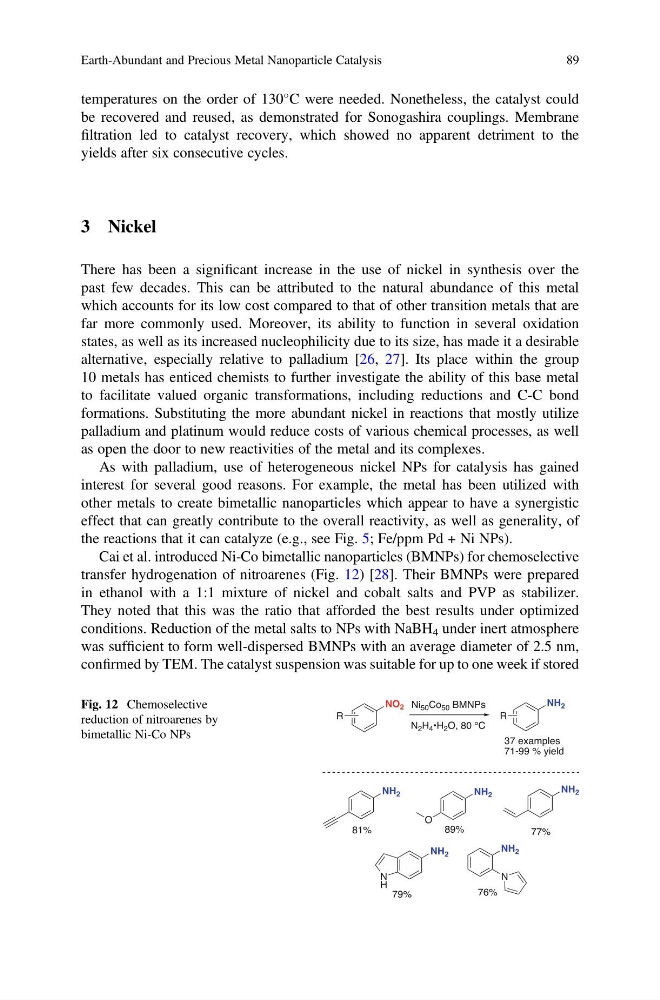
Cai et al. introduced Ni-Co bimetallic nanoparticles (BMNPs) for chemoselective
transfer hydrogenation of nitroarenes (Fig. 12) [28]. Their BMNPs were prepared
in ethanol with a 1:1 mixture of nickel and cobalt salts and PVP as stabilizer.
They noted that this was the ratio that afforded the best results under optimized
conditions. Reduction of the metal salts to NPs with NaBH 4 under inert atmosphere
was sufficient to form well-dispersed BMNPs with an average diameter of 2.5 nm,
confirmed by TEM. The catalyst suspension was suitable for up to one week if stored
Fig. 12 Chemoselective
reduction of nitroarenes by
bimetallic Ni-Co NPs
Earth-Abundant and Precious Metal Nanoparticle Catalysis
89
C were needed. Nonetheless, the catalyst could
be recovered and reused, as demonstrated for Sonogashira couplings. Membrane
filtration led to catalyst recovery, which showed no apparent detriment to the
yields after six consecutive cycles.
3 Nickel
There has been a significant increase in the use of nickel in synthesis over the
past few decades. This can be attributed to the natural abundance of this metal
which accounts for its low cost compared to that of other transition metals that are
far more commonly used. Moreover, its ability to function in several oxidation
states, as well as its increased nucleophilicity due to its size, has made it a desirable
alternative, especially relative to palladium [26, 27]. Its place within the group
10 metals has enticed chemists to further investigate the ability of this base metal
to facilitate valued organic transformations, including reductions and C-C bond
formations. Substituting the more abundant nickel in reactions that mostly utilize
palladium and platinum would reduce costs of various chemical processes, as well
as open the door to new reactivities of the metal and its complexes.
As with palladium, use of heterogeneous nickel NPs for catalysis has gained
interest for several good reasons. For example, the metal has been utilized with
other metals to create bimetallic nanoparticles which appear to have a synergistic
effect that can greatly contribute to the overall reactivity, as well as generality, of
the reactions that it can catalyze (e.g., see Fig. 5; Fe/ppm Pd + Ni NPs).
Cai et al. introduced Ni-Co bimetallic nanoparticles (BMNPs) for chemoselective
transfer hydrogenation of nitroarenes (Fig. 12) [28]. Their BMNPs were prepared
in ethanol with a 1:1 mixture of nickel and cobalt salts and PVP as stabilizer.
They noted that this was the ratio that afforded the best results under optimized
conditions. Reduction of the metal salts to NPs with NaBH 4 under inert atmosphere
was sufficient to form well-dispersed BMNPs with an average diameter of 2.5 nm,
confirmed by TEM. The catalyst suspension was suitable for up to one week if stored
Fig. 12 Chemoselective
reduction of nitroarenes by
bimetallic Ni-Co NPs
Earth-Abundant and Precious Metal Nanoparticle Catalysis
89